Wallpapers are rightfully considered one of the most popular finishing materials for walls in any room. The speed and ease of installation, as well as the ability to make an interesting design due to a variety of prints, has caused their popularity. With the help of wallpapers in one day, it is possible to change the appearance of the walls in the root, and not spending big funds for it.
Content
Types of wallpaper

At this time on the wallpaper market there are a large number of different types of their types:
- Textile wallpapers.
- The liquid wallpaper.
- Vinyl wallpapers.
- Paper wallpaper.
- Wall mural.
- Gymelomes.
- Wallpaper "Painting."
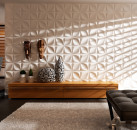
- 3D wallpaper.
- Raufeser.
Each of these finishing materials is distinguished not only by its appearance, but also the basis that affects their quality and resistance, as well as on the features of sticking.
By resistance to the influence of moisture, wallpapers are divided into:
- Moisture-resistant. On the tags in such wallpaper indicates marking B-0 or B-1. They differ in the fact that their surface is resistant to abrasion under the influence of moisture, but without the use of chemical detergents.
- Washable. Designation B-2, B-3, B-4. Wallpaper, as follows from their name, can be washed. Their surface has a special structure that is able to withstand the effects of various detergents without loss of the initial type. As a rule, such wallpapers are used in more passing places where the probability of pollution is quite high. It may be an entrance hall, a kitchen or even a children's room of a small child, which is guaranteed to "test" their markers, paints and baby porridge.
- Inhabitant. Marking C-1. As a rule, the wallpaper on a paper basis is indicated. If moisture gets into moisture, they turn around and lose the integrity of their surface. These wallpapers cannot be used in the places of moisture concentration, such as a bathroom or kitchen. Since they can not be washed, it is better not to glue them in the passable premises, as they will quickly come into disrepair.
Vinyl wallpapers and their types

Vinyl wallpaper is one of the most popular species of this finishing material. The choice of colors and the difference in textures make them an excellent option for finishing any room. This is one of the most moisture-resistant materials, most of them are perfectly clean even with the use of detergents.
Your name vinyl wallpaper was obtained thanks to their structure. It consists of 2-layers. The first is the basis, can be made of fabric, simple paper or fliesline. It is applied with glue when sticking. The outer layer is made of polyvinyl chloride (or just vinyl).

Vinyl wallpaper can be divided into several species. This classification depends on the type of PVC applied coating.
- Coating from foamed vinyl. This is one of the most popular types of vinyl wallpaper. Due to the use of foamed PVC coating, they skip the air well to the wall, allowing it to "breathe". However, their upper structure has large pores that can pass moisture, damaging wallpapers, so it is necessary to treat them carefully, without applying abrasive cleaning products.
- Vinyl wallpaper with silk screen. Thanks to the use of synthetic fibers imitating silk, the appearance of these wallpapers looks very attractive. At the same time, in comparison with textile wallpaper, their price is much lower. The transfusion of their surface by pearl in the sun can make the interior in the room quite interesting.
- Washing wallpaper. Due to the dense vinyl structure, with microscopic pores, such wallpaper perfectly tolerate the washing with the help of detergents and cleaning the brush. In contrast to the coating of foamed vinyl, washable wallpapers are mainly a smooth structure without a particularly noticeable relief. Such material is the perfect solution for the kitchen.
- Wallpaper with solid vinyl coating. Such wallpapers are distinguished by the fact that the air is well passed, despite the dense coating, and also practically not swell when applying glue. It is worth noting that this material is relatively new on the market and its price is still quite high.

The advantages of vinyl wallpaper can be attributed:
- Moisture resistance. Although different types of them react differently to moisture, in this respect they are more preferable than other types of wallpaper.
- Due to its density, thickness and structure, vinyl wallpapers can easily hide small wall surface defects.
- Vinyl coating perfectly amenable to molding, so any drawing and any structure can be applied to such walls. They can be imitated under the brick, torn stone, tile, wood, etc.
From the disadvantages, poor breathability can be distinguished. Due to which the moisture can accumulate and mold and fungus can be accumulated. When applying glue, the vinyl wallpaper is swelling and stretched, so it is necessary to glue them neatly.
How to swing vinyl wallpaper
Materials

To start work on sticking vinyl wallpapers, you need to prepare tools and materials:
- Wallpaper.
- Wall-made glue. Be sure to read the glue instructions. It must be intended for such wallpapers. The fact is that cheap glue that is perfect for paper canvases may not withstand the weight of heavy vinyl. Often, novice masters ask a question: can the vinyl wallpaper can be blocked with fliesline glue. Such glue can be glued with any kind of vinyl wallpaper, both on paper and on a flieslinic basis.
- Spatula for cuttle cuts.
- Roller or wide brush for applying adhesive composition on the surface of the wall and wallpaper.
- Brush for primer surface of the walls.
- Knife stationery for cutting powders.
- Little brushes for stacks.
- Rubber roller for rolling joints.
- Rule and level.
Preparation of walls and sticking wallpaper

The order of sticking:
- Before starting work on sticking wallpaper, it is necessary to prepare walls. They are cleaned of the remnants of old wallpaper. All problematic places are covered with finishing putty and rub in a special grid.
- After that, the wall must be projected. To do this, use deep penetration primer. It penetrates the structure of plaster and binds her grains, not allowing it to peel into parts. For primer, a brush with a soft pile is used so that when applied it penetrates deep into the wall. The solution should not be "sorry", here you can use the principle "the more" the better.
- In the summer, the primer dries pretty quickly, so work on sticking can be carried out on the same day. If it is assumed to use washing wallpaper, which misses the air, before starting the walls, it is better to handle a special composition that will prevent the appearance of mold or fungus.
- The main rule, how to shove the vinyl wallpaper correctly, is dry walls. On wet walls, it is impossible to carry out works. In order to check the surface moisture, you can glue a small piece of polyethylene for the night, and then check its condition in the morning. If the wall is dry, it will be dry under polyethylene. Otherwise, there will be drops of moisture on the surface of the wall. It is impossible to glue the vinyl wallpaper on this wall, they will not have time to dry and can break off the wall surface.
- We start cooking glue. The packaging contains a consistency for each type of wallpaper. It is necessary to clearly adhere to the specified proportions so as not to spoil the kneading material. If there is not enough time to shove the whole room, it is better to cook a small batch of glue, because it cannot be kept long.
- Glue prepare very simple. In the water of the room temperature gradually add dry glue constantly stirring. In order for the solution to be uniform without lumps, you can use a drill and an industrial mixer. Drill are exposed to minimal revs to not splash the glue to the floor. Gradually, the composition will be stuck, turning into a mass close to the jelly. It is necessary to leave it for about 1 hour and after that you can start work.
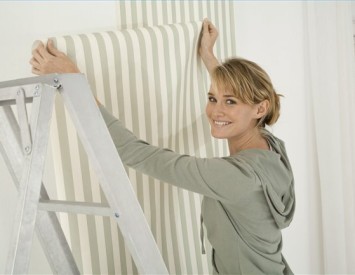
- Consider further how to shove the vinyl wallpaper with your own hands. Initially, it is necessary to measure the distance from the top baguette to the bottom of the wall. This will be the length of one strip. If you fail to guess to a millimeter, you should not despair, the bottom of the wall will still be closed by a plinth.
- It should be started with a visible corner that is diagonally to the entrance to the room. This is the most noticeable room in the room. To stick the first strip exactly, it is necessary to delay the level of the vertical line on the entire wall.
- The cut wall of the wallpaper is placed on a clean surface. For this you can use rolls of old wallpaper. In this case, the floor will remain clean, and it is not necessary to clean the cleaning, it is enough to roll and throw the old wallpaper emasculated with glue.
- The strip on the surface is stacked so that the litter leaves from under the wallpaper. It is necessary to wash the junction well. Wallpaper band is lubricated with glue carefully, not leaving dry places. Otherwise, it does not stick to the wall.
- A very important point in how to bleach vinyl wallpapers on a fliesline basis - at room temperature below + 18 ° C glued can not be glued. Be sure to read the specification to this type of wallpaper. The fact is that when weeping some of them, it is necessary to lubricate only the reverse side of the wallpaper, and for some it is necessary to lubricate the surface of the wall.
- The smeared strip is neatly folded in such a way as not to smear the front side and, gluing the top, is neatly folded in the direction of the floor.
- After that, the wallpaper is smoothed with a spatula, so that air bubbles are left under them. Movement with a spatula must resemble a Christmas tree, that is, from the center down to the edge. After that, the roller point the joint. Vinyl wallpaper glued down the "joint in the joint" without adhesion.

During the work and after their end, it is necessary to eliminate drafts indoors. At this time, it is impossible to use air conditioning or a fan. Otherwise, wallpaper can "appear", and they will have to be changed. After drying the adhesive, a little retired places are molded with a small tassel and rolled the roller again. If the wallpaper band is larger than the desired length, it can be cut only after drying.