As if the road you were not furnished, but over the years she wear out and the time occurs when it is no longer possible to use it. The first in dissent comes the upholstery on sofas, chairs and chairs, it not only comes out, contaminated, but also winds. Because of the unsightly appearance with your favorite soft chairs, it is necessary to part. If your family has an old furniture, which inherited you, then there is a chance to renovating it.
Content
To perform a chairs of chairs, it is necessary to follow the basic requirement - save the wooden frame, well, the final result will depend on the efforts and your desires.
If the chair is not very worn and losses formed in some places, you can disassemble it - remove the back and replace the old fabric to a new, suitable shade. If the framework is badly damaged by the bugs-cores, it is possible to restore such a product, but the chair is unlikely to be so strong, as before and over time it will still begin to deteriorate and crumble. Carpenters do not advise the restoration of furniture, damaged with grinder bugs. Separate elements can be replaced, but if the chair is badly damaged - it makes no sense to restore.
In the 60-90 years of the last century, burlap, felt, wool and hay were used as a filler for upholstered furniture. Even now, some furniture factories continue to be used in the production of technology of the 90s, and vegetable fiber is used as a filler for chairs. For several years of operation, such a natural filler is quickly gluable, lumps may form lumps, as a result of which the upholstery fabric quickly comes into disrepair.
How to choose upholstery
When choosing a fabric for chairs, keep in mind:
- the density of the material - it should well hold the shape and be durable;
- the fabric should be easily elapsed;
- the ability to process the surface with soap solution or brush.
Popular fabrics:
- jacquard - dense tissue, has good wear resistance, it does not form tightening;
- shenille - Popular Upholstery Material for Upholstered Furniture. The fabric is very dense and durable;
- tapestry - made of cotton, material can be erased by hand or in a washing machine;
- nubuk or artificial leather - resistant to abrasion material;
- velvet, Flock - the cloth is durable, does not fade;
- the skin is "breathing", but not resistant to mechanical damage (scratches).
How to drag the chair with your own hands
So that work on the challength is made in a short time, consider in advance what materials you need and prepare the appropriate tool.
Instruments

List of materials and tools:
- the cloth. It is best for having chairs to use furniture fabrics - tapestry, flock or jacquard. They have durability to abrasion and durable. Before you go to the store behind the cloth, you need to arm a centimeter and decide on the amount of material. Perform the stool seating measurements and add 10 cm to the resulting digit on each side. This stock will go on bending, as well as to the height of the upholstery;
- filler. Good recommendations received such a filler as a sheet of foam (thickness no more than 40 mm), can also be used as a filler with Sinyppon, batting or latex. It is impossible to take bulk materials as a filler for the seating of the chair (buckwheat husk, polyurethane or silicone balls), since the load on this part of the chair will be much higher than the load on the pillow. If you use a small filler, then in a few weeks of operation, it will begin to refrigerate. If the foam rubber is chosen as a filler, its density should be from 30 to 50 kg / m 3. If you use the material of another density, the foam rubber will be able to stop and sit on such a chair will be uncomfortable;
- tight cardboard to make a pattern;
- glue and tassel. It is best to take PVA in a construction store;
- stapler and furniture staples or cheaper option - small carnations and hammer;
- screwdriver;
- pliers;
- roulette and sharp scissors;
- rule, pencil, chalk or slice of soap for marking.
How to remove the old fabric
Work must be started with the removal of old upholstery.
How to remove the wear fabric to remove:
- First you need to remove the seat. To do this, turn the chair with legs up and in a strictly defined sequence (it is desirable to remember the procedure, since then you have to collect a chair back) to disassemble fasteners. First, we use the fasteners with a screwdriver, then remove the nails, unscrew the screws and remove the metal lining. Staples Easily pushing a screwdriver and pull out the pliers. If they were in disrepair, the brackets can be thrown away, and fasten the rest of the rest in a separate package in order not to lose.
- Now it is necessary to check in what condition is the wooden frame of the chair. If he is broken, then the furniture hauling will not solve the main problem, the appearance will be beautiful, but it will be unsafe to sit on the ocked chair. Therefore, you first need to eliminate all cracks in the wood (fill out with colorless sealant or sample PVA glue), put the clamps, and weakened connections are desirable to be sealing.
- It came a turn to remove the old upholstery fabric. On the floor, put a plastic film or bed of old newspapers. Remove the old fabric and carefully remove the entire foam rubber. At this stage, the chairs are needed with their own hands. Put on the wrong side of the new furniture fabric, the old canvas and circle the contour with chalk.
- Now it is necessary to postpone the fabric to the side of the cloth and go on the basis of the seating. Remove the remnants of the adhesive crushed foam rubber, remove the old glue.

Prepare cloth and foam
Because for a beginner, perform a chalk drawing without a template will be difficult, just deal with its manufacture. You can make a pattern in different ways. First option: Put the seat of plywood on the cardboard sheet, circle it with a pencil. Now Phaneur can be removed, and in our drawing, add 10 cm on each side for points. The pattern cut out with scissors or a sharp stationery knife. Second option: We use the finished template and we will make an old fabric to the sheet of cardboard, circulate the contour pencil. This will be our template. Select the appropriate option and make the seat template.

We have a finished stencil - you can carve out a sharp knife from the piece of foam rubber the desired detail. By the same principle, we make a pattern of fabric: we will supply along the contour and add another 10 cm on each side (let it be better to be a small margin of fabric than it is not enough). Strip the item.
If you have chosen a fabric with a pattern, then it is necessary at the initial stage - the purchase of tissue, take into account this moment and take the material with a margin. Put the fabric with a pattern so that it is in the middle and there was no displacement. If this rule does not observe, the chair will not look presented. Now you need to fix the fabric and mark the markup.
In some chairs, instead of the usual seating from plywood, you can see the frame from the mesh or rubber. When a woven base is normal, it is not necessary to do anything if the material came into disrepair, then it must be changed to dense wide rubberized tapes.
How to drag stool
First we glue the foam rubber to the plywood. The foam rubber is glued to PVA glue. On the front (top) part of the seating from plywood, apply a brush layer of glue and attach foam rubber. Wait until the glue is grabbing. Works on the upholstery of the fabric can be started after complete drying of the glue.
When the glue gets up - check again, the foam rubber was well stuck - if there are not ignited places, it is desirable to fill with glue and again wait for it to complete drying. After that, you can fix the upholstery fabric. Put it with the invalid side up, put the seat on top so that the foam rubber is located "face" to the fabric. On each side, overcome the fabric (this is a stock) on the Fanoire. Tension the material is tight so that the fabric is not going to the fold. Now take the furniture stapler and shoot the edges of the fabric to the plywood. Work sequentially, with a step of no more than 2 cm. Between the brackets should not be formed by large folds. If you see that large folds are formed in the fields of roundings, and the furniture brackets do not hold them, then these places can be strengthened with furniture cloves. Wreck cloves hammer. Surplus fabric After completing the chapel of the chair, you can cut.


If you drag a square chair seat, then the corners need to lay the folds and send them to the center, fold the fabric and then attached to the plywood.

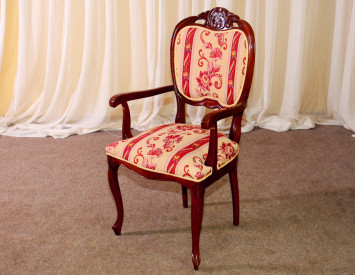
drag chair seat set back on frame initially attach the plate, and then fasten the screws. Hauling the chair with his hands completed. Here's what a refurbished chair:

How to win over a chair, you can watch this video: