Whatever good, comfortable and high quality furniture, with time, with time, the upholstery wear out and the sofa comes into disrepair. Yes, and not only the appearance will deteriorate, some structural parts come into disrepair, the springs are deformed, the filler is crushed, restoration and cleaning are required. It is often necessary to restore not new upholstered furniture, but, for example, presented, given or antique. If finality has finances, you can give furniture on a drawing into a specialized company, but this simple process can be mastered on your own. About how to drag the sofa, it is worth talking in detail.
Content
Where to start the restoration and upholstery of the sofa
If the upholstered furniture in the house is similar to design, but has a different upholstery and degree of worn out, you can make a breathtaking of the entire set at the same time, having received a kind of furniture set. Although it will pull over additional costs, but the renewal of furniture will cost at times cheaper than the fullest replacement for a new one. If you are leaving a sofa drawing, then change the upholstery of the chairs and chairs with soft backs for you will not be difficult. But it's easier to start with a sofa, because it is less than various structural parts, and the surfaces themselves are greater, and it is much easier to hide the seams and a bending of the fabric.

Getting Started, it is important to consider all stages of work:
- identify all defects that occurred when using a sofa;
- decide with the type of upholstery;
- calculate upholstery;
- make preliminary calculations on expenses;
- purchase upholstery fabric;
- prepare all the necessary tools;
- disassemble a sofa;
- carry out overall cleaning inside;
- make the necessary restoration;
- step by step to drag the sofa.
Without the idea how the sofa is arranged inside, do not rush to take a job. The easiest way to make a sofa with simple constructive details of the geometric shape are easily. In this case, there are no problems with complex patterns and wise details.
The people say that the eyes are afraid, and their hands are doing, so if doubts arose and questions, it is worth familiar with the video, how to drag the sofa with your own hands. Next need only patience and time.

Basic defects of old sofas and signs of wear
The definition of the "old sofa" is very relative, that is, the "new" is just bought. The sofa, used, can have a different degree of worn, and it depends on different reasons:
- degree of daily load;
- layout frequency;
- the room in which it was exploited;
- additional loads, for example, when children often jumped on the sofa.
The sofa on the wheels is experiencing the greatest load in the roller part of the legs, and it is important to pay attention to it. The degree of wear of the sofa is determined by:
- on legs and rollers;
- upholstery contamination;
- sitting deformations;
- crumpled filler;
- stretching springs;
- the integrity of the layout mechanism.
It is these parts of the sofa to be carefully examined and restoration. This will entail additional costs, but it is unlikely that another opportunity to look inside him in the coming years.
It is easily easiest to perform a chamber of the sofa book, because it is less than all design details and the simplest layout mechanism.
The most necessary tools for restoration of the sofa:
- drill;
- nail or screwdriver;
- pliers;
- furniture or construction stapler with brackets;
- scissors and chalk (marker);
- needle and threads for wetting;
- glue pistol;
- sewing machine.

Drawing a corner sofa with your own hands is much more complicated than the restoration of a simple ottoman, a kitchen mild corner or a broomstick. The main stages of the work are the same, but you have to take into account its design features and complexity of cutting. The most difficult thing is to collect it after the restoration and lead to the original state. The same is true for some types of layouts, for example, automatic. If there is no replacement skill, you should not touch these angles. In such cases, the folding part is to securely fix during operation.
Do not make a sofa drawing yourself, if:
- The sofa model has a complex configuration and upholstery elements that will be difficult to restore in a new material.
- The furniture has a complex design or a transformation mechanism that interferes with access inside the sofa.
- You have doubts that after disassembling furniture it will be possible to assemble again to the working condition, including the frame, filler and other structural parts.
- You have expensive Italian or antique furniture, the restoration of which can be trusted only by specialists.
- You are afraid of working with upholstery material, such as thin skin or old handmade tapestry.

Possible difficulties in restoration and drying of sofas
Viewing a sofa to design details, remember that without this stage you can not do. Revise the carrier frame, wooden frame and other details. Most often detect a crack or chalkboard. When it is not possible to remove it and replace with a similar one, you can bore it on both sides by the corner and pull the screws.
Record the integrity of all accessories: the mechanism of transformation, screws, rails, etc. If there are defects and a strong wear, replace the analogues and check the accuracy of the fit.
If the old sofa creaked, you need to reconsider all the articulations, they need to be adjusted and proceed again. Avoid toxic glue, as it can highlight harmful evaporation for a long time, and this will have to be involuntarily inhaling, sitting on the sofa.
Carefully review the entire block of springs, and if something is wrong - correct. Sometimes you need a bandage of springs or replacing one of them. Usually sofa springs are durable, but their clutch is deformed. Springs sticking in the seat should be shortened, compact or replace, for this you can take the same from the extreme corners of the sofa.
Do not stand the springs too tightly tongue, because it makes it difficult to work. The springs fit the filler and packing.

We disassemble the sofa to the structural details
- Prior to the start of work, the floor in the room is covered with film or an old oilcloth to alleviate cleaning. Old filling type foam rubber is difficult to remove without a residue.
- We begin to disassemble the sofa: lay out the removable puffs and retractable parts, remove the armrests if they are. Next, we separate the back of the back and dismantle the seat. The last operation may seem the most difficult due to the transformation mechanism.
- The layout mechanism can be removed if it does not cause difficulties. If there is normal access to all surfaces of the seating in the unfolded form, it makes no sense to touch it - this will facilitate the back assembly.
- In order not to confuse the fasteners, it is better to sign them, such as "right" or "left armrest", postponing so that then they can be found for the assembly.
- Old brackets for fixing upholstery can be fed a screwdriver and remove the pliers from the frame - all this is no longer useful. Make sure the sharp staples do not stretch the children or pets in the floor to accidentally do not come with bare feet.
- Carefully remove the old upholstery to use as a lecop for the subsequent cutting.
- Thoroughly spend the space inside the opened sofa, then make the necessary restoration. Inspect the filler - whether it is suitable or requires replacement.
- We turn to the cutting of the new fabric for upholstery.
Tip: Unlock pattern on the wrong side of the cut. Slices of old fabric placing invalid to themselves so that they are tightly adjacent to each other. A competent layout will reduce the number of cropping and save upholstered tissue. If the material remains, you can sew a sofa pillow or leave about the reserve. I set the pins on the edges, placing chalk. Making sure that all the details are properly laid and marked, you can cut a fragment - it is convenient to make big sharp scissors.
- Stitching of details is a responsible moment, because you need to own the skills of work at the sewing machine. But this operation can be entrusted with an experienced dressmaker or atelier. Previously in those places where there will be seams, you need to occupy the details so that they do not wrinkle during the line. Drawing a sofa, photo:
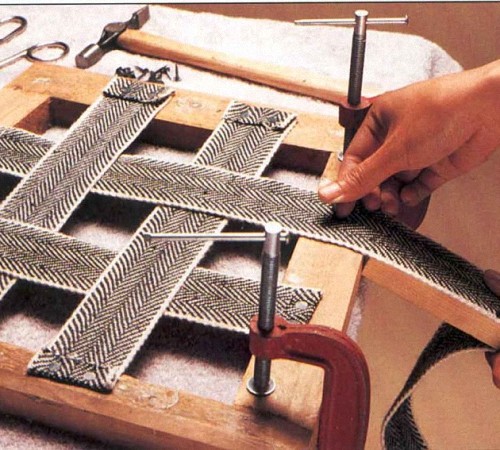
- Tensioning stitched parts on puffs, armrests, back and seats, follow the wrinkles and distortions. Only after that you can stick to all the details of the upholstery.
- Now you can drag the sofa with your own hands, fixing the stroke details with a furniture stapler, starting with the seating and bonding around the same places where old brackets were.
Tip: Stapler can be replaced with furniture or shoe wedge-shaped nails. So that they do not slip through the fabric, better in those places where nails will be drunk, put the skin pieces with a penny size.
- It is now important to collect a sofa to the initial constructive state using the former fittings or replacing it to a similar new one. After that, the sofa looks like a new one.

How to choose to choose upholstered tissue?
When choosing the upholstery, it is not necessary to navigate the prestigious or low cost of the material, but on its appearance and practicality. If the sofa serves to destroy episodically, for example, in a country house, then the choice depends on whether they will often use it. Often, especially elegant or antique sofas are tightened by expensive tapestry, silk, skin or fur - to underline the status of the owner and living room decoration.

If the sofa is the main place to communicate the family, then there is a practical upholstery, which is difficult to spoil something. It can be a special upholstery fabric of imported production or a sofa velor with such a pattern, where contamination is not so visible. Those fabrics that are used for tailoring are not suitable, but they can be used as removable covers, if there is such a need.
Most often for fun furniture use:
- special synthetic velor;
- furniture tapestry;
- shinyl;
- skin;
- furniture jacquard;
- lowline artificial fur on a dense basis;
- high-quality leatherette.
Tip: Regarding coloring it is impossible to say something unambiguous - it all depends on the stylistics, in which the product is performed, and from the interior design. Jacquard and "Flower" will be appropriate in country style, and expensive atlas in a strip or tapestry are suitable for furniture in historical styles. The skin is appropriate not in every stylist, and white, brown and black leatherette is very similar to genuine skin, but much more practical and cheaper. A responted sofa must be harmonized with a common interior. Acid and bright shades are better to choose for the youthful interior, but remember that they are tired and not suitable for the zone of a comfortable stay. In the choice of fabric you can also use the tip in the photo:

Features of leather sofa
Hair sofa leakage is the most difficult process, especially if it is antiques. The most difficult types of work should be entrusted with professionals, for example, to charge similar legs to the joinery workshop. The skin for the sofa is usually saved and diluted with similar on the texture and shade by leatherette for hidden and rear upholstery elements. Although the replacement of just one part of the leather sofa is required, the new skin will contrast against the old sofa, even if the color is the same.
The disassembly of the leather sofa to the components is similar to any other, but the worn skin is difficult to remove without damage, especially when the bracket is notched. It is important to remember that the skin over time is slightly shrinking, so on the edges of the old lecturers under the cutting add a bit on the allowances - about 1 cm. Symmetric parts easier to paint one lecture. The most difficult thing is to calculate the required amount of skin without experience, so it is better to purchase material with a margin, cutting flap can be useful for the next restoration.
When the pattern of skin items, it is important to remember that the skin is of different thickness and quality, and the strongest pieces will go to the seat and the upper part of the back - under the back of the back and the blades, as well as on the armrests. All skin pieces carefully examine on the absence of defects, especially when buying wholesale. If the skin is not enough, then low and rear items can be replaced with artificial skin of the same color.
Tip: A line for a typewriter in 2-3 layers is better to check in advance, since not every machine is adjusted under the skin. The sample picks up the stitch width and turn the strength of the thread (only strong silky synthetics). If the machine does not cope with the task, entrust this operation of the Atelier. And remember that the skin requires special care specialized. Spots on the skin are removed with alcohol, acetone, gasoline, glycerin or stain removal that you need to try on a separate piece of leather - whether the paint will not fit.

The most difficult type of furniture is a restoration of an antique sofa, especially if all the details of the Old. It is sometimes easier to perform an accurate copy from professionals in the furniture workshop than to make a thorough restoration. Today, a whole technique has been developed, how to give wood with dilapidation or how to visually draw up new furniture so that it does not differ from the best antique samples. In this case, there will be no problems with its operation, because it is no secret that antiques are practical not used for its intended purpose.