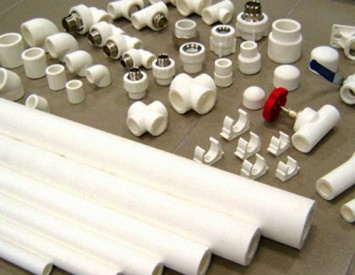
Polypropylene pipes has a lot of advantages over other types of materials. They are not subject to corrosion and fungus, have a high wear resistance and a wide temperature range of fluids. Therefore, plastic products are widely used in household and industrial construction and repair work.
Content
Polypropylene pipes are installed using a specialized soldering device. The compound of a plastic tube with metal water supply elements is carried out by special connecting parts. On how to properly solder pipes from plastic, told below.
Heat resistance of polypropylene pipes
For a better understanding of the rules for working with any type of materials, you need to know the general characteristics and properties of the material itself. The first characteristic of plastic pipes to pay attention to - heat resistance. Plastic products lose their solid properties at a temperature of 140 0C, this figure depends on the type of pipe. Manufacturers indicate their products the maximum temperature mode for which it is intended. On average, this indicator is 95 0C for non-reinforced pipes.

For heating systems and water supply, hot water should pay special attention to the type of pipe acquired. High heat resistance demonstrate reinforced pipes that combine the quality of plastic and metal structures. Another indicator that pay attention to the selection of material is the pressure maximum permissible in the pipe. All these numbers are indicated by the manufacturer directly on the pipe itself.
Thermal lengthening of polypropylene pipes
Thermal elongation is an indicator of a change in linear dimensions when heated. The straight and long section of the pipe with heating is covered with waves and saves. Installation of heating systems or hot water supply systems should not be carried out from overlapping to overlap by one pipe. Otherwise, there will be tension in the riser, it will lead to the deformation of the pipe and the mass of trouble. How to solder heating pipes to avoid problems:
- Use a reinforcing coating pipe to supply water, as mentioned above. The coefficient of thermal elongation in this type of products is 5 times lower than that of non-reinforced, besides, above the value of permissible pressure.
- Use compensators - the bends of the pipe section in the form of the letter "P". In this case, the elastic plastic will remain direct during the elongation, since the legs of the bend will come close. To mount the heating system, experts recommend using both described methods.

Polypropylene reinforced pipes
Reinforced pipes are products with a rigid aluminum or fiberglass frame. The reinforcing aluminum layer is located outside or between plastic layers. The layers are connected by special glue. The thickness of the aluminum layer is 0.1-0.5 mm. The reinforcement of fiberglass is performed slightly on another principle - the layer is located only in the center, and the pipe itself is a monolith, a layer in which is reliably welded to each other.
The presence of the reinforcing layer affects not only on the characteristics of the pipe, but also on the method of its spike. In general, the process of mounting the reinforced pipe is no different from the laying of non-reinforced designs. There is only one nuance - a pipe with an external reinforcing layer of aluminum before soldering is being drawn by a special tool - Sheer. The product reinforced inside the product is preparing a carrier.
Reinforced pipes more expensive product without coating, because they perform the installation of the cold water supply is not feasible. With cold water wire perfectly cope conventional polypropylene pipes.

Kinds of pipes and fittings
Polypropylene pipes are divided into four main categories:
- The product is thin-walled PN10 for floor heating systems and cold water supply. Pressure indicator - 1 MPa, maximum temperature - 45 0C and 20 0WITH.
- PN16 product for installation of heating systems with low pressure value and the cold water supply systems. Pressure indicator - 2 MPa, the upper temperature indicator - 80 0C, internally reinforcement aluminum.
- The product is a universal PN20 for laying hot and cold water. Pressure indicator - 2 MPa, the upper temperature threshold - 80 0WITH.
- Product for routing hot and cold water PN25, internal reinforcement aluminum. Pressure indicator - 2.5 MPa. The upper temperature indicator - 95 0WITH.
For the compounds of the polypropylene tubes and steel products used fittings with chrome and brass inserts. The main types of fittings:
- Solder joints for the same product and different diameters.
- Corners 45 and 90 degrees for the same product and different diameters.
- Corner triple tee product of the same diameter.
- Cap.
- Brazing of polypropylene.
- Crossings.
- Couplings combined with different types of thread - the inner, outer and cap nuts.
- Welded seat.
- The corners 90 combined.
- Tees combined, external and internal thread, combined nut.
- Squares combined to connect various devices.
- Cranes solder ball, with American, straight and angled.

Required tools
For soldering pipes made of plastic using a specialized soldering equipment. Sold this machine in any hardware store, prices from 100 EUR. The most simple mechanisms have a capacity of heating element 800 W, it is enough for the construction of communications in an apartment or private house. Professional soldering temperature setting regulators are accurate to 1-5o C. At the soldering does not affect the quality of power, it only determines the speed of the heating element to the desired temperature.

The standard soldering iron for pipes from polypropylene has a set of 20, 25 and 32 mm in a set of nozzles. These sizes are suitable for standard pipes, couplings and connections. Nozzles are part of the heating element, have a sleeve that pays the external part of the pipe, and Dorn for the internal surfaces of the materials connected. Well, if the nozzles have a Teflon coating, it protects them from the effects of molten plastic, makes it easier to remove the molten pipe, increases the quality of welding.
The soldering iron is the main tool that is necessary for laying polypropylene pipes, but besides him still need:
- Roulette - for measurements of the required pipe size.
- Pencil - for marking pipes and walls.
- Hoven for metal - subject to the absence of a special knife for plastic pipes.
- A sharp knife - to remove the chamfer from the pipe when installing.
- Building level.
- Sheer for pipes reinforced outside.
- The carrier for reinforced inside the pipes.
Special attention should be paid to cutting pipes before mounting. The optimal tool for this is special scissors made of high quality steel. With their help, the pipe is cut smoothly, at an angle of 90 degrees. It saves time when installing and makes the process simpler. Often, manufacturers introduce such scissors in the package of a soldering iron for pipes, because when buying a soldering iron should look at the contents of the box.

Rules operating soldering iron
- The soldering iron is installed on a flat surface. Special keys fasten the nozzles of the desired diameters. The nozzle that will be necessary for soldering on the wall is installed from the edge.
- Separate parts of the pipeline are collected on the installed stationary soldering iron. When assembling the chains, it is convenient to perform on the wall of work with the helper.
- Works start only after full heating of the soldering iron. For heating to 260 degrees, it needs about 10-15 minutes. More accurately, this figure is specified in the instructions for the device.
- The soldering iron is not turned off from the network throughout the installation process.
- Two connected parts are heated at the same time.
- Remains of plastic with nozzles are removed immediately at the end of the spike using a tarp vet. Clean the cooled nozzles are unacceptable.

Instructions for soldering polypropylene pipes
- The soldering device for heating is turned on. Standard mechanisms have two indicators - the thermostat and the power on the device. Indicators are not extinguished in the process of heating the soldering iron, after 10-15 minutes the thermostator indicator goes out. This suggests that the soldering iron heated and ready for work.
- Soldering consume more energy during the first activation, the nozzle is often heated over the required temperature. Therefore it is advisable to wait for the re-activation and deactivation of the indicator the thermostat, and then get to work.
- Metered piece of pipe required length. The length is taken from the stock is taken into account the depth of the nozzle and fittings.
- A measured piece of pipe is cut with special scissors or hacksaw.
- Selected appropriate size fitting - in its inner diameter is not heated as to be wider than the external diameter of the pipe.
- Wiped dust from the socket of the fitting and the outer part of the pipe, is degreased with a soap solution or alcohol and dried.
- Details are set on the soldering iron tip. The pipe is inserted into the attachment sleeve and the fitting dresses on the mandrel.
Details on the soldering iron are maintained for the required diameter and their width time. This value is determined by using the table:
Pipe Diameter, mm Belt Width Heating time, sec Connection Time, seconds The cooling time for adhesions, min 20 14-16 6 4 2 25 15-18 7 4 2 32 16-21 8 6 4 40 18-22 12 6 4 50 20-25 18 6 4 63 24-28 24 8 6 The heating time indicated in the table with the room temperature - about 20 0C. At lower or high performance time, respectively, is increased or decreased. Conduct solder at a temperature of 0 0With prohibited.
- Items are removed from the handpiece and connected to each other axially without rotation. This is done with slight pressure. The pipe is inserted into the fitting to its full depth. Compounds becomes easy after complete solidification of the plastic. This value is indicated in the table above.
- If the edges of the socket formed a continuous influx of a roller over the entire circumference, the connection is made correctly.
- During the incubation period, the cooling pipe is not permitted twist or bend. If the compound has an angle or offset, then it must be cut and re-run. He describes in detail how to solder pipe video to the end.
Several different process spikes reinforced pipes:
- On the outer side of the tube are chamfered, shaver trimmed reinforcement.
- If the tube is reinforced with aluminum top, it can simply put in the cleaning and make a couple of turns.
- If internal reinforcement, the reinforcing layer is firmly pressed against the sweep-planer and crank.
- Then the process repeats spike not reinforced pipes, which have already been described above.
A few tips
- To learn how to solder pipes from polypropylene, it is necessary to understand that in this process the most important thing is to act quickly and confidently and comply with the ratio of details. If the pipe solder is performed for the first time, it is advisable to perform several trial connections. To monitor the quality of the performed spike, the control sample is cut along.
- During the work, special attention is paid to corners, tees and cranes. Crane knobs should move freely into any position and do not rest in the pipe. It is also necessary to perform safety techniques, since work is carried out at high temperatures using a plastic material, which, when heated, highlights hazardous pairs.
- Removing chamfer from the pipe must also be removed from the inside of the fitting. Otherwise, the softened plastic during the spike will be handled, the connection will become less durable.
- The pipe in the fitting is inserted until it stops. The pipe is welded to the fitting along the entire length and its end. This moment is particularly important for products with an internal reinforcing layer.
- The tip of the teflon coated soldering iron cannot be cleaned of plastic residues with metal objects. It is necessary to remove polypropylene residues with a rough cloth with a preheated nozzle.