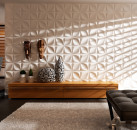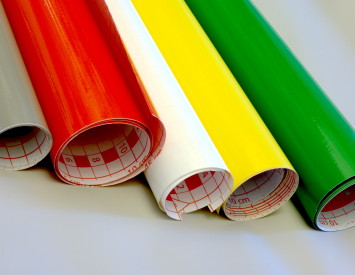
Self-adhesive film is one of the easiest ways to change the environment around him. It is often used in decorating the interior. This is facilitated by simplicity of its use, low cost, wide color scheme and large selection of various drawings. Only one must not forget that this material has its own characteristics and requires a certain approach to work. About how to glue the self-adhesive film will tell further.
Content
Product specifications

Today, you can find many types of self-adhesive films for various surfaces. So, it can be intended for sticking furniture, cars, walls of the room. All of them have something in common, namely the fact that the technique of scotch is used. Due to which this material combines the quality of adhesive tape and wallpaper.
Of the benefits of "self-flippers" it is worth noting the following:
- Moisture resistance.
- Easy application.
- High temperatures resistance.
- A variety of textures and drawings.
- Low cost.
- Easy care.

In addition, this material can be applied to almost any surface. Whether there are plasterboard, metal, plastic, wood, glass, plug, ceramic tile or plywood. The self-adhesive film on the furniture looks particularly well.
Just need to immediately prepare for one complexity, which is the main disadvantage of this material. This is the need to align the surface when pasting. If you do not fix all irregularities, the film will eventually begin to flap or unwanted defects (bubbles) will appear on the wall.
All you need when working is patience. If a large surface is required, it does not prevent the assistant.
Features of working with material

Consider where this material is applied:
- Thanks to its qualities, such a film can be used in almost any room. For example, it is allowed to glue in the kitchen with high humidity. Here it will help without special costs to update the interior, and will also save cleanliness and comfort.
- Self-adhesive film will be by the way in the house where there are small children. After all, they love to draw, and on any surface. From such a material, it is possible to erase traces of paint or markers without much difficulty. If everything is completely removed completely, the film can always be replaced with a new one. It will cost much cheaper than the plywood of the wallpaper.
- The self-adhesive film for the bathroom and toilet is well suited. Here it will help protect the walls from excess moisture and soapy water splashes. After all, they can easily wipe them without difficulty.
- This material is also suitable for the children's room. And no matter how old you have a child. Perhaps the kid himself will help you choose a more suitable coloring "Selfclock".
- The modern range of self-adhesive film allows you to update the appearance of the room and even completely change the style by pasting some interior items.
If you decide to choose a film, first of all, consider which surface it will be glued. For example, material with mosaic patterns is suitable for glass, and for old furniture - a film transparent self-adhesive film.
As already mentioned, one of the advantages of this material is simplicity of care. For this purpose, it is quite enough to use warm water and detergent. Just do not use scouring powders and solvents. The fact is that these funds can damage the structure of the film and its color. best use of ethyl alcohol to remove stubborn dirt.
Obviously, the self-adhesive film can be called a universal material, allowing you to change your home at low costs as you yourself want. To update the appearance of your dwelling, it is not necessary to change the situation at all. Self-adhesive film will help make your life brighter.
How to glue a self-adhesive film

Instruments
From the tools you will need:
- Ruler.
- Pencil.
- Scissors.
- Mounting knife.
- Felt spatula.
- Construction hairdryer. It is important to warm up with the help of it the branded film throughout the perimeter.
Preparatory work
Before glue a self-adhesive film, you first need to prepare the surface. We offer some tips, how can this be done:
- The surface that is subject to pasting should be well cleaned, degreased by gasoline or alcohol, and then dry thoroughly. The easiest film is applied to the smooth wall with a varnish coating. If the surface has roughness or mattness, it is better to cover it first with a soil or polyester varnish. In addition, instead you can use the wallpaper methyl adhesive.
- The surface of plywood, wood, chipboard, fabrics, plaster should first clean well from dust and particles of material. If you need, use a putty or acrylic primer. Thanks to this, the film will latch much longer.
- Before glueing a film on a metal or glass surface, the foundation should be completely moistened.
Cutting material

In order to correctly cut the film into parts, a grid is applied on the reverse side of the material in a step of 1 cm. If there is no such markup, it can be applied independently, without forgetting to leave the stock a pair of centimeters. For cutting, scissors or a special knife are suitable.
In general, the cutting film of the self-adhesive film has its own characteristics. For example, if the pattern on the material is made in the form of a tile, then cut the best on the seams. If the film has a pattern with a rapport, it is cut from the front side.
The sticker of such a material does not require much time. The most important thing is not to rush and be very neat. This will help avoid many mistakes when working with self-adhesive film. The tree is one of the best materials on which the film is perfectly to bed.
Stages of sticking

- When the pattern is ready, the film can be used about 50 mm from the paper substrate, then the sticky side is applied to the surface of the surface. It is important that the size and form match the sizes.
- Now without a rush, it is necessary to gradually separate the rest of the substrate from the film. At the same time, the material should be carefully distributed over the surface, smoothing with a cloth made of soft dry tissue.
- To avoid the formation of bubbles, smoothing preferably from the center to the edges of the canvas, i.e. Also as when pasting wallpaper. These are the main work when using a self-adhesive film. The photo below shows an exemplary final result.
- Missile errors must be corrected at once. The film must be aligned on the surface until it grabbed completely. Otherwise, all the work will have to re-on.
- If you need to salary a large enough area, then the surface that will be processed must absorb moisture well. The wall should be cleaned and dried, coat with a layer of the wallpaper glue and while it is not dry, distribute the film on the surface, without forgetting to fit the material in size. Then you need to try the film with a soft dry cloth.
- Some species of such films are very quickly collapsing with the surface, which can be very uncomfortable when working. Especially difficult to customize such material in size. To slow down the adhesion of such a "self-keeper", you can use powder and talc. If air bubbles occur, they should first pierce, and then carefully smooth out.
- If you need to fly a metal or glass surface with a film, then it should first be moistened with water by adding a small amount of detergent or soap solution to it. This tool helps to properly adjust the film on the necessary dimensions. After that, the material is completely separated from the paper substrate. It is then neatly applied to a wet surface. And finally, dry is rubbed with a sponge or soft cloth.
How to remove a self-adhesive film

After some time, the film passed at one time may be bored. Then he wants to change it to something new. In this case, the old material will have to be removed. Moreover, it must be deleted correctly without damaging the surface. So, how to do it correctly:
- First, it is better to try to use hot water for this purpose. So, the surface is thoroughly wetted, after a few minutes it is recommended to separate the film using some sharp object. Only you need to be neat and not damage the surface to which it is applied.
- If hot water did not help, you can try to use a hairdryer. To do this, the film needs to be warm. Thanks to this glue can be disconnected from the surface. It is best to use an industrial hairdryer, but it is allowed to apply the usual household hairdryer.
- A similar principle of work has a fan heater. Therefore, it is also suitable for removing the film. To do this, it is set to the maximum power and heads to the surface with which you want to extract the material. Gradually, the film will become softer. When this happens, you will find one corner and gently pull the layer in your direction until it is completely separated.
After removing the film on the surface, most likely, adhesive particles will remain. They can be removed using a solvent, gasoline or alcohol. The choice of fluid depends on the surface of the surface.
You can find out more about how to glue a self-adhesive film on video: