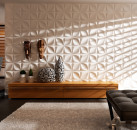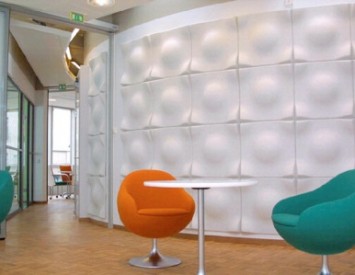
Those times have long passed when the surface of the walls deliberately hidden for furniture. The wall in today's trends of decoration of premises often acts as a central figure of the interior that makes the focus. Gypsum panels are a universal means for creating such a decoration wall.
To understand how such blocks differ from each other, first will understand the qualities and properties of the main raw materials.
Gypsum – clear powdered substance of calcium sulfate, forming crystals when contact with water.
The main characteristics of the gypsum
- Ground size. Gypsum of coarse grinding is used in construction, small - to simulate small decor elements.
- Speed \u200b\u200bspeed. A standard gypsum is suitable for the creation of finishing mixtures, which slowly freezes, for the manufacture of gypsum panels - plaster, frozen faster than normal.
Gypsum classification
Depending on the ratio of the volume of dry suspension to the volume of water, such types of plaster with different density distorts
- 1.25: 1 - light;
- 1.75: 1 - normal;
- 2.25: 1 - dense.
It's important to know!
- Average gypsum pouring time: from 6 to 10 minutes. Therefore, you should not knead the gypsum mixture "with a margin", as it will not be able to use it later.
- The final volume of the gypsum mixture is approximately equal to the sum of the volume of water and dry gypsum powder.
- You should not adjust the ready-made mixture that started glanceding, adding water or dry gypsum into it. In the opposite case, a defective material, which has low strength and astringent properties ("dead gypsum").

Creating plaster at home
- Highlight the mixing container (old, which is not sorry later).
- Pour the required amount of water into the container.
- Slowly pour the plaster, constantly stirring the mixture to a homogeneous state.
- Give mixes to stand a little (before thickening).
- Do not put it off for later, proceed to work.
Although much easier to create an original interior with the help of ready-made plaster panels, which in modern building stores a huge choice.

Wall panels made of plaster
This pretty popular material today is a 60x60 cm gypsum modules that are attached to a flat surface of the wall. For this, the partition is pre-sewn with plasterboard or just plastering.

Seamless decorative plaster 3D panels
The use of volumetric decorative gypsum panels to allow a sad standard wall to make the work of art, a business card and the main art object of the housing.

Dimensions of bulk panels and gypsum
Standard 3D plates are two sizes:
- 120x80cm;
- 180x60cm.
Thickness can be different in the range from 1.4 cm to 2.5 cm, depending on the relief of the surface. The mass of the structure also depends on: 13-21 kg / m 2.
Basic quality characteristics of gypsum 3D wall panels
- Ecology. When heating does not emit toxic substances.
- Long service life. These practical panels can be repainted or separated.
- Diversity. A wide range of textures, reliefs, sizes - all contributes to an increase in the number of guinated panels among various segments of the population.
- Resistance to temperature differences. Equally well used both in frosty conditions and in a hot climate.
- Moisture resistance. The material is calmly withstands even a long-term contact with water.
- Heat resistance. Do not burn at all.
- Soundproofing. This property is due to a low density.
- Ease. At a density of about 1000kg / m3 and 50x50x2.5 cm dimensions, the weight of the plaster plate does not exceed 5 kg.
- Easy processing. Plates are easy mounted, easily processed by various construction tools and are perfectly combined with any finishing materials.

Options 3D panels
A variety of existing gypsum panel variations make it possible to create a unique modern and elegant interior.
- Large modules of geometric shape with a smooth surface.
- Modules that create when mounting a repeating pattern.
- Gypsum panels folding horizontal or vertical ornament.
- Imitation of natural textures (stone, wood, etc.).
- Bas reliefs.
- Elements that create a bulk artistic picture when assembling.
- Combined panels (panels with pattern + single elements).
- Mosaic.
- Constructions made to order.
In addition, today you can order an exclusive decorative panel of plaster on the author's sketch, which will be made on the milling machine with software control or on a 3D printer.

Sketch of plaster plate

Wall panel made of gypsum made by sketch
Installation of plaster panels do it yourself
Necessary materials
- Grounding of deep penetration (as for ceramic tiles).
- Level.
- Simple pencil.
- Glue for plaster (such as Knauf Perlfix).
- Putty for seams (such as Knauf Uniflott).
- Putty for finishing panels (type Tikkurila Presto).
- Putty knife.
- Sandpaper.
- Paint (acrylic, polyurethane or other).
- Brush or sprayer for applying paint.
Installation process
- Treat the surface of the wall and the working plane of the decorative panel from the primer gypsum.
- Make a vertical and horizontal marking of the pencil using a level.
- Apply glue on the plaster plate and press it to the wall. Thus, place all the plates.
- Clauses between parts of the panel Try to make the smallest.
- Get seams with putty, removing the surplus with a wet sponge.
- Give the joints to dry.
- Process the surface of the panels from gypsum finish putty.
- Let dry.
- Speak the irregularities of sandpaper.
- Clean the wall panel using a brush or sprayer or treat another finishing material.
The selection of gypsum panels as an interior decor element is a modern and practical idea, which can be implemented and personally. Good luck!