The quality and durability of the wallpaper covered in the process of capital or cosmetic repair depends largely on the right approach to the preparation of the foundation. If earlier, before saving the wallpaper, it was necessary to preliminarize the walls of the walls or wetting the dilute wallpaper glue, today it is enough to produce only the prints of the walls in front of the wallpaper.
Content
Appointment of primer
The primer is a composition produced on the basis of natural or synthetic film-forming elements with the addition of a minor number of pigments and fillers.

Compared to newspapers and wallpaper glue, which in the nearby past, only improved adhesion between the adhesive materials, the primer of the walls before blowing wallpaper performs a number of additional functions:
- the durable adhesion of the upper base layer, preventing cracking and subsequent sweeping of plaster, as a result of which the black coating of the walls becomes a more dense structure;
- alignment of minor depression, so that the risk of air pockets is reduced;
- reducing the absorbency of the surface being processed, as a result of which the wallpaper glue is applied to a uniform layer, thereby contributing to the economies of adhesive composition;
- the half-hand film eliminates the transmission of a concrete or other dark base through thin wallpaper;
- protects the wallpaper from the formation of fungus, mold, since the film formed after drying the film prevents the condensate access directly to the wallpaper;
- cleans the surface of the construction dust, worsening the quality of the gluing of materials.

Thus, the primer for walls under wallpaper is a fairly substantial point in the preparation of the surface to the subsequent finishing work. However, the quality and duration of the trouble-free operation of wallpaper depends largely on the correspondence of the primer and the surface being processed.
Selection of primer
The characteristics of a huge amount of primers presented in the modern market are largely determined by the substances and elements used in the process of manufacture of composition and elements, which act differently on concrete, metal, covered surface, coating from wood, etc.
Depending on the degree of impact on the surface being processed, the entire variety of primer compositions is divided into:
- strengthening - only the surface layer of the wall without penetration into the structure of the material affects the structure of the material. When drying the primer composition, a film is formed with a thickness of 1-2 mm. Priming strengthening character are ideal for processing wooden, metal surfaces;

- deep penetration - affect not only the base surface, but also on the structure of the material being processed. Primers of deep penetration contain binders 10 times less than the strengthening compositions, allowing the mixture to penetrate into a deeper layers of the material being processed, reaching 1 cm thick .

Based on the main component, primers are divided into alkyd, mineral, acrylic, perchlorvinyl, glyphthaled and many others. However, during finishing works inside the premises more suitable:

1. Acrylic compositions are used to progress any coatings. The exception is only metallic surfaces, since the rust over time is still seeping through the protective film, since the primers on an acrylic basis rarely contain anti-corrosion additives. The predominant features of acrylic primers are:
- lack of specific smell;
- the ease of purification of the tools used in the priming of the tools under the jet of warm water;
- the speed of drying one layer, occupying 1-4 hours.
However, the water-dispersion base of acrylic primers reduces the stability of the film coating to the negative effects of the environment, therefore is suitable for performing work at temperatures above + 10 ° C.

2. Alkidic compositions are produced on an organic basis and contain anti-corrosion elements, therefore apply to the processing of metallic, as well as wooden coatings. The strengthening primers on an alkyd basis possess high resistance to various kinds of pollution, as well as good atmospheric resistance indicators, which allows them to use them during the priming of the walls of the veranda, summer kitchen. However, the presence of a specific smell causes the need to ventilate the premises during the period of work until complete drying of the composition. Unlike acrylic, alkyd primers dries throughout the day. In addition, the tools after the end of the work will have to throw out, because it is unlikely to be completely laundered.

Thus, when choosing a primer, it is worth considering the level of humidity in the room, as well as the material on which the primer is applied. In most cases, the optimal variant of the primer for wallpaper is an acrylic composition of deep penetration.
Preparation of the surface
Before applying primer on the walls, it is necessary to prepare the surface as follows:

- get rid of glue residues, wall wallpapers by spatula and water;
- remove from the walls mold if it is available by applying a chlorine solution with the subsequent washing of the treated area with warm water;
- clean the wall from peeping pieces of putty with a spatula, clean the rust on metal sandpaper on metal, remove burrs and roughness from wooden coatings;
- tassel moistened in the acquired primer, moisturize defective places and sharpen;
- check the degree of drying of the covered places through a piece of cellophane pasted on the wall with a size of 15x15 cm. For this, the cellophane is glued to the wall with a tape from all sides. If there is no condensate in the morning under polyethylene, then the putty is completely dry and you can move to the primer of the walls (see the video of the article).

The process of applying primer
Before proceeding with the direct grinding of the walls, it is desirable to protect any open areas of the skin, since the elements included in the primer can cause an allergic reaction.

Grinding walls before sticking must begin at least one day so that each layer, and there must be at least 2 of them, I managed to dry carefully.
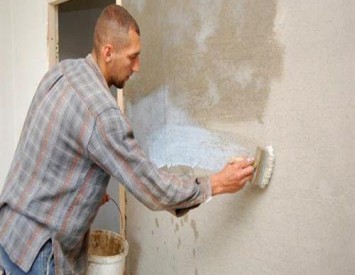
On the prepared surface, the primer composition is applied using a foam roller or sprayer, and in hard-to-reach places - by means of a wide brush.

Works are manufactured in the following order:
- the places of eliminated flaws are moistened;
- after grazing, the primer is applied to a uniform layer on the entire surface, not forgetting to process all the angles;
- the next layer of primer is applied similarly to the first one after 3-4 hours.

After complete drying of all the layers of the applied primer, you can breed the glue and proceed to the finish finish of walls with wallpaper.

Thus, if the primer composition is competent and the primer of the walls is carried out - the wallpaper is unlikely to be broken.