Goblen is a great option for home decoration. Pictures, performed in this technique fascinate. Machine production tapestries are very much inferior to the tapestries made by hand. But, alas, stand very and very expensive. Much cheaper to make tapenered with their own hands. In addition, such a solution will make it possible to make a harmoniously in the interior of the premises.
Content
The history of the occurrence of Gobel
Tapestry is a one-sided carpet, handy manually crossing the threads. The word tapestry itself has french roots. In the XVI century, housing Goblen opened a dyeing. Later to her attached a weaving factory. Louis XIV bought this factory and began mass production of carpets from painted threads. The factory was called "Royal Tapestry Manufactory", and carpets - tapestries.

It cannot be said that the tapestries appeared in the XVI century. Back in the III century. BC. The first samples of tapestries were found. In ancient Greece and Egypt, the palaces of pharaohs and state rulers were decorated with tapestries. Masters for the manufacture of tapestries used only natural threads, sometimes inserts from gold and silver were practiced.
The Renaissance era refers to the dawn of tapestries. The masters made whole rows of cloths performed in the same topics. Only the aristocrats allowed themselves such a luxury. Until the XVIII century, wool was used as a material for the manufacture of tapestries. A little later began to make tapestries from silk and flax. Now tanks are tanks both from synthetic threads and from natural.
For the production of the earliest tapestries, a wooden frame was used on which the threads and a special hook stretched, which allowed to securely fasten the nodes.
From the middle of the twentieth century, weaving machines appear, which simplify work on the tapestries. Tapestries, made by machinery have a lower price and quality, compared with manual tapestry.

Varieties of tapestry
Handmade tapestries are divided into:
- woven
- non-woven.
Woven tapestry is more complex in manufacturing. A thread base from cotton threads is wound on the wooden frame. Summums are used to secure. The clarity is intertwined with the main thread along the entire width of the carpet, thus connecting and fixing the basic threads among themselves. The process of manufacturing woven tapestries is the winding thread coagulation through the main one, while use a wide variety of techniques and nodes.
Looper or nonwoven tapestry is easier. A drawing is applied to a dense piece of fabric, and with a needle is flashed with wool or synthetic threads.
Manufacturer manufacturing technology
For the manufacture of woven mini-tapestry, you will need:
- threads - various colors and textures,
- wooden frame or weaving mini machine,
- fork,
- scissors.
Stages of work:
- For a start, take a wooden frame or board. 2 times longer in length and 3 times in height than the future tapestry. At the edges of the frame I clog nails. Distance 2-5 mm, depending on the thickness of the threads.
- We make a thread. On nails alternately wound the thread. Next, horizontally fix the refinement thread, using the nodule. We begin to weave the tapestry. Changing threads, depending on the desired pattern. The plug will help compact the structure of the tapestry. At the end, tapestry are refined with fringe, pigtails or tassel.
- To make brushes for the edges of the tapestry, you need to fold 4-6 threads in half, to tie the thread and attach to the edge of the tapestry, using any node.
- For a fringe, cut the threads in length twice as much as the desired fringe. These pieces of yarn are attached to the end of the tapestry with a knitted hook or needles. Optionally, the fringe is decorated with beads.

Methods for the manufacture weave tapestry:
- Linen - the most common way of weaving. Weft thread passed through the main one after one.
- Uzoroobrazuyuschy - weft yarn made of wool, each yarn around a swing the main twice.
- Twill - only the weft yarn is laid between the odd warp yarns.
- Egyptian - right entwine the main weft thread, then the weft yarn goes down. Get an invoice in the form of columns. Well suited for the relief image objects.
- Greek method is used in combination with a smooth weave, because that in itself is very loose. Use bright and voluminous yarn. The weft yarns are intertwined in a braid.
- Tying - woolen yarn paving from right to left. The first row of plain weave manner, then the weft yarn is got for the main loop is created and through which the weft yarn is displayed. Creates an embossed surface resembling netting.
- Sumach - two key swing the weft yarn twice from the inside to the outside and output from the two main strands forward. Created invoice columns.
- Carpet - the weft yarn is cut into small pieces 4-6 cm into two main strands are putting this segment of the middle and the ends of the wrap.. After one such series should perform a series of plain weave. Surplus pile cut and weaving to the desired shape.
Ways of weft thread between them:
- To create a clear pattern boundary, the compound of the weft thread, wherein the weaving of the desired color is brought to the border, and then interconnected, continuing the braiding.
- Possible way when the main thread lies on the boundary of two colors weave. Warp paving to the border and then bent and weave back and so on. On the other side of the weft thread of a different color paving as well.
- Palasovoe compound is used to obtain a clear and smooth lines. In this case, the weft yarns do not connect, and between them is formed a gap. Such a method is rarely used, because the gap between different colors have conventional stitching thread.
- Method compensated compound - the weft yarns are interconnected and move smoothly from one color to another.

Another type of woven tapestry is a circular tapestry that is used as a rug or hang on the wall. Circular tapestry differs from a rectangular shape and technique of prison. In a rectangular tapestry, the capture is taken from below, and in circles in a circle. For a circular support, even a gymnastic hoop is used, or a circle is cut out of a dense material.
For the manufacture of circular tapestries at home, you will need:
- Cardboard.
- Yarn for knitting and cotton threads. Necessarily different colors and structures.
- Thick needle for yarn.
- Wooden fork, if not - usual.
- Scissors.
Stages of work on tapestry:
- Cut the circle from thick paper, with a diameter of 30-40 cm.
- By the diameter of the circle, we make cuts by 2 cm. The distance between the cuts is 2-3 cm.
- We stretch the cotton thread on the circle. The filament base will not be visible at the end, so its color is not important.
- We produce a thread in the needle and fix the thread-foundation in the center of the circle. We make stitches, then go to linen weaving.
- We skip the refinement through each thread-foundation, thus making a weaving in a circle. We do this 25-30 times.
- Using a plug, we are sealing and recall the threads.
- Change the color of the thread. To secure a new thread, we make a node or twist for the thread base.
- We skip a white thread through two threads of the base.
- We alternate the colors at your discretion.
Fantasy is limitless here. The possibility of choosing different colors and textures.
Photo tapestry round:

Work on the embroidery of the tapestry
Tools for work:
- Needle.
- Thread.
- Dense fabric.
- Frame for fastening the fabric.
Stages of work on nonwoven tapestry:
- With the help of a stapler, attach the fabric to the frame.
- Draw a sketch on thick paper.
- Place the sketch on the fabric and circle a pencil. To correct if something failed.
- When the drawing is ready, circle it with a marker.
- Thread to do in the needle.
- We make stitches along the contour of the pattern, gradually filling the entire picture.
- If necessary, change the color of the thread.
Schemes Tapestry :


How to make tapestry volumetric
There are several ways to manufacture bulk tapestry:
- "Koshechka" - with the help of reducing the bases through one or two threads. If you need to achieve a convex texture, a flower, for example, it is necessary to alternate this technique with the usual, when the refinement thread is done through one thread.
- "Nodules" - first we make a lower row that will serve as a background. Next, a needle with a thread knit nodules, tightly adjacent to each other. The nodules are reclocked on the surface and create the desired texture. Thus, draw a picture, for example, chamomile.
- "Embroidery" - do the background. And we are treated with the future drawing, using various weaving methods. It turns out a double tapestry.

Recommendations for work on tapestry:
- Before starting work, decide on the picture. For beginners, it is better to choose not a complex picture, without small elements.
- With the help of a pencil and tracing, make the main drawing sketch. Circle the main contours.
- Threads stretch strongly, but they should not be like guitar strings. The fingers between the threads should pass freely.
- The yarn is selected according to the drawing and the desired texture.
- Decide in which color scheme the picture will be performed, pick up the threads of the necessary colors.
- It is best to start weaving from the lower right corner.
- Securely attach the drawing under the filament.
- Use the plug to seal nodes. Sliding movements drive the nodes after weaving each row.
- During the work, check the tapestry width.
- The free edge of the thread should be kept free.
- At the end of work, check that the upper and lower rows are the same width.
- When tapestry is ready, it is naked to a large frame or stretch. Then covered with wet cloth and leave for a day.
- Through the fabric tapestry stroke the iron.
Goblen - an interesting design solution for the interior
Technique tapestry does not lose its popularity for more than two thousand years, modern tapestries fascinate and give the interior special uniqueness. The tapestries fit perfectly in both classic and modern design styles.

Most often, tapestries are used in country houses. Large walls and ceilings allow you to place a series of tapestries, combined with one topic.
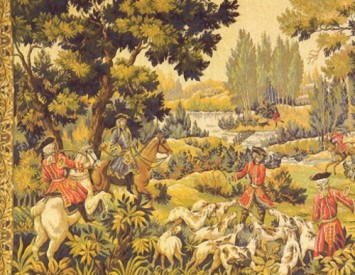
Diverse ornaments of juicy and balanced colors, mythological and medieval scenes, stylized patterns of plants and animals harmoniously fit into any interior.
The tapestries are not only hanging on the walls, but also present in the design of the house or apartment in the form of tapestry covered, covers for pillows, tablecloths, napkins, paintings. Even furniture and walls are squeezed by tapestries. In these cases, use, of course, machine tapestry.
Tapestry gives a common style of sophistication, luxury and versatility. An excellent addition to the tapestry will be the mosaic, stained glass and fusing. And vases, candlesticks and figurines will make the style more classic.