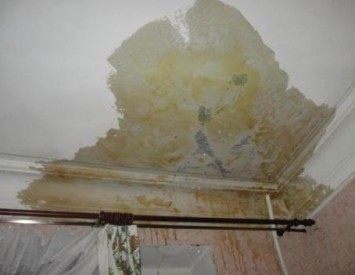
Most of the residents of apartment and private houses are thinking about the waterproofing of the ceiling too late, that is, in fact - flooding neighbors from above or the flow of the roof. Avoiding these troubles will allow a small complex of work that can be entered into planned repairs. Today we will discuss which materials are used for waterproofing ceilings, and how can it be done with your own hands, saving on hiring a construction team.
Content
Why do you need it?
It is easy to guess that the waterproofing of the ceiling is needed so that water does not penetrate into the house. It may happen for various reasons - the neighbors burst the aquarium from above, they forgot to close the crane, or simply broke the pipes. For owners of private houses, waterproofing is important as ever, since it will be necessary to compose in case of leakage only on its own inconsistency.
In addition, waterproofing avoids the occurrence of mold and fungus due to excessive evaporation indoors, for example, in the bathroom or kitchen. It protects the insulation layer, which, when wetting ceases to perform its protective functions. Thus, waterproofing not only does not give water to spoil interior items and decoration, but also prolongs the period of insulating ceiling materials.

It is important not to forget that the flooding of neighbors is fraught with not only the damage of the property, but can cause much damage. Water can wet the wiring and provoke a short circuit with a fire as a result. Special attention should be paid to the waterproofing of the ceiling in the bathroom, kitchen and other rooms with elevated moisture levels. Since all the time in them, or very often, evaporation is present, which, as you know, strive up, the interior of the ceiling is in an extremely vulnerable position and requires protection.
But in which the paradox is to perform the waterproofing of the ceiling from the inside in principle incorrectly. Since the main threat is the flooding from above, then the water will put water on the protective layer and can tear it off. It is much wiser to isolate the outer surface of the ceiling, but the floor in the neighboring apartment is in the coincidence of the circumstances. And it is unlikely the neighbors will be delighted if you come to them with this idea and will need to remove parquet or at least a linoleum floor mastic to cover up for the safety of their own homes. That has wisely and select materials that would be convenient, and most importantly, effectively guard against accidental flood.
Waterproofing materials
Waterproofing materials, there are many, but the ceiling - the surface is quite specific, and work is not so easy with her. But resourceful wizard still manage to select effective ways to protect a variety of ceiling materials. Let us consider each of these in more detail.
lining hydraulic seals
This whole section of waterproofing materials, the most prominent representative of which is a roofing material. Kraftliner call any waterproofing that needs to be stick or overlay onto the prepared surface. Usually sold in rolls, such as polyethylene film, fiberglass, polypropylene, synthetic fabric and other functional analogs.

However, a significant drawback of this type of materials is precisely in their way of applying to the surface. If you have tried to glue the wallpaper at least once, you will immediately understand what is meant. Ruberoid, even the cheapest and usual, much harder to wallpaper, and therefore it is even more difficult to cope with him, and it's not a fact that it will be tight. And with the first high-quality flooding from the neighbors from above, such waterproofing can successfully fall off with a decorative coating. A similar perspective will pay few people, therefore inland waterproofing for ceilings are infrequently used.
Stretch ceiling
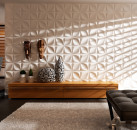
This method is much more popular than the pasting of the ceiling by polyethylene, but it is much more expensive. Stretch ceilings have deserved recognition not only in interesting appearance and high aesthetics, but also the ability to reliably protect the dwelling from the encroachment of uncontrolled neighboring water. In the case of a flood, the liquid is simply accumulated under the ceiling and can not leak through its canvas. If there are quite a lot of water, the ceiling will turn into an interesting sight, more resembling an avant-garde art object, as, for example, in the image below.

But even if the cloth alternate himself until the floor, it will not miss any moisture drop. The liquid is then released through the holes for the lamps, well grappling in the container. The film structure of the panel is capable of withstanding up to 100 liters of water for 1 m² of area - no waterproofing can boast of indicators.

The disadvantages of stretch ceilings, in addition to their cost, can be attributed to the fact that when installing, they significantly reduce the height of the room, so it is not suitable for all apartments. If such a ceiling saves you from flooding from above safely, and you started water from under it, the work is not yet completed - the space between the concrete ceiling overlap and the cloth need to dry. Moreover, it is very high quality, otherwise there is a risk in a short time to acquire a mushroom or molding plantation, hidden from the eyes. For this, most likely, you have to remove all the film, dry it, and then install in place.
But still benefits of stretch ceilings much more, and therefore the installation completely justifies any victims. Such a coating not only reliably protects from the moisture from the outside, but also creates a perfectly smooth and smooth surface - you will not succeed with a single whitewash and plaster. Installation of the stretch ceiling although specific, but quickly leaves no dust and dirt. This is the perfect solution for the above-mentioned rooms with high humidity - the film does not miss evaporation and retains the concrete overlap dry.
Foolish waterproofing
With degrade waterproofing, everything is much easier than with inlet. It includes a series of liquid mixtures that are applied to the surface with a roller or brush. Mastics usually have a bitumen rubber or polymer base, so they create a fairly reliable and durable waterproof film.

In order for the composition well to hold on the ceiling and did not be peeled under the pressure of the water from above, the surface must be prepared thoroughly. Often, preparatory work takes much longer than the application of the protection itself. This is the lack of these materials. The ceiling must first clean from the old coating and process to several times. The primer should not be chosen from any of what, and deep penetration - such compositions penetrate inside the concrete slab, brick or other porous material, where it is safely frozen, increasing the strength and waterproof of the overlap. Outside, the primer leaves the adhesive film to which any coating waterproofing adhesibins well.
Important moment: Since organic solvents are present in almost all waterproofing mastic, in the process of working with them it is necessary to open all windows and doors to provide high-quality ventilation of the room. Based on this requirement, it can be concluded that it is not a better idea to practice the ceiling processing.

Liquid rubber, relatively recently appeared on the construction market, are attractive waterproofing materials. This substance is based on two-component bitumen mastic. It does not have a single toxic substance, and the drying time is almost instantant compared to one-component compositions. However, if you do not want liquid rubber to fall off from the ceiling in six months, it is necessary to choose the products of a high-quality proven manufacturer, most likely by paying a round sum.
Penetrating waterproofing
This method is the most common, and not only because the cheapest, but also due to good qualitative indicators. The principle of operation of penetrating waterproofing is like a primer of deep penetration: the substance seeps through the pores of concrete to the maximum possible depth, where it is crystallized and firmly fixed. Thus, the microcracks and holes in the overlap are cleaned, not allowing moisture opportunities to lean inside.

An important point: Often, the depth of penetration of the composition in the concrete depends not only on its quality and manufacturer, but also on the temperature at which the work and the degree of surface humidity is carried out - the warmer and wet concrete, the dende the waterproofing penetrates. There are compounds that can impregnate concrete by 60-80 cm. They are quite expensive, but fortunately, for concrete floors in apartment buildings they will not need - it is quite suitable cheap compositions that penetrate only 15-20 cm.
The waterproofing of the ceiling from the inside in most cases is carried out popular in the domestic market with a mixture of KT "Trone-1". We suggest to consider gradually, how to contact her:
- The surface of the concrete overlap you need to wet. To do this, it is enough to wipe it with a damp cloth several times, sprinkle with water from the spray or walk with a wet brush.
- When the water heats the concrete, the penetrating composition can be applied. It is best to do with a wide construction brush with synthetic bristles.
- The movement of the brush should be carried out in one direction - do not take several times in the same place.
- Apply waterproofing is better than a thin layer. When the first layer slightly grabbing, but it will not finally freeze, you can proceed to applying the following. A total of 2-3 layers. Before writing the ceiling again, it is necessary to moisten it again - water is a transporting agent for microparticles of the composition inside the overlap.
- Each subsequent layer must be applied perpendicular to the previous one.
On 1 m², coated in 2 layers, it will take about 0.8 kg of "throne-1" provided that the surface is smooth. It will take about 1 kg / m² on the grungy ceiling.
During operation, special attention is paid to the stakes of the walls and the ceiling, since these are the most vulnerable points. During the construction of apartment buildings, often walls and overlaps are connected by conventional concrete, which over time gives a strong shrinkage, dissipates and begins to crumble. Squate water through such a place is easier lung, and to prevent these all the angles and joints need to be thoroughly missed penetrating waterproofing or even a sealant, even if you are going to install a tension ceiling.

Important moment: After you have made the ceiling waterproofing in a house with several layers of penetrating mixture, maintain the relative humidity of the surface for 3 days. This will allow the composition to penetrate as closely in concrete.
Waterproofing wooden ceiling
If you have a wooden private house or a cottage, which is heating, and you are going to use this blessing of civilization in winter, insulation and waterproofing the ceiling are required. In the summer, the evaporation of moisture occurs by itself, but in winter evaporations much more, and they are delayed in longer, because the temperature is lower, and the windows and doors are constantly closed. In addition, if you plan to live in a wooden house in the cold season, the uninsulated ceiling will give you a permanent coolness and huge heating bills. As you know, the heated air is actively striving up, and if you do not create a barrier in the form of protective layers of the ceiling, nothing will prevent him from leaveing \u200b\u200bthe room that you are so diligently try to heat up.

If you warm the ceiling of mineral wool (the most popular and inexpensive material), then evaporation from the bottom, passing through it, will create condensate, the insulation will appreciate them and stop saving heat. If you simply attach a waterproofing film to the ceiling, heat will also leave, because the film, unfortunately, protects only from moisture. Thus, the insulation work with the ceiling in a wooden house should be produced in a complex with insulation, hydro and vaporizolation. The latter is not only a barrier for vapors, but also protection against dust and small sera, which can crumble through the wooden ceiling elements when walking on the top floor.

Polyethylene film is considered the simplest and inexpensive vapor barrier, to attach which the usual stapler can be used. At the same time, the material should be attached to the brass at 15 cm and fasten the strip between themselves with a wide scotch. Parosolation is laid on the insulation, and it is on top of waterproofing.
How to make the ceiling waterproofing:
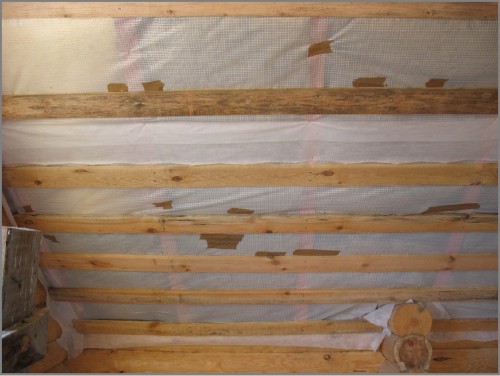
- To the wooden ceiling overlap, attach the waterproofing film - a construction polyethylene with a thickness of 200 microns, a polypropylene fabric or other. To fix it to wooden surfaces, use a stapler, and interconnect material cuts with a wide scotch. Place the waterproofing of a 20 cm waterproofing.
- At all the waterproofing film, attach the insulation. It can be a mineral wool in rolls or plates, foam or other non-empty material. By the way, if you make waterproofing the ceiling of the bath, then the insulation should choose the non-combustible and most immune to high humidity. Minvata in this case loses - since having soaked in moisture, completely loses its protective abilities. But since in a dry form, it perfectly retains heat, many continue to use it by adding an additional layer of waterproofing - on both sides of the insulation.
- To the insulation, put a vaporizolation membrane that will not allow condensate to penetrate inside. In the case of waterproofing the ceiling with your own hands in the bathroom, bath or in the kitchen instead of vapor barrier (or with it) you can put another layer of moisture protection film. Membrane cuts should also be treated with a mustleless, attaching to the tree stapler, and to each other - a wide scotch.
- On top of vaporizolation or additional waterproofing, wooden rails need to be knit - a peculiar crate for fixing the finishing material. Reiki not only hold the ceiling finish tightly, but also leave the ventilation gap, which is necessary for evaporation of condensate.

It is useful to know: in wet premises, the use of vaporizolation must. Membranes are different: one-sided and bilateral. If you bought one-way, it needs to be stacked with a rough side down, and smooth - up (to thermal insulation), double-sided can be mounted as you like. Bilateral vaporizolation is more expensive, but allows not to leave the ventilation gap. In the bath over the steam, many experienced hosts laid vapor barrier from kraft paper with a foil coating - it evaporates condensate and reflects heat back to the room.
If there is a draft floor on the top floor, it is best to lay waterproofing on it - it's easier, faster and more reliable. As for the waterproofing of the ceiling on the balcony in a wooden house, it is also better to perform it outside, attaching additionally insulation and vapor barrier.
We hope the above information will help you in time to take care of protecting your own housing and avoid trouble with leaks and floods.