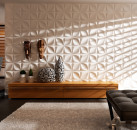
Flexible stone - Innovative material for finishing, which has already managed to earn respect and love of designers. The low cost and simplicity of installation, coupled with excellent performance, make it possible to apply it both within the house and for facing facades. In this article, we will consider in detail the technology of manufacturing and installing flexible stone.
Content
Characteristics of flexible stone
The technology of manufacturing flexible stone was invented in Germany a little more than 10 years ago, and in Russia it appeared quite recently. Despite this, the material immediately gained popularity, which is not surprising - the flexible stone coating has a mass gain. It is suitable for finishing all sorts of surfaces - walls, gender, ceiling, columns, furniture, facades, stairs, etc.
The advantages of the material flexible stone:
- Functionality - a small thickness (up to 4 mm) allows you to use a flexible stone for lining of any surfaces, including rounded, angular, non-standard forms.
- The ability to withstand increased air humidity and direct contact with water provides new opportunities for finishing bathrooms, swimming pools, kitchens, etc.
- Flexible stone is made of natural minerals, so it is completely safe from the point of view of ecology (you can apply in the children's room).
- The release form is tiles and sheets, thanks to which the installation passes very simple and quickly.
- A special structure makes it possible to create seamless coatings, imitating a one-piece surface from the monolithic stone slab.
- Flexible stone is easy to cut the stationery knife or scissors.
- Absolute fire safety - the material does not burn and does not support burning. For this reason, it is chosen for finishing stoves and fireplaces.
- Simple care - a flexible stone coating is easy to launder with ordinary water and sponge, so if there are little children living at home, they can not forbid to draw on the walls.
- Immunity to temperature jumps, which allows the use of material for the exterior finish even in the northern regions of the country.
- The uniqueness of the picture is a special production technology eliminates the pattern. With all the desire, it will not be possible to make two identical patterns, which speaks only in favor of uniqueness and naturalness. Natural color gamma simulates the surface of natural stone, of course, if the source material (baby) is not painted with pigments.
- Another unique property of flexible stone is traffic permeability. They can be covered with floor lamps or making disguised sources of lighting in the room - the rays will break through the surface, giving a soft soothing light.
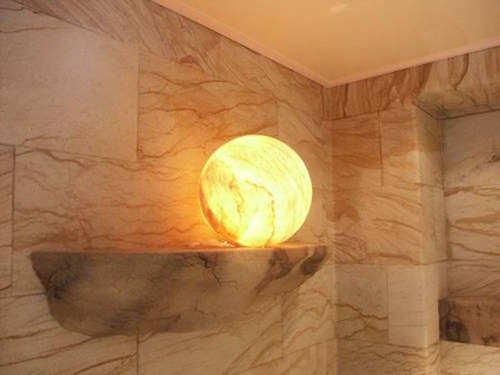
- You can apply a photo printing on it, which is even more expanding the boundaries of his decorativeness.

Making flexible stone
As we have already spoken, a flexible stone is a relatively new building material invented in Germany. The specific technology of its manufacture could be explained by German practicality or European thrift, but the fact is that the flexible stone allows to obtain a solid, durable, beautiful and natural coating, while saving natural resources.

There are two ways to manufacture: in careers and in the workshop. At the workshop we mean both large plants and modest homemade production. In the first case, during the excavations in the careers, a smooth slope of the sandstone slope is covered with a gauze cannol, soaked with glue and gently cut after drying. The thickness of the material layer is from 1 to 3 mm, so there is a special high-precision technique for such a filigree work. As a result, the canvase remains a natural drawing, conceived by nature and formed several thousand years ago. Clay forms brownish and red divorces, iron oxides give saturated brown shades, sandstone - yellow tones, etc.
As for the production of flexible stone with their own hands, it will be necessary to show fantasy here and create patterns yourself.
For the production of flexible stone, the following instruments and materials will be needed:
- A stirring device is an installation consisting of a construction mixer and a large capacity. For the manufacture of small batches, you can use the conventional perforator with a microscale nozzle.
- Natural marble crumb, sandstone or quartz sand. To make a multicolored coating, bulk material can be colored iron oxides. This is one of the most stable, durable and natural dyes that can be used for external finish.
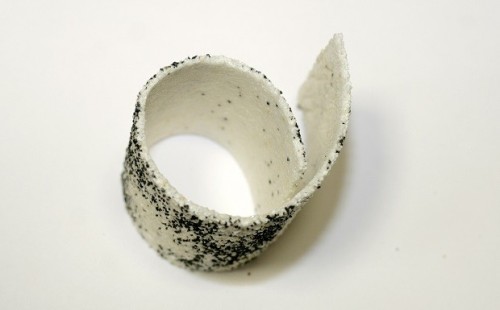
- Acrylic adhesive for impregnation and fixing stone crumbs. Acrylic is distinguished by high flexibility and elasticity, and to enhance these qualities, polymers and plasticizers are added in some cases.
- The basis on which stone crumb will be enshrined. The glass cholester in this case is most suitable, since it is characterized by high strength, good adhesion with adhesive compositions and flexibility.
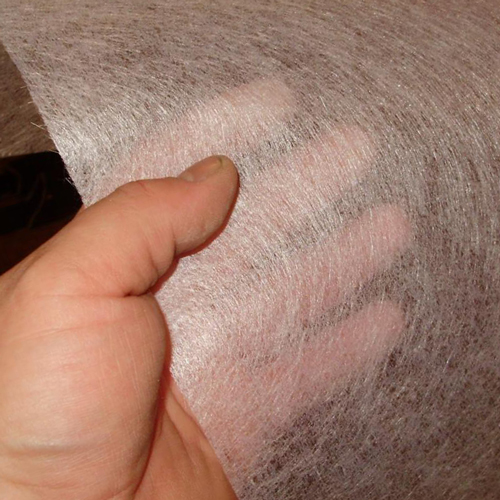


It is recommended to work on a wide table with good lighting. A sandy crumb is applied to the reinforcing canvas (glass cholester) and impregnated with adhesive composition (acrylic resins), after which they align and send to dry. Dry the raw flexible stone sheets are recommended in a separate well-ventilated room, laying them on wooden racks. In order to save place, you can make pallets with your own hands from OSB sheets and bars on the sides of 10-15 cm wide. So they will be folded on each other, leaving a sufficient gap for stable ventilation and drying the flexible stone.
Flexible Stone: Mounting Technology
One of the main features of the flexible stone, as a finishing material, is that it is possible to create a solid seamless coating. To work, you need a plastic and toothed spatula with a teeth of 3 mm, a rubber roller, a construction hairdryer and a stationery knife.
In addition to the finishing material, stocking with acrylic glue (can be universal) if you leave the seams (the effect of wild stone), buy the grout composition. In some cases, it may be needed to fill the gaps between the lined surface and the floor (ceiling) - use a transparent acrylic sealant for this. To improve adhesion with the base, treat it with primer deep penetration.
Installation features:
- The flexible stone can be glued to any surface, but better if it is smooth and smooth - then the finish will look more effectively. If there is no possibility to align the base, or this does not provide for design, just clean it from the previous coating and dust.
- If the finishing works are held in a room with a high level of humidity, the walls are recommended to be treated with deep penetration by water protection plaster. It can be bought in the store or make it yourself from the construction glue of PVA, cement and water.
- A flexible stone can be glued to uneven walls, but if they are sterbatched and shot down angles, it is better to pre-restore them, otherwise the finish will serve less than the laid.
- After preparing the base, cover it with the primer to improve the adhesion and wait for it drying.
- When using a flexible stone in rolls, glue is recommended to be applied to the wall, in other cases, lubricate the back surface of the material. Apply a small amount of glue and distribute it to the toothed spatula. Working with rolled stone, by and large, no different from sticking ordinary wallpaper.
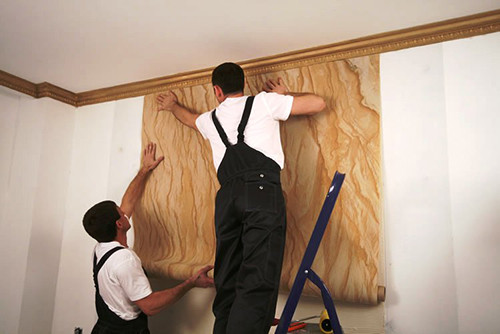
- Attach the stone tile to the wall and roll over the entire area with rubber roller. Facing the interior items (columns, lamps, etc.) should be made in small fragments so that they can be easily kept while sticking for a pair of minutes.

- For facing the angles, the flexible stone warms up the construction hairdryer, bend and glued close to the wall. High temperature melts acrylic resin, holding stone crumb and does not allow the material to crack. When the tile cools, it retains the shape that she was given when flexing. As a result, you get neat angles without junctions.

- By the word about joints - if you want to make a monolithic "stone" wall, just set the seams with a small segment of the emery paper or the same flexible stone. When rubbing, the baby is exfoliated and fills the junction between the elements, making it invisible. There is another way of eliminating seams - hot. For this, the sheets of the material are laid with a small overlap, after which the place of the joint is warmed up until the thick mass of acrylic with the crumb is formed. This mass is rapidly aligned with a spatula, and the surface is frozen without a seam.
Video about flexible stone and mounting features:
- If glue spoke between the tiles, immediately remove it with a rubber spatula and wipe this place with a wet rag.
- Putting the seams with special compositions or sealant is carried out in the same way as when laying ceramic tiles, that is, after complete drying of the glue.
- It is possible to remove the protective film from the surface of the stone only after the completion of all finishing and paints and varnish works in the room.

- At the end, the lined surface should be treated with water-repellent primer, which forms an impenetrable protective film that protects the stone from the negative effects of the environment. It is better to primitive in two layers, applying the second after the complete drying of the previous one (must pass at least 2 hours). Alternatively, the primer can use a transparent varnish.


Wild stone
This is a special technology for mounting the flexible stone, which we decided to consider separately because of its specifics. Laying material under the "wild stone" is actively used for decorative design of facades of buildings, fences, interior decorations. It allows you to create a wall imitation laid out of untreated boulders, and from being reliable and durable.
To create the original interior in the house also use the "wild stone". At the same time, it is not necessary to adhere to any rigorous forms and outlines - than "coarse" will be forms, the more naturally the wall will look.

How to finish under the "Wild Stone":
- Prepare the base, removing the old coating and aligning if necessary.
- Turn over the flexible stone and mark on the back of the back with a marker. Draw fragments of various incorrect forms.
- Take the stationery knife or ordinary scissors and cut the flexible stone on the outlined lines.
- Enclose items to the wall in chaotic order, leaving gaps between them several millimeters.
- Start the seams with a special composition.
- Cover the surface with hydrophobic primer or varnish.
Flexible stone care
Since the manufacture of flexible stone provides for the use of high-strength acrylic glue, the mineral crumb is very tight. In addition, after cladding, the surface is covered with water-repellent composition (primer or varnish). For these reasons, care for flexible stone is very easy.
The surface is completely not afraid of moisture, so it is enough to wipe with a damp cloth. Because the baby creates a certain roughness and ribbon, such a cladding collects dust, so it can be vacuuming it from time to time.
Over time, the lacquer coating or water-proof primer wear out, so it is necessary to update the wall. To do this, it is enough to wash it, re-covered with a protective composition and forget about it for another 5-7 years.

The technology of manufacturing flexible stone appeared quite recently and is still improving, so do not be afraid to make your own adjustments to it and use all sorts of additives. For example, plasticizers that will not allow adhesive can be used for facing facades in winter. Coloring of marble crumbs in various colors will help achieve the uniqueness and originality of the drawings, and the photo printing will allow us to create real masterpieces.
Flexible stone: photo
In conclusion, we suggest you see how designers use a flexible stone to design interiors and outdoor decoration.