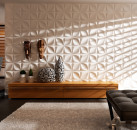
Plasterboard has long been firmly and for a long time won a worthy place among the variety of materials for construction work due to the simplicity of installation and the presence of many useful physical properties.
Content
Nevertheless, it is interesting than professional builders and designers are guided in their daily practice, preference to this popular material today.
Some examples of how plasterboard are used in construction are presented in the photo below.


Classification
Plasterboard is a plate that has a plaster core, framed on both sides of cladding cardboard sheets.
GlKl plaster base includes different additives that make the material obtained with certain useful properties. By the type and purpose of additives present in the feedstock, plasterboard is customary to divide into the following categories:

- GLK is the most common drywall at all without additives. Its appointment is the sheath of wall structures and ceilings in buildings with permissible temperature values \u200b\u200band a low indicator of moisture content in the air.
- GKLO - Plasterboard refractory with reinforcing inclusions. This type of material is designed to build places where special attention is paid to the observance of fire safety.
- HCCB is the type of drywall, which is not a delicate effect of excessive moisture, contains in the composition of anti-grib and hydrophobic additives. Cardboard to create such plates is also not easy - impregnated. This type of material can be operated even in places with high humidity, however, subject to the use of additional, water-resistant decorative mixtures.
- Glevo - waterproof and refractory drywall, micx GKLV and GKLO. It is appropriately used where, along with high humidity, high temperatures are recorded.
The reasons for which it is worth choosing plasterboard
- Low weight. This quality greatly facilitates the installation process and avoids an excessive load on the bearing walls.
- Ecology. This material "breathes" and is absolutely not harmful to the inhabitants of residential space.
- Plasticity with moisture. This feature of the drywall allows you to simulate parts of a unique non-standard form of various complexity. To achieve this effect, the sheet is pierced with a needle roller and wetted with water. In such a state, it is easy to build any element with radial lines. In addition, after drying, the material restores all the "necessary" properties. It was this fact that became one of the most good reasons for such an ubiquitous use of drywall in construction. After all, neither stone nor ceramic, nor wooden products are simulated so easily.
- Resistance to fires. Gypsum, which is a basic component, absolutely not a fuel.
- Easy installation. The assembly of plasterboard forms does not require any special devices.
Weaknesses of plasterboard
- Exposure to deformation changes in the conditions of increased humidity values. It is understood as the level is more than 80%.
- Fragility. It is forbidden to drive the nails into drywall walls, because, the sheet can easily burst. All parts are mounted with screws, holes that make a screwdriver. It is also not necessary to hang heavy items on the blacks (mirrors, panels, etc.).


Where is the use of drywall?
- in poorly heated buildings;
- in high humidity buildings (more than 80%).
What is fraught with incorrect operation of plasterboard?
- the formation of mold and rot;
- deformations forms;
- destruction and peeling of the decorative layer.
To eliminate the occurrence of such unpleasant surprises, care should be taken about the installation of air conditioners in the housing when an excessive moisture content of the air. Their operation will significantly increase the service life of components of the GCR.
Which usually involve drywall in the building?
- To create wall structures and piers.
- The form of the substrate in the regeneration of flooring.
- For the manufacture of suspended ceilings.
Plasterboard is very convenient when you need to make alterations to rooms without major changes. Light plate not heavier construction. Simply put, plasterboard partitions perform a role similar to stationary screens.
Additionally, for the gypsum plates easily hidden surface defects in the form of chips, cracks and so forth.
A particularly high-quality drywall Knauf can play the role of an excellent substrate for laminate, linoleum or ceramic tiles.
Constructions of plasterboard, which is equal to the standard thickness of 1.25 cm, it is possible not only to decorate wallpaper, but somewhat more difficult. For example, the finishing tiles, artificial stone, etc.
Designs that are made from LGC
- Arches and domes.
- Falshkaminy.
- Perestenko.
- Column.
- Niche plasterboard.
- Boxes for masking vehicle lighting systems and other communication lines.
- Plasterboard layered.
- Various elements of irregular shape for zoning premises.
- Other non-standard products.
Cardboard-gypsum elements assembly
There are some differences in the process of installing a variety of cardboard-gypsum elements, but the materials, tools and basic operations, virtually the same.
What to prepare in advance

- Pencil and tape measure to mark.
- Sharp knife for trimming sheet.
- Screws and screwdriver.
- Profiles of metal.
- The material for insulation.
- Waterproof primer.
- Construction grid.
- Putty.
- Sandpaper.
- Finishing material.
Installation process
- Remove the remains of the dismantled elements, old wiring, garbage. The plane, which is planned to be finished, remove previous coverage.
- Make markings, given the size of the GCR.
- Construct frame made of metal profile, reinforcing it in areas where it is assumed a special load, using a screwdriver and screws.
- Fill material carcass cavity insulation.
- Sew cloth plasterboard frame structures.
- Coat the obtained surface water repellent primer.
- Treat the seams with putty, applying the construction grid.


- Speak the irregularities of sandpaper.
- Apply a layer of finishing putty to the entire plane.
- Remove the wall with the selected facing material.


It is better to navigate in the information about the use of drywall you can watch the video clip submitted below.