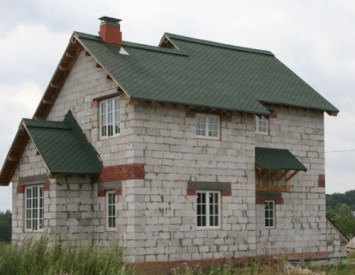
Foamclock is the material in the form of a rectangular parallelepiped with a size of 30 per 40 cm. Motable blocks made of foam concrete, which is mixed with cement, water and sand. The material is characterized by gray color and the ability not to be sinking in water, even having a fairly large weight. Foam block on some characteristics is similar to aerated concrete and often confused with this material. But the foam blocks for the foundation the price is much lower than the cost of aerated concrete, because this material in construction is used more often.
Content
The advantages of using foam blocks
Falo blocks are distinguished by the low cost in comparison with other similar materials, while the structure of it has the same indicators as from brick or wood. In addition to this factor, there are other weighty advantages:
- In the manufacture of foam blocks, no harmful impurities are used, this material is environmentally friendly and does not harm human health and the environment. According to sanitary standards, foam block is suitable even for the construction of various children's institutions.

- The walls of the foam block do not let the sound and do not require additional sound insulation processing.
- The surface of bricks from foamed concrete is easy to process, it creates structures of any form.
- The porous structure of the material provides a good air exchange between the room and the street. This indicator is at the same level as wooden walls. At the same time, they do not conduct warm, holding it indoors.
- Foundation from foam blocks will not be cooked due to the same porous material structure. It will not be necessary to install additional structures to combat high humidity in the basement.
- When laying foam block, all work is performed quickly and easily, as all bricks are small and the correct form.
- The maximum distance between bricks is 3 mm, so not only cement is used for laying, but also special glue.
- With the finishing decoration of buildings, laying a large number of plaster, as the walls of the foam block have a smooth surface.
- This material is highly resistant to heating.
With all the advantages, foam blocks have one drawback - the strength is not very high, this should be considered when calculating the load on the foundation.
Types of foam blocks
To accurately determine what the foundation for foam blocks need, it is necessary to study all possible options, as well as the characteristics of the area where construction is planned. The most common foundations for structures from this material are divided into 4 types:
- Ribbon foundation - this design is constructed by a swallowed or finely breed.
- Stamp Foundation - the design includes reinforced concrete, pillars in the form of a square or a circle with a painter or beam, which has a reinforcing belt from the reinforcement.
- The pile foundation - when construction, apply piles screw or hanging, piles-racks with painter from reinforced concrete. The fundamental difference of this type of foundation is only available to strengthening pile elements. Otherwise, the design is erected as a ribbon or column. Piles are optimally suitable for unstable bases that need extra support.

- Monolithic foundation - on the principle of construction does not differ from such structures from other types of material. The design of foam blocks has a small weight, and therefore the thickness of the base is less, but this factor depends on the project of the house, its floors and square.
Parameters of selecting the foundation of foam blocks
When choosing the optimal version of the foundation for a house of foam blocks with their own hands, the peculiarities of the terrain on which the construction is carried out. The foundation should be reliable because it is the basis of the house, but the calculation is carried out so as to minimize the costs. Read more All factors that take into account when choosing a type of foundation are described below:

1. Features of the soil at the construction site. To determine the type of soil, geological studies are carried out, which are carried out by specially trained people. But this work is easily carried out independently. For this, one or more wells are made by a depth of no more than 2.5 m. Of these wells, land samples are taken to determine the components of the components. For groups, tillage are divided into:
- non-empty, contain gravel sand with a large or medium size of gravy;
- weakly, contain the grasp of small size or sandy dust;
- bunny, contain clay impurities, loam and sandy.

2. Next, the analysis is determined by the optimal type of foundation. For the Third Soil Group, you should not choose a ribbon foundation. The optimal solution will be piles.
3. If there are soils from the first group at a depth of more than 2 m, and the freezing passes at a sufficiently large depth, then it is advisable to build a structure of a columnar or pile foundation. When calculating the pole or pile, it is arranged so that the distance between them corresponds to the total mass of the structure. The depth of the primer of the soil is determined on the basis of observations of several years, on average, this indicator is from 0.5 to 2 m.
4. The following factor is the level of groundwater and its influence on the construction. Highly standing water exclude the construction of a ribbon foundation, this indicator is 0.5-1 m. At such a height, it is necessary to supplement the foundation of the drainage, which will increase the cost of work. In this case, the optimal option is a monolithic foundation. However, if it is planned to build a house with a basement, the construction of a ribbon foundation and drainage under it is inevitable.
5. The last factor is the necessary work deadlines and their cost. For quick construction, the foundation is optimally suitable for the foundation of the pile or column, since these works require the smallest time costs. The most expensive foundation for the house of foam blocks is monolithic and tape.
Construction of a belt foundation from foam blocks
The ribbon ribbon base from foam blocks is optimally erected on the soil of clay or soils from the group of a bunched type. The depth of the goal is calculated based on the data on the freezing of the soil. The width of the foundation under the foam block is calculated so that it is greater than the thickness of the wall at least than 100 mm. The height of the base is not less than 40 cm, the upper part is reinforced by reinforcement 10-16 mm with two rows of two layers.

A low-rise foundation has no more than 60 cm. This type of base is optimally suitable for non-empty soils with a solid base. Ribbon foundations allow you to equip a house with a basement. The construction algorithm looks like this:
- The process begins with the Pillow tab, for the manufacture of which is used by sand or a mixture of rubble and sand. Prepare a trench for the base of the house, sand, trambets fall in it, and then on top of a crushed stone or gravel. The thickness of each layer is 15-20 cm.
- Further on the finished pillow perform the fill of the cement mortar with a thickness of 5-10 cm. This part is called "sweeping". The solution is left for 5-7 days, but not until complete drying, but only up to half.
- When "sweeping" dried half, the foundation is reinforced. The reinforcement rods are associated with a knitting wire belt. It is not recommended to fasten the rods with welding, since the exposure places are more susceptible to corrosion. The fittings for the foundation should be chosen from products having an anti-corrosion coating. If necessary, the foundation is reinforced with a more complex frame, which is additionally poured with concrete. This measure is necessary at high gravity of the future structure.
- After reinforcement, formwork is performed. To do this, we use a tree, slate, faeer or metal material. A concrete solution is poured into the finished design.
- For the preparation of a concrete solution, all components are taken in such a ratio - 3 parts of sand on 5 parts of rubble and 1 part of cement. The ratio of water to cement is 0.5. When performing work in the cold time, various substances that accelerate hardening are added to the solution.
- The finished concrete is poured into the formwork and compact. The optimal option for a good seal is a vibrator, which is also not difficult to make it yourself. Or to compact the solution using a wooden hammer, pre-making several holes in the concrete for air output.
- The formwork is removed after complete solutions, usually goes about 3 days. Next, begin the laying of foam blocks on the finished base.
Some features of the area relief significantly affect the construction of the foundation under the house. If the area has a tilt, the foundation is poured by the omens, start working on the lowest surfaces and are moving on. At the same time, the height and length of the ledge is calculated in the ratio of 1: 2, its height should not exceed 50 cm. With the same calculation, the deeper mint goes into the fine one. When erecting the foundation on dry soils, the thickness of the sandy pillow increases, while reducing the size of the masonry.
Construction of a column foundation from foam blocks
A columnar foundation under the house of foam blocks is simply ideal, since this type of structures is reliable for buildings with a slight weight, and such a feature is inherent in the buildings from foam block. The basis of the structure is the construction of the columns on which the entire building will be built. Places for pillars are calculated in such a way that they support each angle and places of the intersection of walls, also the pillars enhance all points of the load focus - heavy or bearing walls, beams, runs, etc. Calculations also take into account that there should be no gap between the colums than 2-2.5 m.

The column foundation is built using various materials, including stone, brick, boot concrete, wood and others. The depth of the embedding divides the structure into ruined and finely translated. Constructive features share foundations from pillars to monolithic and collapsible. If, when erending the foundation, the beams are laid on top of it, then this is a framework with painter, but it is possible to build it without it. The most reliable design, the leading experts recognize the reinforced concrete base for the house. The algorithm of its construction looks like this:
- In each noted under the post, the pit is digging. In the finished deepening, the pillow of sand, gravel and rubble are placed. Out of the pillow laid the material that does not pass the moisture, so that when pouring the poles concrete moisture does not go to the base.
- In the pits install shields and cut them, so that the design does not fall inside. This measure is needed in order to prevent the land in the pit. The same shields are used as a formwork if their width corresponds to the necessary.
- Next, reinforcement, the thickness of the rods for this requires about 12 mm. The reinforcing material is inserted into the pit vertically, at a distance of 5-10 cm from each other. All rods are fastened with knitting wire.
- Before filling the solution, the formwork is securely fastened. For the preparation of the solution, 1 part of the cement is used to 3 parts of the sand. The solution is poured gradually, in small portions. Every 20-30 cm cement is carefully tamped.
- Spilled poles leave 10-14 days before complete drying. Next, remove the formwork and mount the overlap. Use for this concrete fill or monolithic blocks made of concrete.
- The overlap of concrete fill is made by the same principle as the pillars themselves. It is strengthened by it grids from fittings.
Construction of a monolithic foundation from foam blocks
This foundation for foam blocks is optimally suitable for bunching soil. It fills all the space under the house, while the species described above support only individual elements.

Minus design is the inability to equip the basement. The construction algorithm looks like this:
- It is equipped with the necessary dimensions with a depth of no more than 60 cm.
- At the bottom of the pit stacked a pillow with a thickness of 40 cm as during the construction of a tape or bonded base. The thickness of the sandy layer is not more than 25 cm, the layer of rubble is no more than 15 cm. On the upper churable layer of the pillow, the waterproofing material and two strengthening layers from the reinforcement are placed. The strengthening layer consists of a reinforcement with a diameter of 10-12 mm and the size of the cells of 20 by 20 cm.
- Fitting is installed throughout the area of \u200b\u200bmonolith. Concrete solution is poured.
- After complete drying of the solution, the formwork is removed, the waterproofing material is placed.