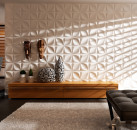
How to update the design of the living room, but not to do overhaul? The optimal solution for this task is the frescoes. The technology allows you to transform any room beyond recognition and create an atmosphere of comfort and luxury in it. Methods of applying drawings on the walls are quite a lot, as well as advice on the use of frescoes in the interior of the apartment. Consider the best of them.
Content
Varieties of frescoes
Initially, the fresco meant the technology of drawing a pattern on wet plaster. After its drying, the drawing was covered with a protective film that made it durable and stable to burn apart. Over time, the term transformed and began to designate any painting on the walls.
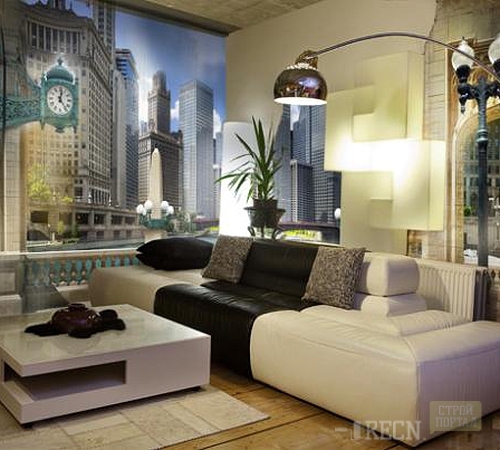
To date, there are three large groups of making frescoes:
- natural paints
- decorative elements,
- pre-harvested drawings.
Classic frescoes
The most beautiful and expensive frescoes are drawn by oil colors, they turn the usual wall into the work of art. But, such a job is able to fulfill only a professional artist who specializes specifically on frescoes, as the technology is very different from drawing on canvas.
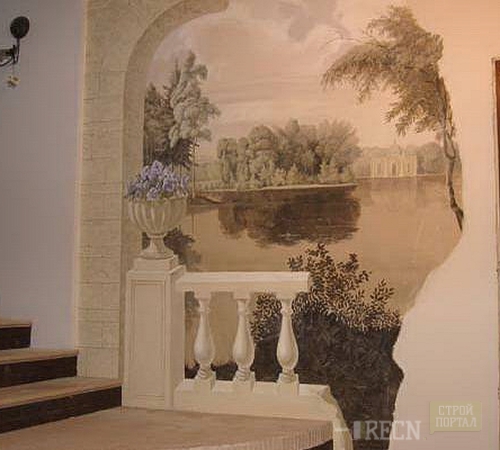
In some cases, watercolor paint is used. They are easy to lie on the surface and anyone who at least know how to draw a little, will work without difficulty. Watercolor frescoes need to handle varnish, otherwise the paints will quickly lose their color. In some cases, the frescoes are performed by acrylic, it is relevant if you want to see your living room in the style of futurism.
Art Deco Fresco
The frescoes for the living room with decorative elements appeared not so long ago, but quickly became very popular. Major techniques:
- sand fresco
- craquelure,
- mosaic.
The sand technique is called quite conditionally, since in fact, the sand has nothing to do with the work on the fresco. However, the drawing made in such a style, distinguishes from other extraordinary radiance, especially with artificial lighting. This effect is achieved quite simple, or in plaster, or bright sparkles are added to the paint. Choose them preferably under the total color gamut of the future drawing. By the way, the addition of sequins in the plaster is used not only for frescoes, but also in the design of the entire room. As a result, with bright sunlight or electric lighting, the surface of the walls will brightly glisten and overflow the glare and surprising guests. Despite the seeming simplicity, the technique is not common and is a wonder in domestic construction practice.
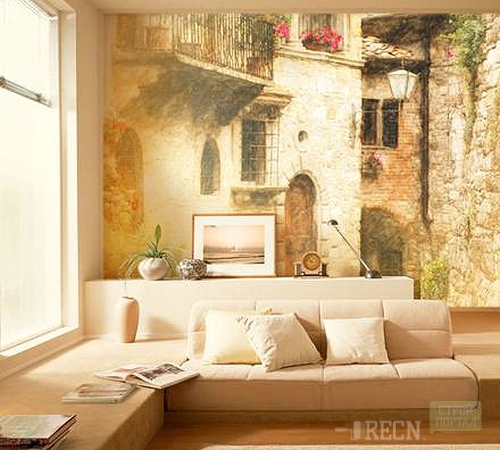
Craquelur is an older way to create original wall painting. Instead of sequin in the plaster, marble crumb is added. After drying, the drawing "is aged" and cracks, but at the same time the surface remains perfectly smooth without a single flaw. Although the frescoes made in a similar style look quite effectively, in everyday life it is suitable only for several design solutions, such as Boz-AR, High Tech and Ampir. This is due to the fact that craklers in simpler solutions is too bright spot creating a contrast with the rest of the interior.
Another interesting solution is the use of mosaic elements in the picture. It manifests itself in two types:
- decorative
- roller.
Decorative mosaic involves applying a regular pattern on the wall, which is made in the style of the mosaic and consists of separate, multicolored elements. It looks quite original, but not as impressive as a real mosaic. To create it, individual patterns are replaced with color glass, which is mounted directly to the plaster. Such a combination is distributed in England, but it is extremely rare outside of its limits.
Frescoes on pre-harvested drawings
To date, this is the largest group that is represented by the following technologies:
- stencil,
- fliselin fresco,
- elastic fresco
- canvas,
- digital printing.
The frescoes in the living room with stencils are made most often. The work is very simple, does not require special skills, and the rich palette of stencils allows you to choose absolutely any solution. However, stencils do not allow you to create anything truly original, moreover, the area of \u200b\u200btheir application is very limited. Suitable only for small living rooms or as additional decorative elements.
Flizelin frescoes are akin to wallpaper. Only instead of a boring monotonous coloring on the top layer of paper is applied a specific pattern. It is not worth identifying this concept with photo wallpapers, since the manufacturing technology is fundamentally different. Flizelin frescoes are glued onto the wall with an ordinary wallpaper glue, the average width of the web 1 m.
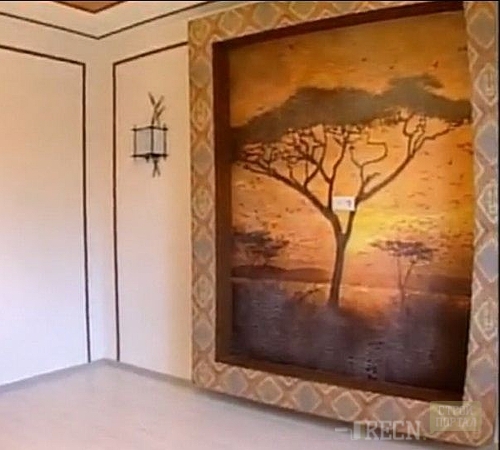
The elastic fresco appeared recently, but has already become very popular thanks to their unusual appearance. The drawing is created with the help of plaster, which is applied to the fiberglass mesh. This technology allows you to mount the frescoes absolutely on any surfaces, especially relevant for the angles and places of floor adjustment (ceiling) to the wall.
Inventive Italians in the sixteenth century came up to save on the services of incredibly expensive, at that time, masters-fresochnikov, and replace the painting of crude plaster by the usual host. Installation is simply simply:
- on the upper and lower edge of the canvas to the wall attached a wooden rail,
- on it, like a lighthouse, plaster is done,
- next on the rails tensioning canvas,
- the edges of the picture are embarrassed by stucco.
Such pictures are mandatory need to open with varnish, otherwise they burn out in the sun.
Digital printing or photo wallpaper is an already ready picture that you just need to stick onto the wall. This is the cheapest and simple option, it looks in comparison with the real fresco, respectively, as well. The canvas is made both solid and separate rolls.
Frescoes in the interior of the living room
The use of frescoes is possible everywhere, it can be like a separate art object and a whole gallery. This element is enough to completely transform the room. But, if you wish to achieve a maximum effect, then the placement of the frescoes is required as much as possible.
Designers advise several concepts:
- global design
- central element of the interior,
- separation of living areas.
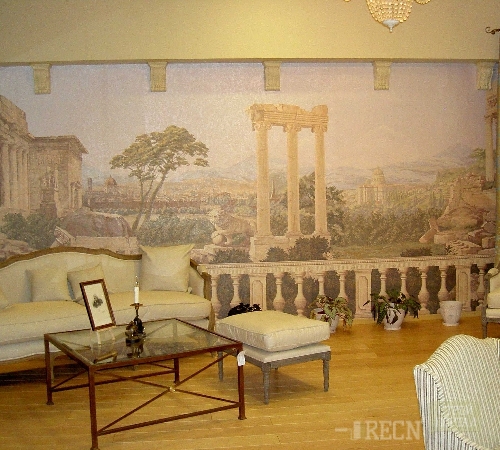
In the global version of the frescoes in the interior are used on all walls, constituting a single monolithic painting. This approach is especially relevant for large living rooms, where the abundance of the drawings will not create discomfort. For such design it is appropriate to choose specific stories, it can be:
- battle scenes,
- landscapes of wildlife,
- artistic versions of various literary works.
Compliance with the storyline is the guarantee that the frescoes will perfectly fit into the interior and will delight you.
For small living rooms (less than 20 square meters. M.) This method is not suitable, since the gradation of its scope does not correspond to the area. Consequently, the frescoes will annoy and look caricature.
As a central element, only one drawing is drawn up. The place is selected so that it looks well viewed from anywhere room. The fresco must be made as bright as possible and spectacularly, on the verge of an empty. This is manifested both in choosing the theme and in the technique of execution. Dimensions, at the same time, do not matter much.
The fresco on the wall in the interior is often used to highlight or divisions of different living room zones. The pattern is made up one of the walls. In addition to the fresco itself, it is necessary to competently think about the surrounding design. Depending on the theme of the picture, it can be:
- decorative rock,
- vases with flowers,
- forging elements
- fireplace,
- home Cinema.
The choice of option depends exclusively from taste preferences and fantasies, as in fact any fresco is very luxurious and spectacular.