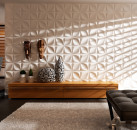
If you wish to cover the walls of your housing atlas or separate the facade of marble, there is nothing easier. It will help you in this texture finish - applying a variety of finishing materials, you can achieve various decorating effects. Such an admission will allow to hide the irregularities of the walls, create a special texture and relief of the surface, giving design uniqueness and originality.
Content
Types of textured coatings
Professional designers widely apply the texture trim of the walls. With it, it is easy to imitate in the wall covering the texture of a tree, stone, various types of weaving, trellis, tapestries, create various fantasy compositions on the walls. This effect can also be achieved independently by placing textured walls with your own hands. A rich selection of finishing materials allows creative and at low cost to transform the surface of the walls in a wide variety of styles.
Textured wallpaper
Coatings from embossed (textured) wallpapers allow us to achieve various effects of decorating rooms. With their help, you can visually adjust the proportions of the interior - "push the walls and" lift "the low ceilings. Through the use of modern technologies, the texture of such wallpapers successfully simulates various materials, aligns the irregularities of the walls and creates wonders with the volume of space.

The following options for textured wallpaper are available:
- paper - Initially, such wallpapers mimic the texture of tapestries and a sleeper due to special printing methods. Currently, the textured wallpapers for the walls have acquired a real relief. In them, the two-layer (duplex) wall coating consists of a decorative paper layer fixed on paper or flieslinic basis. At the same time, decorative relief on them create a method of embossing, artistic printing, or through the use of other technologies. Modern textured wallpapers made from high-quality material are distinguished by stable to burn out in the color, as well as wear resistance, and can serve for 5-10 years - before the next cosmetic repair. The textured decoration of walls with paper wallpapers will be suitable, including for the children's room or a bedroom, since these finishing materials are characterized by environmental friendliness and excellent breathability;
- vinyl - such wallpapers consist of a layer of polyvinyl chloride (PVC) placed on the basis of technical paper or fliseline. For this, the foamed polymer mass with special technologies is applied to the base layer, forming a factory decor. The technology for the production of silkographic wallpapers by the method of complex embossing allows you to simulate ancient wallpaper textile (the so-called slope). Vinyl wallpapers are suitable for decoration of walls of various premises, including with a mode of high humidity - kitchen, bathroom, as they do not absorb moisture, perfectly clean with various means of household chemicals, resistant to significant temperature differences. The recently appeared vinyl wallpaper with micropores have increased breathability and allow the walls to "breathe", while the water falling on their surface quickly evaporates, not absorbed into the coating. Thus, on the walls under the wallpaper, the moisture does not accumulate, therefore, the fungus will not appear under them or mold;
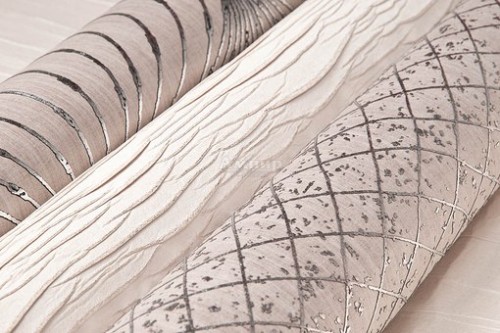
- fliselinic - such wallpapers are made of polyester and acrylic with the addition of natural viscose fiber by the method of hot pressing without the use of chemicals. Such wallpapers are environmentally friendly, elastic and are little prone to deformities. In addition, they are distinguished by excellent sound insulation properties and provide ample opportunities for decorating. Currently, phlizelin wallpaper with embossed texture in ethnic style, as well as corrugated;
- natural wall coverings made from natural materials (as sisal, cork, bamboo, jute, reed, bark of trees). Such textured wallpapers differ quite high cost. They are suitable for different premises, including with a mode of high humidity, although it is still not recommended to place them in the immediate vicinity of the bath, washbasin and shower;
- wallpaper under painting - vinyl, as well as paper with a layer of wooden chips. Such a wall-mounted coating of white, cream, greenish color differs from painted wallpapers with a pronounced relief, which will acquire its final look after applying the paint of the selected shade;
- gymelomes - are a woven or woven coating on a paper basis. Such structural wallpapers are painted with acrylic or silicone paints. Gymelomes are distinguished by high wear resistance to abrasion and exposure to detergents, so they can be used to finish frequently visited premises - corridors, halls, hallways.

Textured paint.
Interactive paints are widely used for finishing interiors in various styles, as well as for external work. This finishing material for its structure resembles a decorative plaster and is a viscous weight of white with different intersions. As the basis of textured paint, acrylic, silicate or silicone dispersions can be performed. In addition, mineral fillers of various graininess are added to its composition - the crumb of granite or marble, gas silicate, quartz sand, as well as artificial materials - polymer fibers forming a certain texture and various relief on the surface of the coating. Initially, the texture paint for the walls is produced white, while giveing \u200b\u200bit any likeholds like the shades is easy by adding a special dye (color paint) of a suitable shade. Insessions are presented texture paints for the base of the building, facade, as well as for internal works.

The textured coloring of the walls will help align small irregularities and create a homogeneous coating on them. Thus, before applying paint, the walls do not need to be aligned to the state of perfect smoothness, it suffices to clean their surface from garbage and peeling plaster, and then primed under the subsequent application of structural paint. Primer will contribute to the best clutch of textured coating with walls.
The following benefits of texture paint can be noted:
- high air permeability - even applied with a thick layer coating allows the walls to "breathe" without creating a barrier for moisture and steam;
- structural paints do not contain solvents, such a finish is safe for health;
- high frost resistance, allowing to use this finishing material for external work;
- due to the acrylic binder component, structural paints are resistant to various atmospheric influences. Such textured wall covering is characterized by high wear resistance and durability.

It is worth noting that for the textured walls of the walls, there will be a significant consumption of structural paint - about 500-1500 g / m 2. This is explained by the thickness of the textured coating, which can reach 1 cm (while the front paints are usually applied with a layer of 0.2-0.3 mm). The texture paint is applied to the walls with a special roller, in addition, it is convenient to use the textured coating with a powerful vacuum cleaner or a specialized pumping station, which can be purchased or renting.
Textured plaster
Currently, the walls are increasingly popular with textured plaster, allowing you to create various decorative coatings on the walls. Due to the presence of special binders and forming additives in its composition, it is possible to create a wall coating with various patterns and relief.

Depending on the composition, the following varieties of this finishing material are distinguished:
- acrylic plaster is made on the basis of acrylic resin. This material is sold in the form of a finished mixture that is conveniently applied to various building surfaces. Such a coating is elastic and, if necessary, hobs small cracks on the wall formed due to shrinkage. The disadvantages of acrylic plaster should include the absence of air permeability, as well as the ability to absorb and accumulate dust, because of which, with time, the facade coating can sweep off;
- in silicone plaster, silicone resins protrude as a binder component. This finishing material is characterized by high plasticity, ease of application and durability (service life - up to 25 years), suitable for mineral and other surfaces, breather and does not absorb salts, is used for external and internal works;
- mineral plaster is sold in the form of a dry mixture based on cement and sand, which must be kneaded immediately before use. Mineral crumb as part of plaster gives such a coating the desired relief. Such plaster is easy to use, even a beginner master can cope with it. The disadvantages of this type of plaster should include a short period of operation (up to 10 years), as well as the absence of elasticity and the possibility of cracking on the facade;
- silicate plaster can be purchased as a finished mixture. This finishing material is enough plastic and convenient in applying. Silicate textured coating is elastic and resistant to cracks, is a durable and breathable, possesses antistatic properties and does not attract dust.
The textured plaster for the walls of varieties of "Coroed" and "Marble" is particularly popular with the finishing - the first received its name due to the characteristic coating, resembling the wood-spinned wood, the second - due to the presence of marble crumbs and dust.

For internal works, it is recommended to choose a textured putty for the walls of fine-grained composition or plaster with granules of various grain (without much large) - such a relief finish will look at the walls of the room organically. Get a homogeneous coating coating of outer walls can be using compounds with a calibrated marble and granite filler. If there are large inclusions in the plaster, you will need to use steel ironing instead of a roller.
The advantages of using textured plastering for walls can be attributed to the ease of application and plasticity - it is easy to issue textured walls with their own hands without any experience of such work, as well as ample opportunities for decorating walls. Using this finishing material, you can create a different type of coating with imitation of marble or sandy surface, rocky relief, fantasy patterns. At the same time, the color gamut of wall finishes is not limited - you can purchase a ready-made solid solution or pick up the colors yourself, adding a kelp paint of the desired shades. In addition, the coating of textural plaster is distinguished by resistance to mechanical and atmospheric influences, durability and durability.

Technology for applying textured plaster with their own hands
Visit the suitable material, you can start designing textured walls. Since the freshly mounted layer of plaster quickly freezes on the wall, it will be necessary to work in a rapid pace, preferably together. It will be necessary to apply a dense layer of plaster on the wall and smooth it with a spatula or smooth iron, and then form a relief of finishing with suitable tools. After 10-15 minutes, the textured coating will completely freeze, and make any adjustments will not succeed.
Preparatory work
Before applying textured plaster, it will be necessary to pre-prepare the surface of the walls. To do this, old wallpapers are removed from it, peeling blots and paint, so as to get a dense and homogeneous surface. The painstaking alignment of the walls will not need - texture plaster will subsequently hobs small irregularities and small surface defects. Next to the purified dry surface, it is necessary to apply deep penetration fluid. Treat the walls in this way it is necessary per day before applying texture plaster. The primer will fill the surface microcracks and will help avoid development under the plaster and fungus.

For applying on the walls of the textured coating, ironers, plaster cells, spatulas of different sizes, special rollers, sponges, stamps and other devices for the formation of surface relief are required. Depending on your desire, as a result of such a wall processing, various results can be achieved.
Ways for applying texture
There are various ways to finish textured walls with their own hands:
- a roller with an applied pattern - this method is easy to implement and allows you to quickly get a spectacular textured coating;
- with the help of a special stamp to make a relief - it will be necessary to apply the base layer of plaster by Kelma, and then leave the print with a stamp on the surface in the right places;
- a flat roller for painting walls (the so-called sprayer) will help achieve various original decoration results. To obtain the effect of the "torn surface", you will need to apply the plaster using the Kelma, and then process this layer with a texture roller. In addition, the initial layer of material with roller can be applied, and then process it with light smoothing movements of the spatula.

Posted by texture plaster The original relief is also easy with the help of a special comb or toothed cell, sponge, cellophane package. Slightly experimenting on a small area of \u200b\u200bSquare, you can then implement the decoration effects on the walls. After complete drying, the coating can be stacked with surface color.
You can create the effect of textured walls "under a fur coat" with the help of conventional cement-lime or cement-sand plaster by splashing. To do this, it is convenient to use special devices (compressors). For the absence of such as tools, a brush or broom with a layer of material is used as tools, as well as a stick for tapping around them near the treated surface and a metal mesh through which the solution on the walls splashes.
Textured Walls - Photo