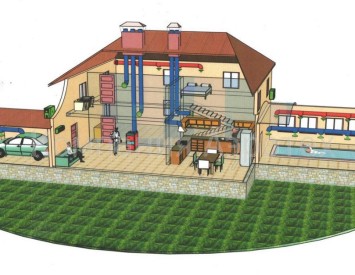
The comfort of accommodation in a private house or apartment is determined by many factors. It is no secret that the microclimate in them largely depends on the circulation of air flows. To breathe truly clean air, in the construction of housing and its further improvement it is important to carefully consider the ventilation system. If the air is sufficiently enough, it is advisable to use natural ventilation in the premises. Having spent some work and time, such a system can be installed on their own.
Content
How does natural ventilation functions
In the process of erection of any residential building, a system of natural ventilation is being developed according to a principle similar to ventilating. It is easy to organize an air flow by opening windows and doors - nevertheless, in the cold season, the possibilities of ventilating are largely limited. In addition, in some rooms, due to the lack of windows, the problem is largely complicated.
Create a consistently comfortable microclimate in different premises is quite realistic using the installation of a natural ventilation system, and it can be set to minimally. In a residential building or an apartment of the room in which the air flow is carried out is called dry (they include, for example, a bedroom and a living room). The kitchen, as well as the bathroom, is traditionally premises for which the presence of high humidity regime is consequently, it is required to organize a wet air removal. In this case, dry air comes into the house and moistened with the accumulation of excess moisture and the appearance of unpleasant odors in the premises can be avoided. Under the influence of temperature drops and pressure arises, due to the natural supply ventilation through the holes, the gaps, the windows and the air ducts inside the rooms fits fresh air. Heated light air masses rushed outward through natural exhaust ventilation, cool and fresh air comes into their place. At the same time, the impact on the thrust has the wind, the height and cross section of the ventilation channels, the presence of essences and bends, as well as thermal insulation.

A number of requirements for the arrangement of natural ventilation at home should be taken into account. It is necessary that such a ventilation system ensures:
- the presence of a permanent movement of air masses in the house - with a high-quality influx of fresh air in all rooms;
- removing contaminated air from the kitchen, as well as from sanitary premises.
This requires avoiding tangible air cooling in the winter, as well as the occurrence in the house of drafts.
The following varieties of natural ventilation systems are distinguished:
- channels (with accommodation in vertical channels), as well as without channels (such systems are used in industrial premises);
- permanent ventilation carried out by supplying an air flow through the valve system, as well as periodic - with ventilating through any intervals.
Features of natural ventilation
It is worth noting that the arrangement of natural ventilation is appropriate in the presence of really clean air outside the room. This type of ventilation is optimal for small buildings placed on an environmentally friendly territory - in such cases it will not be necessary to apply forced ventilation systems. In addition, it is necessary to take into account the type of materials used in the construction. The largest natural ventilation is suitable for brick, wooden and stone buildings, as well as for buildings from building ceramic, ceramic, gas, slag and foam blocks, self-monolithic ceramzite concrete.
Before installing the natural ventilation system, it is important to make careful planning, otherwise the microclimate in the premises may be far from the ideal. In such cases, various unpleasant symptoms may be observed (the fumes, the feeling of gravity after sleeping in people living in the house, as well as the manifestations of them allergies). To avoid penetration through the air ducts of extraneous sounds, insects, as well as fluff and dust, some improvements contribute to the system - for this, the outer walls are mounted inlet channels equipped with insulation to absorb noise, as well as a mosquito net. In addition, it is necessary to take into account the following - in the old buildings, air circulation was carried out through the existing gaps between the doors and the floor (the so-called break holes), as well as through loosely adjacent wooden frames. However, in the residential premises had to open the windows or windows for conducting.

Modern window designs, as well as the doors provide tightness of the premises, so they are often stuffy, there are harmful evaporation in the air, the reproduction of mold is observed. If you do not want to keep the windows of the windows constantly, to ensure a stable flow of fresh air, you will need to be provided in window openings either in the walls special supply valves. The stream of heated air masses from the premises is given by exhaust pipes, and fresh in its place.
Pros and Cons Natural Ventilation
The advantages of installing a natural ventilation system can be attributed:
- ease of design, due to which the probability of failures and breakdowns is minimized;
- no need to acquire special expensive equipment. I mounted it, it is possible to achieve significant savings in comparison with the installation of forced or mixed ventilation systems;
- natural air circulation is perfectly combined with the work of climatic systems in the premises;
- with the help of a well-thought-out system of natural ventilation, it is possible to maintain optimal humidity and regulate heat exchange in the house, as well as heating the unheated premises - for example, corridors, staircases.
As minuses of natural ventilation, it is worth mentioning its limited capabilities. For the normal functioning of the human body, a constant influx of fresh air is necessary, which can not always fully provide natural ventilation. With an insufficiently active air exchange in the premises can multiply mold and fungus, harmful evaporations highlighted by building materials, appliances and furniture. In the case of stagnation of air masses, in rooms you can observe the appearance of dampness and accumulation of unpleasant odors. In addition, it is worth noting the dependence on the air temperature on the street - the lower it, the colder air entering the room through the ventilation channels (and therefore the cost of heating increases - in some cases up to 40%).
Often, to achieve the most effective result, it is necessary to combine natural ventilation in the house with other types - in such cases in addition to it in places where it is necessary (as a rule, in working and sanitary premises), the mechanical supply or exhaust forced ventilation is equipped.

Arrangement of natural ventilation with their own hands
When planning, how to make natural ventilation, it is necessary to take into account the following. A similar ventilation system in a private house is organized by equipment of exhaust channels and installation of supply valves. In the construction process, the construction will be required to provide ventilation channels, so it is necessary to plan their arrangement before the construction of the construction. Depending on the specific conditions, at the design stage, it will take to develop a natural ventilation scheme and carry out the necessary engineering calculations.

In apartment buildings, ventilation channels are combined into blocks. In private buildings, combine ventilation flows there is no need, otherwise the effectiveness of the functioning of the ventilation is somewhat reduced. Each canal from the room should be displayed on the head of the roof. In order to reduce the impact of the wind on the functioning of the ventilation system, it should be positioned in a certain way relative to the roof surface. On one floor it is more convenient to position several channels nearby, combining them into a single riser. Such channel blocks are usually placed inside the carrier wall or attach to it. Similar risers for ventilation are laying out of stone or bricks, in addition, ventilation channels can be placed inside the hollow concrete blocks. In wooden and frame buildings, the ventilation systems are equipped with plastic or steel pipes placed in the box.

Stages of work
In fact, the sequence of actions for the installation of natural ventilation with their own hands is reduced to the following steps:
- performance of technical calculations - calculating the required minimum volume of supply and exhaust air according to sanitary standards. In accordance with the results of calculations, the number and height of the ventilation channels should be planned. When performing the calculations, the number of people who will be indoors, as well as the necessary amount of supply air, should be considered. The execution of these calculations is easier to entrust professionals;
- selection of a suitable type and cross-section of air ducts according to the results of calculations. For the arrangement of natural ventilation, rigorous, as well as with a rectangular cross section of rigid air ducts;
- development of an indicative placement of ventilation channels;
- choice of places for air intake and installation of equipment;
- purchase of the necessary materials and fixtures required for installation of ventilation;
- installing the ventilation system.

Where do Natural ventilation channels need
When planning the ventilation arrangement, it is worth considering that exhaust channels will need to be equipped in the following places:
- in the kitchen, bathroom and laundry;
- in the storage room or dressing room - in cases where they need to enter the living room. If their doors go into a non-residential room, a trimming valve in the window opening should be provided or on the wall;
- in rooms separated from existing ventilation channels with several doors;
- exhaust and supply ventilation will need to be equipped in boiler room;
- over the first floor, if the entrance door is provided with the stairs, the ventilation channels should be provided in the above rooms - either, in the event of their absence, in the lobby or in the corridor. If such a door is absent, exhaust ventilation channels must be provided in all rooms.

In other rooms, in the absence of an exhaust channel, you will need to equip the supply valves placed in the window opening or on the wall. It is necessary to provide exhaust channels from rooms with high humidity regimen. Natural ventilation should also be provided under the floor of the first floor board, as well as inside the ground space. If there is a basement, which is actively operated and heated, it should be equipped with ventilation in it similar to the first floor. It is also worth considering the following - if the descent in the basement is located inside the house, it must be separated from the residential premises using a sealed door.
Natural ventilation - Photo