Electric warm floor can be used not only as the main heating system, but also as an additional source of heat. This type of heating room has its advantages and disadvantages. Consider the features of how to choose an electric warm floor.
Content
Advantages

- Warm floors allow comfortable to distribute the temperature in the height of the entire room. It does not matter whether the main system is selected or additional. Thus, the main scheme makes it possible in any room where such heating is used to automatically maintain the necessary temperature with high accuracy. If an additional scheme is used, then the same characteristics will have local heating areas.
- In contrast to water heating, electric electric devi floors and coatings from other manufacturers, have less inertia, i.e. After turning on heating, the temperature in the room will reach the mark installed on control elements.
- If you use an additional circuit of electric heating floor, you can perform laying of the floor covering on top of the old one. For example, it is so possible to mount in rooms where the coating is made using porcelain stoneware or ceramic tiles, such as in the bathrooms, bathrooms and kitchens. In this case, usually heating electrical mats are used.
- If you need to repair electrical heating, it will not be necessary to engage in the opening of the floor. Taking advantage of special equipment, it is possible without much difficulties to determine in what kind of place there is damage to the thermal cable. To restore it, you will need to operate only a small section of the floor. Repair the cable can be taken advantage of special couplings. When touched to the damaged electrical cable or its parts conducted by electricity, the protective device will almost immediately turn off the voltage.
- The merits can also be attributed to the fact that these floors can last long enough. Some manufacturers call the life of their products up to 50 years. At the same time, only environmentally friendly materials are used in the manufacture of coatings.
disadvantages

- The main disadvantage of this type of heating is that it consumes quite a lot of electricity, especially if the warm floor is used indoors as the main heating system. Because of the same reason, restrictions on the use of such coatings in homes, which are more than ten years old. Here you can use such systems only as additional heating. This is due to the fact that in old houses, power supply is calculated according to outdated standards. Also in this case, power cable overload is possible. In general, before using a warm floor electric even in houses built on modern technology, it is necessary to make sure that the wiring placed in the apartment can move the load that this heating will have. Permissible load parameters can be found in a special table. If the existing wiring does not meet the established standards, you will need to connect the system using the other electrolyne and a separate machine.
- Some varieties of such heating are unevenly distributed in the room the temperature field. And if parquet and laminate was used as an outdoor coating, then he could deform from time to time. That this does not happen, it is necessary to strict adherence to the installation technology and floor installation. It is especially important to keep the depth and step of laying thermal cables.
- Due to the fact that such heating has increased electricity consumption, it requires considerable costs. For example, the cost of electrical heating of the floor whose area ranges from 10 to 15 square meters in two years of use may be greater than the cost of the equipment itself.
- Some experts believe that such heating systems have a harmful electromagnetic effect on the human body. True, there is no unambiguous opinion on this. Today there are quite a few people who disagree with this statement. They are convinced that the warm floors of electrical heat and coatings from other manufacturers are environmentally friendly and meet all established requirements. Moreover, according to some studies, induction and tension testimony in rooms equipped with warm floors, as a rule, do not exceed background values.
How to choose a type of flooring
- Before choosing everything you need for electric heating floor, it is important to determine the type of coating. It must satisfy the requirements of wear resistance, strength and aesthetics.
- It is recommended to use such materials such as linoleum, laminate, parquet or board, as well as ceramic tiles or porcelain stoneware in the design of the warm floors. So, ceramic tiles and porcelain stoneware are capable of carrying out well. And at the same time they have a small proportion of thermal expansion. Therefore, these materials are considered the best.
- When choosing a linoleum as a floor covering, one that does not have insulation.
- When using parquet for the floor, its wood should be as succeeded. Otherwise, it can be deformed during operation.
- When choosing an outdoor coating, it is still necessary to take into account that the quality of varnish and glue is high enough. By this you avoid the appearance of evaporation harmful to health during heating.
- Even before buying, you need to know in which temperature range can be operated by lacquer coatings or adhesive connections. Such information can be specified on the package. If not, you will ask this to the seller, where they bought a warm floor electric.
- The main criterion for which you need to choose a floor covering is the presence of a special marking indicating the possibility of its use at a temperature that is a working for the heating system.
- To cover the electric floor, you should not choose a plug and thick carpets. The fact is that the plug is known for its low thermal conductivity and is also afraid of high temperatures. As for carpets, they will play the thermal insulation function in this case.
How to choose cable

It is the thermal cable that is considered the most important element in a similar heating system. This should be clear from the heat-insulated floor of the electric. After all, thanks to the cable, electricity is converted into thermal energy. Such a cable is very similar to a regular conductor. It usually has shielding. In addition, as the usual wire, the heating cable may contain one or two veins.
Than such a cable differs from the usual wire, it is electrically resistance of heating veins. It was in it that the main lived, as a rule, was made of nichrome, and this material is known to have sufficiently high resistance. Thanks to nichrome, such a cable plays the role of heating element. In ordinary wires, this lived is made, on the contrary, from materials with the least resistance.
In general, this cable is usually chosen in the rapid power indicator. It is mistaken to think that the more the rapid power, the more effective the system will warm. The fact is that when laying near the surface is carried out, air cavities may form, which are not allowed to leave warmth, which sometimes leads to overheating of the cable material, and this can already cause its failure. In addition, with an increase in the value of the cable strength, the length that falls on a specific area is reduced. A situation may occur when an increase in the distance between individual threads will lead to uneven heating. The distance between adjacent threads at cables of different manufacturers is different. It usually varies from 50 to 120 millimeters. If it is less, it may cause the problem of cable overrun, as well as the risk of rapprochement of threads to an invalid value.
Heating cables with two cores are recommended to use when heating the children's room, a living room or a bedroom. Single cables are best used as a heating of a bathroom and toilet.
Cables with one residential and two veins differ in the installation and design. Thus, when installing the first - copper wiring, which connect the cable with a power grid, is usually connected on both sides. In the event that the two-hind cable is mounted, then these wiring are usually connected only on one side, and on the other hand, heating and auxiliary cores must be laughed and isolated.

The cable with two cores has a number of advantages over one-core:
- So, there is no need to connect both of its end to the device that maintains the temperature. Thanks to this, it is much easier to choose the cable strip track.
- In addition, it is believed that the level of electromagnetic radiation is lower than that of one-core.
Cables that were described above are also called resistive. But these are not the only existing types of cables. There are also self-regulating heating. They differ from resistive, both the appearance and the principle of work. In such a cable there is no heating vein. Instead, there are two veins that are conductors. In this case, the heating element is considered a matrix of polymeric materials. It is thanks to her that these cables are self-regulating. This is achieved due to the semiconductor properties of the matrix. When the temperature of this heating element increases, its conductivity is reduced, which in turn leads to a decrease in the flow through the current. As a result, thermal power decreases. In the case of a decrease in temperature, the value of thermal power, on the contrary, rises.
Self-regulation allows such cables not to be afraid of local overheating, which suffer resistive. Therefore, when the cable laying does not need to be taken into account, where the furniture is located in the room. Their main disadvantage is a relatively high price. Therefore, they were not widespread.
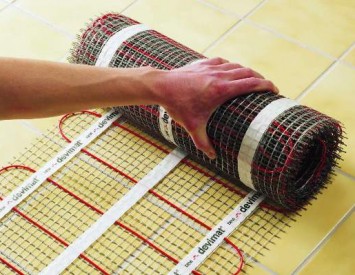
In addition to two types of cable, there are still heating mats on the construction materials market, which are based on thin low power cables. In mat, they usually fit in the form of a snake and attached to the grid of the polymer material. Mates differ in power. Depending on this, they can have a width of 400, 500 or 800 millimeters. At the same time, their length can be from 0.5 to 25 meters.

Advantages of mats:
- Heating mats are much easier to mount than cables.
- High heating ability.
Disadvantages:
- If the floor has an unusual geometry, then in this case these heating elements are not suitable.
- Their cost is usually higher than the cost of the electric floor based on the cable.
Like heating cables and mats today are available in two types: in the form of a finished mounting kit and as a separate product.
This assembly set usually includes:
- Cable or mat.
- Thermostat with a thermal sensor.
- Corrugated tube (needed to install the thermal sensor to the floor).
- Installation and operation instructions.
How to choose a thermostat

The thermostat is one of the most important components in Rehau warm floor systems. Electric floors of other brands also mean. These devices can be both programmable and unprogrammed. They are superimposed and embedded in the opposite or mounted in the electric cabinet on metal products.
For the heating of the bathroom, toilet, the hallways, it is customary to use simple electrical heating systems in which unprogrammed thermostats are installed. In such devices, the temperature is adjusted by using a multi-position switch or using a resistor. In the first case, switching occurs stepdly, and in the second smoothly.
As for programmable thermostats, they provide more opportunities to manage the heating system. So, they allow not only to set the temperature, but they also make it possible to program the parameters of the work that will only have a certain period of time. For example, it is possible to set the parameters for the power on and off under certain conditions, it is possible to install different temperature ranges for different times, i.e. The device is allowed to set different work programs. In this case, these programs can be changed manually. Obviously, such thermostats are more expensive than unprogrammed.
If it is necessary to establish a thermostat in the electrical cabinet, then there are devices that are mounted on special profiles, also called DIN rails.
Such profiles are designed not only for fastening the thermostat, but also other devices and electrical equipment. Metal profile is usually made of galvanized steel with a thickness of 0.9 millimeters. Its length most often is 70-1000 millimeters. Over the entire length every 15 millimeters there are holes. DIN Wheels must be sure to comply with Gosstandart.
Sometimes the thermostat power is missing. In this case, you need to purchase a magnetic starter, which will work under the control of the thermostat. Instead, you can install a hotel thermostat for each section.
How to choose insulation

Any warm floor system must be thermally insulated. It is necessary that the power of the heating system is not spent by heating overlap or soil. Different materials can be used as a heat insulator, but it is best to stop their choice on extrusion polystyrene foam, 20-30 millimeters thick and 30 kilograms density on M3. If it is planned to heat the ground floor in this way, then the thickness of the thermal insulation is required 1.5-2 times more.
Often used thermal insulator, which has a reflective foil layer. The fact is that there is an opinion that the foil not only reflects heat, but also helps to redistribute heat from the cable over the floor surface. But this is not all experts. There are people who are against the use of such thermal insulation, as it is believed that the foil can completely collapse after three, a maximum of five years, when it is under the influence of an alkaline medium of the cement solution. This problem is especially important indoors with high humidity. In addition, for the proper operation of such a thermal insulator, an airbag must be present between the foil and the heating element, and it is almost impossible to do it into the coating with electrical heating.
Warm floors: Characteristics
It is important to be able to properly pick up the warm floors. At the same time, prices do not have such a leading importance as the features of a particular apartment or at home. If the choice is made correctly, the system will produce heat that is enough for heating the entire area of \u200b\u200bthe room. In addition, it will be easy to install and economical for electricity consumption.
Today there are several types and stamps of electric heat floors. Caleo is one of them. Each of the varieties of warm floors has its own configuration and a wide range of power.
There are types of electrical flooring:
- Cable.
- Cable based on.
- Film infrared.
Consider each of these options a little more.

Cable floor
In this type of floor, the main heating element is a cable that turns electrical energy into thermal. This system is the most difficult and time-consuming on installation. The fact is that when it is installed, you need to lay a cable with a certain step. And at the end of the work it will be necessary to fill the layer of the screed.
Advantages
- The heating cable can be used to install indoors that differ in a complex perimeter.
- In addition, it can be used to heat some exterior elements of a private house, such as sings, roofs and wastewater.
disadvantages
- The thickness of this layer is usually about 50 millimeters, which is why the height of the room significantly decreases. This is the fundamental point when booking a cable floor in apartment buildings.
- This type of warm floor makes it impossible to lay it under plumbing and furniture.
Cable floor based on
This type of floor has a small thickness and appearance is a mesh mat, with a heating cable pinned on it in a cross section of about 2.8 millimeters. Compared to the cable floor, this type of floor covering is much easier to assemble due to the fact that the heating wire is laid and fixed on the base. Thus, for mounting you only need to decompose and fix mats.
Due to the fact that the thickness of the adhesive solution is quite bulky, this type of floor is most suitable for installation under the tile. Then mats will be directly in the thickness of the layer. If this type of warm floor is installed under carpet, laminate or linolyum, it will also be needed to fill the screed, but it will not be so thick, as in the case of cable floors, it is usually about 30 millimeters. It is important that the cable floor on the basis does not fit into zones where it is planned to put pressure on plumbing or furniture in the future, since their deformation is possible when heated.
Infrared film
This is the name of a warm floor based on a two-layer infrared film with carbon heating elements. The film usually has a thickness of about 0.5 millimeters, which is quite enough that the height of the room has not changed noticeably. Such a coating is considered to be the most energy-saving option of warm floors. Its use can save about 60% of electricity. In addition, the installation of such a system is the easiest of all existing options. To do this, you just need to spread the film on the base of the floor. The fill of the tie is not needed. Warm hollow floors based on infrared film, thanks to "dry installation" can be installed on any surface, including vertical, horizontal and inclined.
To make a high-quality electric floor with minimal financial and labor costs, it is necessary to select the coating, strictly corresponding to the needs of the technical characteristics of your home. It is also important that the installation is not complicated for execution on its own.