Chimney is an important part of the boiler equipment that ensures the safe removal of combustion products. It responds not only for the removal of spent gases, but also for the flow of oxygen, without which the burning is simply impossible. There is a large selection of chimneys for solid fuel boilers from various materials. In this article, we will look at which of them are most effective, as well as tell how to make chimney for a solid fuel boiler with their own hands.
Content
Features of choice
Chimney is an integral part of the heating system. Without him, no boiler will not work, on what kind of fuel it functioned. The main task of the chimney lies in the allocation of flue gas and fuel combustion products from the house outward. Without it, the whole smoke will go to the room, creating a life-threatening situation. The choice and installation of chimney on a solid fuel boiler is the responsible task at which attention should be paid to the smallest nuances and possess certain knowledge and skills.
Traction force
One of the main criteria when choosing a chimney is the strength of the thrust that it is capable of providing. It depends on it how efficiently and fast exhaust gases will leave the room, as well as the overall productivity of the heating equipment. The thrust in the chimney pipe is determined by the speed of movement of gases, which are formed as a result of the collision of air flows with different temperatures and atmospheric pressure drops.

The magnitude of the force of thrust depends on many factors, but the main ones are the shape of the chimney (the presence of bends and length) and the cross section of its pipes. To get the most good craving, the chimney should be straight and narrowed towards the top. The greater the fibers of the pipe, the weaker the thrust, since the air is required more effort and time to go from the boiler to the exit. For this reason, when installing the chimney for a solid fuel boiler, it is necessary to try to make as few turns, bends and slopes as possible. For this, the heating equipment is better to put in the room, from which you can immediately remove the pipe out. Depending on the characteristics of the boiler, it can be a kitchen, an entrance hall or a separate utility room - boiler room.
Parameters that determine the efficiency of the thrust:
- If the chimney is constantly buzzing or periodically begins to make noise, it is recommended to install a special damper in it (Sewber). It will help regulate the strength of thrust and will achieve the highest possible indicators.
- If you notice that the furnace gases and smoke gradually penetrate the room, it means that the chimney has a low thrust. Typically, such signs are manifested during the first test. In this case, it is necessary to revise the structure of the structure, make it more direct and eliminate possible malfunctions.
- To get a consistently good thrust, the height of the chimney for a solid fuel boiler should be at least 5 m. At the same time, the pipe that comes out of the roof should be climbing at least 1 m above the skunk beam.
Features of structures
If you are familiar with the basics of physics, you should know that smoke comes out of the coaching compartment of the boiler Spiral-shaped, and its speed gradually increases. This phenomenon necessitates the need to arrange the most direct and vertical chimney. If this is not done, the trajectory of the smoke movement will be broken, and the thrust will weaken.

You should also take into account the shape of the section of the pipe for the chimney of a solid fuel boiler. The optimal form is a circle or oval. Square and rectangular pipes cannot provide the most efficient elimination of the flood gases. In this case, the swirls will form, the nagar, soot will quickly appear, the pipe will be clogged, the thrust will be insufficient. The choice of the shape of the cross section and the length of the chimney is determined by the heating system used, the type of boiler and the characteristics of the building.
Types of chimney
In any solid fuel boiler, the temperature of the fuel gases can vary from 180C to 500C. Naturally, not every material is capable of withstanding such extreme conditions, therefore, special high-strength and temperature-resistant raw materials use for the manufacture of chimneys.
Varieties of chimneys, depending on the material:
- asbestos-cement;
- brick;
- ceramic;
- metal;
- glass.
Each of the species is characterized by operational characteristics, cost and installation method.
Asbestos-cement chimneys
Asbestos cement pipes were used everywhere for the construction of chimneys of all 20 years ago, but their more advanced materials were very quickly supplanted. Despite the low cost, such chimneys often could not withstand the high temperature of the combustion products and burst.

In addition, asbestos-cement pipes are actually installed only on vertical sites, because it is impossible to bend them. They weigh a lot, and to cope with the installation of our own forces without the use of large lifting equipment is quite difficult. Another serious disadvantage is the inability to make absolutely hermetic junctions between the elements. This is considered a gross violation of the rules of exploitation of chimneys in private houses.
Due to the specific composition of the pipe in its wall, the condensate is absorbed, which very quickly destroys it. In other words, even the pipes from asbestos cement and cheap, they are very unreliable and for chimneys to use them is extremely not recommended.
Brick chimneys
If you still want to save as much as possible, but not to sacrifice the quality, you can build a brick chimney. It will cost cheaper than the analogues listed below. It is worth noting that only burned fire-resistant brick (red or chamotny) can be used to mount such a chimney. Such a pipe will withstand any high temperatures and even the fire of soot inside.

But if you remember, we said that a good chimney with a steadily strong burden can only be a round or oval section. It will not work from bricks such a pipe - it will be or square, or rectangular, and therefore the accumulations of soot and swirls cannot be avoided. In addition, the brick itself is very heavy, and when taking into account that the length of the chimney should be about 5 m, the burden on the foundation will be quite serious. Before you choose your choice on this option, make sure that the foundation of the house will withstand the extra weight of several centners. For heavy brick chimney, it is necessary to build additional durable reinforced concrete overlap. In general, such work requires professional skills, so it is often trusted by sovetrics.
The rough surface of the bricks will inevitably accumulate soot, so the chimney will be required to be cleaned periodically. In the past, even a special profession of chiffs existed in European countries, because in all houses there were brick or stone chimneys. This profession is alive to this day, but the services of chicks are resorted only in cases of strong blocks.

Masonry features:
- The chimney masonry should be performed only from full-scale brick.
- For fixation uses a conventional cement-sandy solution.
- The walls of the chimney are laying out in the Pollipich so that their thickness is from 12 cm.
- The dimensional and ventilation channel dimensions must be multiple brick dimensions plus the width of the vertical seams (cross section 140x140 mm, 140x200 mm, 140x240 mm, etc.).
- The exhaust gases should not be too cool in the chimney, so it is better to be placed in the masonry of the inner bearing wall of the building or attach to the wall. Those sections of the channel, which will pass through unheated rooms, for example, the attic or storage room, it is necessary to wind out outside the non-flammable thermal insulating material (usually make mineral wool).
Brick chimneys are perfect for solid fuel boilers, as they supply the exhaust gases of high temperature, which does not allow condensate to form. On the contrary, if we build such a chimney for a liquid-fuel, pellet or other boiler that is permanently operating in the mode of slow burning, then condensate will quickly destroy the brickwork.

Modern designs of boilers are distinguished by a rather low temperature of the exhaust gases, so the brick chimney is more suitable for old models or conventional firewood furnaces. The exhaust gases are saturated with gray, which, mixing with condensate, forms a destructive sulfuric acid. If you have noticed dark wet spots on the walls of the chimney, then sulfuric acid has already started horrible.
Useful advice: To connect the brick chimney to the boiler with low temperature of the exhaust gases, you need to insert a special liner in the form of a metal or ceramic pipe.
Ceramic chimneys
These chimneys can be used for any boilers, including solid fuel, since the material of the pipes are immune to extremely high temperatures and an aggressive chemical environment. This type of product is considered the most durable and qualitative, as evidenced by its high cost.

Depending on the permissible temperature of the exhaust gases, ceramic chimneys are classified as follows:
- For solid fuel boilers, pipes are suitable that can withstand a maximum of 600-650c. They are resistant to the fire of soot deposits and can be used in a dry state.
- For liquid-fuel and gas boilers, it is necessary to use pipes that carry out the maximum 400-450c capable of functioning in the wet state. They have special taps for condensate.
Important: The peculiarity of the ceramic pipe is that it absorbs condensate, and therefore when installing should provide high-quality ventilation of the outer walls.
Since the walls of the ceramic chimney are completely smooth and even, they almost do not accumulate soot. It is very convenient to clean them, and it will have to do it quite rarely. For assembly, a variety of elements are used: pipes with a length of 60 cm to 1 m. Connect them between themselves through the shaped parts and a special adhesive heat-resistant mastic.

The image below shows a chimney device for a solid fuel boiler. Make such a system itself is quite difficult, so it is better to charge the work by a specialist. In addition to the ceramic pipe itself, it is necessary to put the thermal insulation material so that the gases are not cooled too quickly and do not provoke the appearance of condensate. You should also build a shell from concrete modular blocks with ventilation channels and openings for vertical reinforcement. Ceramic pipes need to be placed in special vertical channels, for the construction of which hollow bricks or concrete blocks take. The channel itself can be placed in the ventilating unit of the building. In concrete blocks, in addition to ventilation channels, there must be holes for mounting reinforcement. Speaking over the roof part of the pipe must be reinforced in obligatory.

The insulation around the pipe is needed not only to prevent too fast cooling of exhaust gases, but also to protect the surrounding structures from fire. Mineral wool is best suited as thermal insulation material. It is inexpensive and has due toughness resistance.
Metal chimneys
Metal chimneys today are perhaps the most popular mainly due to ease of installation. However, their service life is significantly lower than in ceramic products, and the cost is sometimes higher than the price of a good brick or ceramic chimney. For the manufacture of pipes, stainless steel is used with a thickness of 0.5 mm, capable of withstanding the gas temperature to 400-450c and the effects of condensate with gray.

Important: For solid fuel boilers, it is necessary to choose pipes from the heat-resistant steel with a thickness of at least 1 mm.
Despite the small period of operation, steel chimneys are in demand, since very simple in installation, weigh little and do not require the strengthening of the base for installation or equipment of Ventkanalov. If necessary, they can be easily repaired or replaced one of the plots, without disassembling the entire structure.

There are several varieties of steel chimneys:
- Single pipes - they can be installed in a special in advance equipped vertical channel. Features of the design are the same as the ceramic chimney (insulation, ventilation). Single chimney is suitable for repairing brick and adjusting it for a gas boiler. To do this, the pipe must be simply inserted into the canal. Such chimney is quite realistic to make it yourself made of leaf steel.
- Two-wall sandwich tube - a prefabricated design of finished parts. In essence, one pipe is located inside another, which performs the function of the protective shell. The space between the two pipes is filled with heat-resistant heat insulating material. For the manufacture of the outer tube use galvanized steel or stainless steel. Such chimneys are very popular, because they can easily be assembled by the type of designer, and can also be installed even in homes where special chimneal channels are not provided. Even if you bring them to the roof along the outer wall, it will look neat.
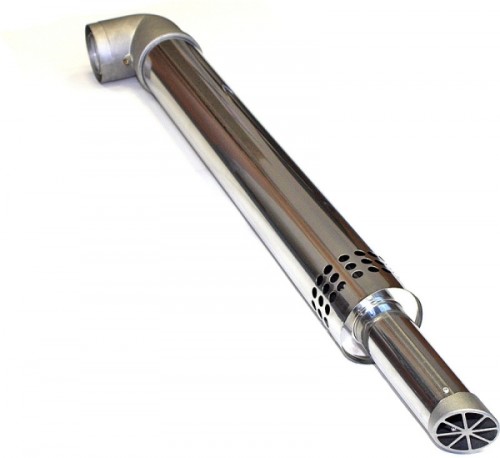
- Coaxial chimney - designed for heating equipment with a closed combustion chamber. The design is a pipe placed in another pipe. The internal channel takes exhaust gases, and the outer serves oxygen to maintain combustion. Because of this efficiency, the cost of coaxial chimneys is quite high.

Glass chimneys
It is difficult to believe, but the chimney can be made even from glass. It is clear that such an exotic product is unlikely to get at home. Nevertheless, factory glass chimneys are the most effective than all the analogues described above. They appeared relatively recently, but immediately demonstrated their exceptional qualities. Since the glass is not at all corrosion, the condensate is not terrible. It is easy to clean if you have to do it - a smooth glossy surface almost does not accumulate soot or soot.

The chimney from glass is the safest and most reliable, however, he has its own minuses. The main one is the proceedable value and a specific installation that requires the presence of a professional. However, compared to the advantages, the amount spent on the glass chimney will pay off in several years.
Montage rules
From everything written above, it is possible to conclude - to know how to make a chimney for a solid fuel boiler, you need to know the characteristics of the material used, have a clear action plan and the pipe gasket chart from the boiler to the roof. Make such work itself, and even without proper skills, almost unreal. It is much easier and safer to purchase a finished product in the store and collect it or invite a specialist.

Here are some recommendations, how to make a chimney for a solid fuel boiler:
- Always mount design elements, moving up-up.
- If you use tees, taps or other similar elements, fasten them with metal clamps. Ensure that the joints of the joints be outside the floors.
- For tees, install brackets for support.
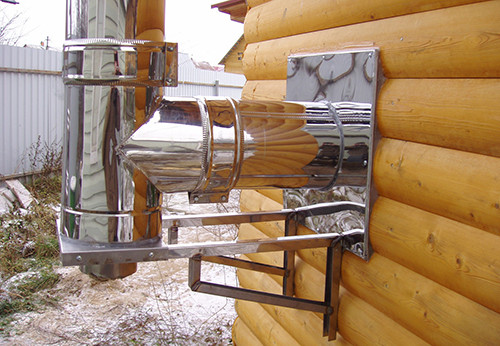
- After every 2 m chimney, attach it to the wall, having previously convinced that the pipe does not bend.
- Do not allow the channel to come into contact with any communications, whether it is a gas pipe, electrical wiring, etc.
- When you derive chimney through the roof or overlaps, keep the distance at 15 cm between the insulation pipe and 30 cm - without isolation.
- If when installing the chimney, do not do without creating a horizontal site, make sure that its length does not exceed 1 m.
- The chimney diameter for a solid fuel boiler should be calculated in accordance with the characteristics of the heating equipment (its power), the length of the channel and the characteristics of the building.
- When installing the chimney, take the fact that the design can be deformed due to regular temperature loads and drops. So that it does not hurt the entire system, install a flexible adapter. If you did not set it for some reason, attach the pipe to the bracket is not too tight - leave a stock of 10-15 mm in case of temperature movements.
- For roofs made of combustible materials, it is necessary to establish a spark-like on the chimney pipe. It can be bought or made independently made of metal meshes with cells no more than 5x5 mm.


So that the chimney serve you for a long time and did not break, take a rule at least once in half a year to look into the pipe, check its condition and clean if necessary. Finally, we suggest watch a video about chimneys for solid fuel boilers: