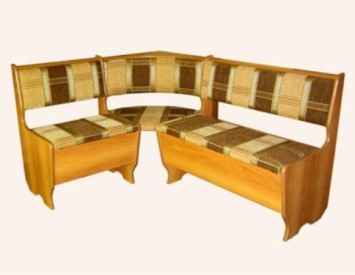
This detail of the interior of the kitchen has become quite popular in the 70s of the last century. Small urban apartments in millions of cities spawned demand for comfortable and multifunctional furniture. The kitchen has become a real discovery, because it is quite comfortable with its small sizes. Usually under the seat there are niches in which kitchen utensils can be hidden, which is especially important in conditions of small rooms. In addition, thanks to the kitchen corner, people can sit around the table quite compact, without having a large number of stools.
Content
One of the reasons for the great popularity of kitchen corners is a relatively low price and simplicity of design. If there are small skills to work with a tree or chipboard, as well as a set of tools, such a design can be made independently. It will not take a large number of time, but it will be able to save enough funds, because in the price of a finished soft corner for the kitchen, up to 70% takes the cost of services for its assembly. On how to make a kitchen corner with your own hands - hereinafter.
Necessary materials and tools

Before starting work on the manufacture of a kitchen soft corner, you need to make a sketch and choose the material.
To prepare the sketch, you need to think through the Sofa Corner location scheme in the kitchen. It should not interfere with the free move around the room, close access to communications, pass to the window.
When developing a sketch, it is necessary to take care that the seat is convenient for all family members, both in height and in depth. To do this, it is enough to remove the measurements from the chairs in the apartment and take the same height.
The standard corner consists of two soft sofas, which are interconnected by the connecting corner. Under the opening lid of the seating is a niche.
Material that will be needed for work:
- For the manufacture of a carcass, a chipboard is required. When mounting the facade parts, a laminated plate is used, for hidden - polished. This reduces the cost of work.
- So that the ends of the parts of the corner look presented, they are processed using an ABS edge of ABS 2 mm.
- The seats and backs of the corner will be covered with leatherette and furniture foam rubber for the convenience of seating on them.
- Special plastic spyers will be installed on the corner stands, so as not to spoil the flooring and protect the chipboard from the exposure of moisture.

To connect the parts of the corner, it is necessary to purchase accessories:
- Loops for opening parts. The most suitable details for the manufacture of furniture are the so-called "piano" loops.
- Confirmates. These are special screws that are used to assemble furniture. Their head is pulled under the hex key, so a special hex key is needed to work with them.
- Sucks. These details are used for invisible fastening of parts. They are small wooden tubes. In the details that need to be connected, the holes with a diameter of slightly smaller than the diameter of the drain itself are drilled. Then a little glue is poured into the holes and fasteners are installed.
- Furniture corners. Steel corners required to give additional stiffness of the structure.
From the tool for such work will need:
- Electrolzik.
- Screwdriver.
- Electric drill.
- Rule, roulette, square, simple pencil, etc.
When all tools and materials are ready, it is necessary to prepare the place of work. Remove all the extra things so that they do not interfere.
To cut the same figured elements, it is better to prepare a template.
Kitchen corner do it yourself. Step-by-step instructions for the manufacture of a large sofa

The dimensions of the large sofa are as follows:
- Height - 800 mm.
- Length - 1000 mm.
- Depth - 400 mm.
Based on these sizes and the main elements will be cut.
The sofa consists of several elements:
- Sidewalls. The main bearing parts on which the entire design of the corner will hold. In order for it to look more attractive, the sidewalls make with milled radii, but it may complicate the work, so if there is no big experience, it is worth making a little easier. After cutting to the end, the parts are treated with an edge that will prevent outlapsing.
- Facial part of the niche. This part is made from the laminated chipboard with the glued paper edge. There is no point in the edge to use the edge, since this detail will not test. DSP plate thickness will be approximately 16 mm. It is enough to ensure the details necessary hardness. The front of the niche is installed at an angle of 10 °.
- Wall and niche days. For them, a polished chipboard is used, since these details will be hidden from the eyes, and therefore it makes no sense to use an expensive laminated plate.
- Planck seating. It will be attached to the seat cover, so that it can be convenient to lift it. The cover will be connected to the bar with piano loops. Since this is a facial part, make it made of laminated chipboard. To the sidewalls, this item will be attached using a pair of ducts on each side. This will make the fastening of imperceptible and more accurate.
- The back is also made of polished chipboard, as it will later be covered with leather and foam rubber. The size of the back should be slightly less than the distance between the sidewalls due to the subsequent tightness. To the side details, the back is attached using a pair of confirmates. The additional strength of the back is given steel corners that connect it with top and stubborn straps. Mount the corners on the self-tapping screw.
- Top plank. One of the most important details. It serves for a screed sidewall and for fastening the back. The top plank of their laminated chipboard with a paper edge is manufactured.

How to drag the kitchen corner do it yourself
Usually, for the convenience of seating on the sofa, the back and the seat cover are surrounded by foam rubber and leatherette. It makes no sense to use a fabric for upholstery to the upholstery of a soft corner, since the leatherette is better cleaned and does not absorb fat and other pollutants.
To cover the seating, a piece of foam rubber in the size of the seating is cut. For the bending of the front edge, the tolerance of about 20 mm is left on the foam rubber. On the side parts of the seating to do this is not necessary, as the lid will be badly closed. Standard foam rubber density for soft corner upholstery is 38 kg / m 3. It is quite enough for the long service of the product while preserving the surface elasticity. Usually such a material has a pinkish shade. Foams with a thickness of more than 50 mm are quite difficult to cut off exactly with a conventional knife. In such cases, nichrome thread can come to the rescue, heated to high temperature. Material lesser thickness is quite easily cut by a typical shoe knife.
The carved piece of foam rubber is glued to the surface of the seat using a special glue. This is done so that it does not move in the process of the cover of Dermatin.

The sheath itself does not require special effort. By surface size, taking into account the thickness of the foam rubber, a piece of upholstery material is cut, its edges bend on the opposite direction and fixed by the stapler with a step of no more than 20 mm. Corners are gently wrapped and also fixed with several brackets.
After graduating from the preparation of all necessary details, a large sofa is collected in a single design.

The manufacture of a small sofa is not fundamentally different from the large detail described above. The only difference is the dimensions:
- Height - 800 mm.
- Length - 600 mm.
- Depth - 400 mm.
Kitchen corner do it yourself. Manufacture of the connecting part of the kitchen corner

Product dimensions:
- Height - 800 mm.
- Length - 450 mm.
Order of work:
- Since this part has an angular shape, its manufacture most often causes difficulties from those who do it for the first time. For the backrest, two curly resistant strips are cut, which are cut with an electrolybiz. The front part of the planks should have a rounding to install three details of the back.
- The corner of the stubborn slats should be cut to put the connecting portion to the wall. Since these details will be visible, the material for their manufacture will serve as a laminated chipboard. The ends need to be treated with an abs by the edge, as they will be subject to additional load.
- Stubborn strips are attached to the sidewalls of two sofas using confirmates. There is an edge of stiffness from a polished chipboard between two stubborn planets in the center of the corner, which will serve as an additional focus for the central detail of the spinning part.
- Seat is also cut with an angular position. The size of its side parts must correspond to the size of the sidewall of the long and short sofas.
- There is one more rigidity from the laminated chipboard between the seating and medium stubborn spacers.
- The back of the connecting part will consist of three parts. At the same time, its central part should be in the form of a trapezium to make it necessary slope.
- Pre-installation of seating and elements of the backrest, these parts are fought in foam rubber and leatherette. The process of upholstery is no different from the above-described work with the seat and the back of a large and short sofas. True, it is worth noting that due to the wrong form of items to do it will be a little more difficult.
- Details of the back to the stubborn placams are screwed with furniture corners, top and bottom. In this case, the back will keep tightly.
- After the assembly of each of the elements separately, the kitchen corner is installed on its workplace, aligned and is assembled into a single integer with furniture bolts.
In the manufacture of a kitchen corner, you can vary the size of the product depending on the configuration of the room.