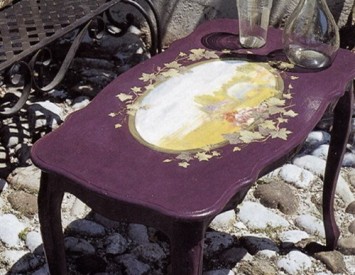
The modern market is flooded with a huge variety of materials for decorating the room, furniture, which makes it easy to update the old coffee table without resorting to the services of professionals. In addition, a variety of species, special effects used during decoupage, allow you to achieve the harmonious entry of an updated table in any interior style of the room.
Content
How to update the coffee table?
Quite often in life there are situations when you get a table, and after the expiration of a short time, he begins to annoy the faded design. However, it is not necessary to hurry, because today there are so many products that can easily change the style of the coffee table ready for emission. At the same time, among the most common decoration methods, it is worth highlighting:
- decoupage - occupies a leading position relative to other means, as it opens up the opportunity to show unlimited scope of fantasy with the complete absence of experience in this case;

- mosaic is a rather small range of variable images, but the combination of various shades is sometimes affecting the uniqueness of the design;

- the painting is an interesting direction, although requiring certain skills and skills.

It is possible to try to make a decoupage of the old coffee table, instead of acquiring a new table for a considerable amount of money.
Types of decoupage
Based on the surface intended for the decor, and the effect of the finished product obtained in the finished form, 5 types of decoupage are distinguished:
- direct Decoupage - is to glue the decorative element on a pre-prepared facial side of the surface, followed by varnish coating;

- reverse decoupage is used when decorating surfaces from transparent material (for example, glass). In this case, the picture is glued not with the facial, but from the wrong side, after which the paint, varnish and other layers should be applied, i.e. The priority of work on direct decoupage is made in reverse order;

- the smoky decoupage is characterized by erasing the boundaries between the main background and the decorative element. This type of decoupage reliably models the artistic painting through a combination of various techniques, effects;

- volumetric decoupage is often combined with other types of decoupage. The volume of the decorated surface is attached to the eggshell, special paste, thermal blinds, fabrics and other materials. In addition, the visual scope of the image is achieved by applying a lacquer in each layer of a pattern that decreases in size to the finishing coating;

- deopatch in completed form is associated with a patchwork, that's just a similar decoupage from the fabric is quite rare. The most common material for this species is special paper, imitating fur, leather, fabric. At the same time, the decorated base is covered completely, and not separately located motifs.

Despite the similarity of the execution technique, all types of decoupage differ significantly among themselves.
Effects used during decoupage
To achieve the style of the decorated item as close to the overall interior design, the effects produced using certain materials and decoupage techniques are significantly helped.
The main decorative effects include:
- craquelur is artificially educated in the texture of the crack, simulating the old thing. The multiple effect is created by applying a special lacquer on top of the paint of the main background. To achieve a better effect on the surface, it is possible to affect hot air from the hair dryer, since the cracks are obtained as a result of the shrinkage of binding elements and uneven liquefying of the upper layer of varnish. At the same time, the size of the cracks largely depends on the technique of applying smears and the thickness of the varnish layer;

- the loss imitates the constantly used subject for a long time, as a result of which some places are needed. To obtain the effect, the necessary surface seats are riveted with wax, after drying, it is dying with fine-grained sandpaper;

- patinating is manifested in the darkening of the surface in order to form a thing, as a result of which the effect of frequent tension to the object is created;

- paltal is the use of gold or silver paints in decoupage when the contour of the applied image is presented, or as applying an independent pattern. At the same time, instead of paints are often used special sheets, externally resembling tin gold;

- shading is often used in reverse decoupage and is to achieve a smooth transition from the printed pattern to the main background. The creation of the effect is reduced to applying the paints with a dry tassel in the region of the drawing boundaries, followed by the decisiveness of the foam sponge or a tomboy;

- toning is included in the final stage of the decoupage when the renewed surface occurs by adding a small spinner into varnish or applying archaic stains on the idea of \u200b\u200bthe designer. The effect of tinting allows you to add a decapatated surface of additional painting.
When decoupageing the surface, it is quite possible to combine several decorative effects (for example, cracker and potal in a volume decoupage).

Materials for decoupage
For the decoupage of the coffee table, you will need:
- brushes with a synthetic pile to urge the contour or any elements, paint, varnish, glue, as well as a brush of a fan type for gluing elements from a napkin;

- sharp scissors - you can use manicure, stationery, special;

- large, fine-grained sandpaper;

- paints - watercolor, honey or professional;

- titanium or zinc bleel;

- pVA glue;

- acrylic lacquer;

- foam sponge or tomps;

- motifs - Napkins, Friedekor, Prints, Decamental Maps, etc.

This list can be replenished or decreased relative to the updated surface, the selected type and complexity of decoupage, special effects.
Coffee Table Decoupage Technology
Before updating the old coffee table, it is necessary to hold a number of preparatory activities, the carefulness of which will affect the finished product.
Table preparation
When preparing a table, the volume of preparatory work directly depends on the material from which it is produced.
- If the table is plastic, then the whole surface is quite well degreased.
- If the table is wooden, then:
- if possible, disassemble the table to the components of the elements;
- using first large, and then a small sandpaper, thoroughly get rid of the layer of old paint or varnish, with all the components and again collect the table;
- sliding irregularities, deep cracks, joints and give putty to dry;
- apply a layer of primer on the surface of the table using a wide brush;

- after drying the primer, apply 2-3 layers of paint, while drying each layer in order to avoid cracking or formation of stains;
- to create artificial cracking, craklery varnish can be applied to the paint and, without waiting for complete drying, cover the table with white acrylic;
- after drying the acrylic layer, it should be proceeded to sticking the motive;
- if the effect of the craklera is not used, the paint is covered with varnish. Moreover, using an aerosol varnish, the surface is covered with a more smooth layer;
- after drying, walk along the surface of the table with shallow sandpaper for better adhesion of decoupament material with a base.
Preparation of decoupage motives
Cutting a decoupage or coffee table design You can use not only professional napkins, films, but also cuts from ordinary magazines, newspapers, photos from the album. At the same time, the process of preparing the motives for labeling is far from the same, therefore:
1. If a multilayer cloth, it is necessary to separate only the top layer. When using a specific motif napkins, it can be cut or pry at dorisovyvanie image after application.
2. If photo image is used, the material requires thinning by:
- rocking the hovering layer. On the front side, the lacquer is pre-applied to avoid spreading the image, after which the photo face down loses the file, and a little water poured on top. As soon as the bottom layer is soaked, you can begin to rolling the unnecessary thickness, without damaging the image. Upon completion of work, carefully clean the surface from the remaining rollers;

- sticking on the inside of the Scotch with its subsequent removal along with the lower layer of paper. If necessary, it is necessary to repeat the procedure until the color layer appears.
3. When using decoupage cards, the motive is simply cut strictly along the contour. Before direct gluing, the motive is soaked in water for 10-15 minutes, after which he sucked from excess water on the napkin.
4. Preparation of FRIDEKOR film is similar to the preparation of decoupage cards, with the only difference that the film is equipped with a glue layer, so after soaking it immediately passes on the base.
Options for gluing motifs to the base
Currently, there are 3 ways to glue the motive to the surface:
1. The hot method is based on the use of the iron, so suitable for perfectly smooth surfaces:
- it is based on a thin layer of glue and leave up to dry the upper layer so as not to stick. In this case, the middle of the adhesive layer must be wet;
- to the dried glue to impose a motive and thoroughly smooth hands;
- from above carefully lay out parchment;
- iron warm up to a maximum, while the function of the steam should be turned off;
- try, slightly pressing, the workpiece with the image, especially the edges;
- remove parchment;
- if the edges glued poorly, then the procedure should be repeated.
2. The dry method requires extreme caution. The order of gluing the motive dry method is as follows:
- an image is based on the basis, straighten;
- saving a brush in glue, glue the motive to the base, moving from the center to the edges;
- advanced the edges of the image glue should be immediately removed with a cotton disk dipped in water.
3. The wet method is to use the stationery file:
- to file a motive of the face down;
- dilm in water glue or acrylic varnish in a ratio of 10: 1;
- pour the cooked mixture to the file and wait until the motive is pretty soaked;
- appearing in the process of wetting motive folds need to be smoothed, and the air gently derive to the edges;
- drain excessive fluid;
- carefully attach a file with the motive to the base, slightly twisting the hands;
- if the motive does not dug, you can pick up the edges and re-attach the file to the base;
- if, when deleting a file on the motive, a break was formed, then adding some water, you need to adjust the situation with your hands.
Thus, when gluing the motive, you can use anyone that is most acceptable method.
Finishing decoupage work
- If it is necessary to draw an outline of the contour of the glued motive or supplement the image of artistic painting, apply the effect of creating the shadow, toning, potal and others.
- Let dry.
- Apply 2-3 layers of the finish coating with varnish through the time intervals required for drying each layer.
Make the finish coating smoother will help the following way: pour water into a small bowl and, perch in her finger, to dissolve strips left by a pile of tassels. Such a procedure is carried out immediately after applying varnish until he grabbed.
Thus, to make a decoupage of the coffee table, the master class is not at all necessary, after becoming acquainted with the main types and effects of decoupage, as well as the technology of work, you can easily create your own unique masterpiece, implementing all its fantasies.