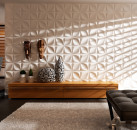
Many millennia, the decorative stone remained the best construction and finishing material. The decorative stone costs expensive, so the manufacture of stone at home was mastered by many masters, for example, a light gypsum stone or heavier and inexpensive - based on concrete.
Content
- What makes a modern artificial stone
- Advantages and disadvantages of artificial material
- Main types of decorative stone
- Forms for decorative stone
- Additional components and adaptations
- The simplest technology for producing artificial cement-based stone
- Making a gypsum stone with the simplest way
- Independent laying of artificial stone
- Additional decoration of stone in landscape design
What makes a modern artificial stone
In the 60s of the twentieth century, artificial stone began to actively apply in the West - the walls and the foundation are organically look in the stone jungle of the metropolis. The idea of \u200b\u200bmaking decorative stone and decorating buildings, architects and interior designers pushed, pushing the whole segment of entrepreneurship. Forgotten building materials are popular again.

Ancient masters have long learned to process the stone, they distinguished him by type of application, like:
- construction or tesne;
- finishing or decorative;
- delicate for jewelry work.
In the old centuries, the sand and stone crumb, grated pembol and shell, lime and chalk mixed in the frozen gypsum. Dyes took natural:
- soot;
- color clay;
- metal oxides.
Nowadays, the stone and its analogue came to the modern construction and arrangement of the Alpinarians, and today it is difficult to submit a modern house without them. The decorative stone, the photo of which is presented in the article, clearly demonstrates the capabilities of this building material.
The decorative stone is done by their own hands on a different basis, and there are accessible in everyday life. Forms are prepared independently or acquire factory models. Receptions, technologies and components are also known - they are offered by specialized firms.
At the base of simple mixtures - water, cement and small, added pigment. The material turns out quite durable, it looks like a natural stone, has excellent decorative properties. An option close to the ancient techniques is made of plaster, and today polymer materials are used as a binder.
Wildstone texture has a different surface:
- fine-grained and smooth,
- laminated and bug
- cross and ribbed.

The natural stone crumbs and strates when contact with the tool, and the artificial does not require treatment. He immediately gives the required form. The most common varieties:
- butt, similar to natural boulder;
- the cheat, uneven, resembles chips from the blow;
- sawn, with smooth and smooth edges;
- wild stone, natural form;
- decorative arbitrary shape, with influx, folds or shoots, reflects any fancy designers.
Advantages and disadvantages of artificial material
The manufactured stone has advantages:
- the possibility of casting on the place of installation to reduce traffic costs and scrap formed in delivery;
- make in small thin plates to reduce the weight of the finished design;
- its strength does not depend on the magnitude and shape of the tile;
- added to the mixture pigment gives the desired shade;
- there is an opportunity to get a straight and arbitrary stone;
- allows you to make the size of the tiles corresponding to the place of installation, even taking into account the curvature and irregularities;
- the available ready-made forms make it possible to get a coarse-grained and smooth texture, almost polished;
- it is easy to make the material of any irregular shape and a broken face surface;
- some technologies make it possible to get a more durable analogue of fragile natural stone;
- polymers give plasticity, and even after manufacture, you can give a new form or consider the edge for seamless compound;
- artificial material often has the best decorative properties;
- it differs from the natural stone of the simplicity of laying, thanks to the smooth back side;
- an indispensable refractory building material for the decor of stoves, mangals, coarse and fireplaces;
- enough moisture-resistant, suitable for wet rooms like the pool or wine cellar;
- the price of an artificial decorative stone is less than a natural analog that requires technological sawing and processing;
- does not need special care, for a long time and reliably serves;
- all sorts of form, shade and textures allow an artificial stone to fit into the interiors of any style.
Possible disadvantages:
- some decorative species have a complex manufacturing technology that increase the value of the material;
- not every wall is suitable for finishing with a wild stone due to its high specific gravity, the exception is plaster counterparts;
- sometimes requires additional costs for transportation and high-tech laying;
- the impeccable bog of individual fantasy block units can not always be ensured, clearance is required.

Main types of decorative stone
To ensure quality assurance, finishing building materials are made in accurately in accordance with the recipe and production technology. The components and technology of the issue make it possible to get a decorative stone of different names and properties.
1. Concrete reinforced stone, the so-called monumental, free molding material, it is made individually manually where it is installed. This is a technology for cobblestones, boulders and plates of artificial granite.
The base for the mold - cement-sandy solution:
- on 3 parts of cement for proportion - 1 dry sand;
- 2-6% pigment from the mass of the solution;
- add polymer additives.
2. Similar material is a stone formal stone from the same cement-sand mixture. Suitable for construction and finishing. Differs in high strength and frost resistance. It is done in the hangars, shops and garages in the cool time of the year.

3. Ceramic - the most expensive material requiring roasting or quenching at a certain temperature. Its production requires associated with large energy consumption and the presence of a large free heated area. In addition, you need a trained worn personnel.
4. Gypsum cast decorative stone is the simplest technology and mining equipment. Make at room temperature, but it is suitable only for work on interior decoration, does not like temperature differences. The mixture quickly becomes viscous.
It is made in small portions and immediately poured into the prepared form, but not later than 3-4 minutes from the start of the knead. We need citric acid up to 1.3% of dry gypsum weight, it will slow down solidification, pigment - 2-6% by weight of gypsum plus water. It is better to make several trial samples to correct the proportions.
5. Decorative polyester from synthetic material. It is done by hot hardening with the addition of mineral fillers. Superior to many natural analogues, but solidification technology requires vacuum, make in workshop conditions.
6. Liquid stone on gelcoat. I am inferior on hardness by casting stone, gel takes less mineral fillers. The mixture is suitable for the release of complex products, such as stone puzzles, but the stone on gel-acrylic basis is more expensive.
There are 2 composition - primer and facial, differ in the percentage of filler and composition. Primer composition: Gelcoat - 20%, microcalcite - 73%, hardener - 1% and accelerator - 6%. Facial composition: gelkout - 40% accelerator and hardener - as 1-M composition, rear composition - filler plus pigment to 6% of the mass of the solution. The composition is collapsed in about half an hour, a stone can be laid through a day.

7. Cast acrylic stone cold solidification based on acrylic resin. Easy to manufacture, requires strict execution of instructions and additional equipment, such as vibrite. For many properties exceeds another artificial material. At high temperatures up to + 210 ° C, it is possible to change its form without quality change.
Tip: no pores and resistance to acrylic stone chimreactles in the finish provide impeccable hygiene, so it is suitable for premises where frequent pollution and surface cleaning are possible - an entrance hall, a kitchen, a veranda and an indoor terrace. The material is also known for its low thermal conductivity, gives the feeling of heat - this is the best choice for the bath, bathroom or pool.
Forms for decorative stone
There are a lot of methods to make forms for stone yourself on your chosen technique, but it's easier to buy ready.
There are about a dozen species of forms for the production of artificial stone with their own hands, but most often use 3 types:
1. Ready polyurethane, for small production, they are offered by firms on the production of equipment and selling technologies Wild stone, comfortable and durable, but cost a lot.
2. Clay forms on the model paid using wax models are suitable for modeling and art casting.

3. Silicone molds, suitable for homemade tile pieces, they are enough for dozens of castings, over time they are deformed.
Tip: The sand pillow is required for silicone forms, with vibrations and heating they cut them. Before casting, the shape is deepened in the sand in the pallet to 3/4 heights to reduce the deformation, and the horizontal dive is tested by a water level.
Additional components and adaptations
1. Pigment for building mixtures is offered in catalogs and stores for building materials in different form of release: liquid, paste and powder. Synthetic pigment-powder is uniformly introduced into the plaster or other dry filler, the pigment paste is entered into the cooked. By the way, thanks to the pigment paste it is easier to get uneven coloration - a layered or spotted, it is introduced by a syringe directly in the end of the kneading.
2. Separators are of different types:
- for cast acrylic;
- for concrete mortar;
- for gypsum composition;
- for liquid stone.
They are sold with the finished instructions and detailed recipe. You can also use high-quality lubricant - cyatim, Fiol.
3. Thermopystole is a device such as a small construction dryer with a strong jet of heated air.

4. Vibrosenda is the main machine for the manufacture of stone with your own hands, guaranteeing the high quality of final products, provides uniformity of the frozen mixture.
Tip: Such a stand can be done yourself - on the Internet there are detailed instructions and videos, for example, for the manufacture of cement-based decorative stone using self-made vibrite.
The simplest technology for producing artificial cement-based stone
1. Sands are mixed with cement for the first layer 3: 1 to a homogeneous mass, for coloring, a suitable dye is added about 2-3% relative to cement, mixed with water to thickness sour cream, liquid pigment is pre-divated with water.

2. The finished mixture is uniformly laid out to half, compacted and distributed shaking and tapping. For the reinforcement of the stone on the 1st layer, the metal grid is placed, poured the 2nd layer without pigment and chims the cross-shaped grooves for adhesion during styling.
3. After 10-12 hours, the finished stone can be removed from the mold and lay it for a complete drying. The form after that you need to clean and rinse with the Fairy after each fill.
4. In the process of monumental forming of a large boulder, the base is formed on a blank, an armature mesh and wire, which lay down thick cakes without dye layers. When the base slight slightly, the solution is prepared with the addition of the pigment of the desired consistency and make the final form. Artificial boulders when frozen, approximately a month, covered with a rain film.
Making a gypsum stone with the simplest way
At home, the decorative stone is made in several ways. Let us dwell on the description of the proven in practice.
1. It is recommended to purchase a pair of ready-made wild stone samples and on them to make forms in the size of a stone, for example, from a plywood box in the form of a trapezium - for the convenience of excavation.
2. 1 liter of silicone sealant on acetic acid is evenly squeezed into it, the layer is lubricated with solidol or another separator so that the finished stone is not adhesive.
3. The sample stone is pressed into the silicone box until it is completely drowned in it, up to the rear surface, the surplus of silicone should be considered, the shape dries over a couple of days.
4. After complete drying, the sample is neatly removed from the box for the form. Ready silicone soft and elastic.

5. The gypsum mixture of the recipe is mixed up to a thickness of sour cream with a pigment, and poured into a shape, lubricated with solidol. After the first layer, the tile is preferably reinforced with a small metal mesh, a 2-layer is poured without a dye, the alignment is shocked and leave to push. If the gypsum is rapidly settled, interfering with the reinforcement process, the mixture is diluted with milk - then it is longer than heels.
6. The form is better drown in the sand on the pallet, for the preservation of silicone shape, and from above, press the plaster with corrugated glass so that the uneven rear surface is better attached to the wall.
Tip: There are time-consuming stone manufacturing techniques, such as quartz, allowing you to get the highest quality and durable building materials for cladding. Having mastered some techniques, you can open your own business.
Independent laying of artificial stone
1. The finished decorative stone is attached to any dry surfaces with an additional crate. Installation, with extension of seams or without them, is done on cement mortar, construction glue, the stone cuts into a grinder on small turnover with a disc on concrete.
2. Before installing it is better to make a sketch of finished work or use a picture with a similar material. Stones are laid out in drawing on the surface for the most beautiful placement and fitting fragments.

Additional decoration of stone in landscape design
For a long time, the stone is not only widely used in architecture, the Japanese decorated them tobiaisi gardens. Today, for special design purposes, stone is additionally painted or ground part of its surface, so that green piglets are formed in the mountaineering. Rub in chroas with soot, aged, and convexities on the south side - Iron Surimer to obtain visibility of tanning and weathered.