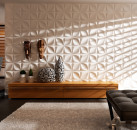
The modern building market offers infinite many materials to create interiors for every taste. If you want to change the appearance of your dwelling, but do not know where to start, why should I get rid of boring wallpapers and not cover the walls of paint? And if you approach this task with creativity, you can turn the usual old apartment in the work of designer art in a matter of days.
Content
Methods of decorative wall decoration
There are many ways of decorative wall decoration, ranging from elementary painting, ending with frescoes and mosaics. The most pleasant thing in such a variety is that everyone can choose a method that satisfies the aesthetic needs and financial capabilities. So, consider the main ways to decorate the walls.
Decorative plaster
Decorative plaster is a special composition for the design decoration of the walls. Depending on the nature of the ingredients, such plaster can produce completely different effects. If you decide to stop your choice on decorative plaster, in addition to it you will need a lot of tools.
Basic tools and materials for working with decorative plaster:
- narrow spatula;
- wide spatula;
- decorative spatulas;
- drill with a mixing nozzle;
- roller;
- brushes;
- foam sponge;
- emery paper number 1 and No.0.
Working with decorative plaster is quite simple - it is enough to distribute it to a smooth layer on a cleaned smooth wall. The principle of operation is exactly the same as for conventional plaster. With the help of a narrow or decorative spatula on a low plaster, a furrow or wave-like divorces can be made to create an interesting effect. After creating the texture and complete drying of the plaster, clean the sharp corners of the surface with sandpaper.
As a protective layer, it is recommended to cover the plastered wall with water-emulsion paint.
Decorative paint
Decorative paint provides unlimited opportunities to decorate, transform and change the interior. A variety of textures and colors circling his head, and operational characteristics allow you to use paint not only in living rooms and bedrooms, but even in bathrooms and kitchens.
Decorative paints have the following advantages:
- high aesthetics;
- long service life (from 10 years);
- simplicity of application;
- do not burn out on direct sunlight;
- protected from mechanical damage (blows, scratches, scuffs, etc.);
- high anti-corrosion properties (not affected by fungus, mold);
- no junctions in contrast to wallpaper;
- the possibility of wet cleaning (especially useful in places around switches);
- variety of shades and textures;
- absolutely harmless to health (excellent option for children);
- versatility (use in any premises);
- antistatic coating (dust does not accumulate).

But they have a couple of flaws:
- need careful pretreatment of walls;
- high price.
However, you agree, these minuses are simply blurred before the advantages that you get after painting the walls of decorative paint.
Ways to decorating walls of ordinary paint
For those who really want to replace wallpaper on paint, but shocked by the value of designer decorative paint, there is an alternative. And, I must say, not the worst! Knowing some tricks, you can with the help of conventional cheap paint create a unique stylish interior, saving on building materials.
Snipping
The snipping is called a decorative painting of walls, which allows you to "range" just a painted monochrome surface. By the way, the spinning fit not only for the design of the walls, but also to decorate the furniture, so you can at the same time paint the closet or table, thereby creating a harmonious interior.
The only minus of this method is that he emphasizes the disadvantages of the wall (irregularities, chips, cracks), so before you begin to decorate, carefully prepare the surface.
Stages of work:
- Cover the wall by any color you like and select the acrylic paint of a contrasting shade. It is important that the acrylic paint creates a pleasant contrast, and not "the eyes cut." Otherwise, this room will be impossible to be.
- Cover the wall with colored glaze, mixed on the basis of the selected contrasting paint, and cover the wall with a wide flat brush. When the wall is completely covered with icing, the same brush neatly touch the paint still not dried. Thus, traces of divorce from the bristles will be invisible, and the wall will acquire an interesting texture.
- Fantasy tassel, directed perpendicularly wall, start "poke" fresh paint with light and disordered movements. So walk all over the wall, periodically cleaning the glaze with the brush. As you progress, you will see which original effect is achieved by this simple action and you will regulate the degree of "aging" of your wall. The smaller and detailed effect of "aging" can be achieved by removing the decorative wall covering with a sponge, and not a face tassel. The only one must ensure that the sponge always remains dry and use the tough side.

Effect "Leather"
Very interesting option for wall design, which is superbly suitable for finishing a working office or a cozy living room.
The mechanism for creating the effect "Leather":
- Cleanted from the former wall covering wet wet rags to remove dust and small litter.
- Painted scotch tape selected areas that are not subject to color (switches, sockets, plinth, etc.).
- Using a roller, cover the surface of the usual latex paint of the desired shade. If necessary, apply two layers and wait for the paint complete drying.
- Slice of suede tissue, cut to the oblong patchwork width up to 10 cm. Collect these strips in the likeness of the snop, fold it in half and fix with a rope or rubber band at the seplace of the fold. As a result, a suede bucket should be turned out.
- In a separate container, mix the glaze with latex paint a darker color shade, which you were covered with a wall. Do not make a big contrast if you want your "leather" interior to look natural.
- Cover the dark paint a small area of \u200b\u200bthe surface. Since the glaze will dry pretty quickly, it is better to advance gradually, working with separate fragments of the wall.
- The suede brush is wetted in water and look great. Neat touches are carried out suede for not yet dried glaze, removing part of the wet coating.
- a slightly wet piece of suede matter carefully fit places with strongly pronounced lines. Thus, you "soften" the surface and give it a natural texture of the skin - with small folds, "pores" and irregularities.

To obtain the effect of "crocodile skin", it is necessary to paint the walls with a decorative roller with the corresponding pattern. At the final stage, after creating small "wrinkles" and decisive, pass through the surface of the roller.
Effect of Venetian plaster
Venetian plaster with its beauty conquers everyone and everyone, but this repair will be completely expensive. For those who dream of Venetian magnificence, but cannot afford such costs, we suggest to recreate the effect, not distinguishable from the real dear decor!
For decorative painting of walls, you will need conventional latex paints that can be found in any specialized store.
To create the effect of Venetian plaster, the following materials and tools are needed:
- latex paint;
- pigments for paint black or brown;
- large pallet;
- plastic spatula.
The procedure for creating a decorative effect is very simple:
- In the large pallet pour as much paint as possible. It is better to fill to the very edges to mix the paint as close as possible.
- On the one hand, add a small amount of pigment to the paint.
- Gently with a wand or wooden end of the brush, stir the pigment without going beyond the conditional border of the half of the pallet. As a result, you should get a dark and bright parties.
- Dry the spatula into light paint and distribute it along the wall. Apply the paint in the same way as the usual plaster - right-left, down-up.
- Pick down the spatula into the dark paint and cover the wall area it. As a result, dark and bright areas should be intermed on the wall, imitating the appearance of Venetian plaster.
- When the wall covers dark and blond stains, spend on her spatulas from side to side to lightly grow color and give the coating of harmony and homogeneity.

To make a gradient, paint the top of the wall only with light paint, and the bottom is dark.
Useful advice: Only a plastic spatula is suitable for creating the effect of Venetian plaster. Metal tool hurts the surface and will not give the desired result.
Effect "Mint Leather"
The effect of "crumpled skin" is perfect for the bedroom or creating a relaxing situation in the living room.
To work, you will need:
- painting tape;
- papile paper or newspaper;
- brush;
- paint for interior decoration.
This technique is easy to perform, but requires patience, because you will not be able to paint the whole wall at once. First, cover the paint a piece of the wall with dimensions of a little more of the sheet of cigarette paper or newspaper (depending on what you use). Lightly remember the paper and attach it to a wet wall. Smooth up paper with hands, giving the desired outlines and controlling the degree of "crumbling" of your future interior. After that, cover the paper paint and proceed to the next site. Repeat the procedure until all free space on the wall is over.
In some cases, you can not apply the base layer of paint if the walls are perfectly cleaned or covered with layers of plaster. Use the wallpaper glue and fix the crumpled paper on the wall in the manner described above.
Helpful advice: To hide the joints from paper, wrap it along the edges or as you move slightly overlay a new piece of paper on the already processed.
It also looks very beautifully glazed finish over "mint of the skin". Use different shades of colored glaze to give the walls an interesting appearance.
Rag roller wall decoration
An extremely interesting effect is achieved with an ordinary rag roller. The room creates a warm cozy atmosphere, so such a design is suitable for bedrooms and children.
The essence is to add another texture colorful or glaze layer on top of a boring monochon wall. This is another charm of such a finish - you can strive to change the interior in the room with conventional uniformly colored walls.
To work, you will need the following tools and materials:
- paint for internal works of several harmonious shades;
- rag roller.

At first it is necessary to cover the walls with a base layer of paint. As a small digression, it can be said that the finishing of a rag roller allows you to disguise the irregularities, cracks and chippers, so too thorough pre-treatment is not required. Wait for the basic layer to completely dry.
While the wall dries, spread the paint in a separate container with a harmonious, but a little contrasting shade. To check saturation, apply paint on a sheet of paper or a small segment of the wall somewhere in the corner or bottom. Divide the water-emulsion paint with conventional cold water until you achieve the desired consistency.
Pure rag plunge into the diluted paint, but do not impregnate it completely. Twist it in the harness, evenly distributing the paint on the roller. Start work from the top end of the wall, rolling down the cloth twisted into the harness. Do not forget to change the direction of movement, turning the roller at different angles to get a beautiful texture pattern.