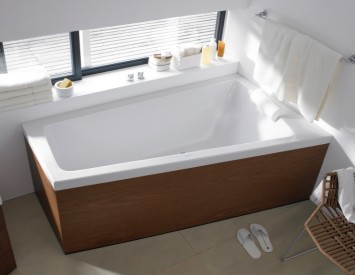
Bathroom renovation is always a painstaking and troublesome process that requires compliance with many subtleties. Such a common problem, as the resulting gap between the bathroom and the wall, can become an unpleasant source of mold appearance, dropping or sedimentation of moisture on surfaces. Therefore, the elimination of such a gap is the first step towards the dry and tidy of the bathroom.
Content
Causes of gap
Often, the gaps in the bathroom may appear due to such reasons:
- The angles between the walls are not equal to 90 ° as a result of the violation of the geometry of the room and non-compliance with construction standards.
- Base boxes do not coincide with the size of the room.
Often, the problem of seamlessness of seams can occur as the result of the violation of the premises repair technology. For example, if the owner initially laid a tile on the walls, and only then installed the bath. After such actions, a gap is necessarily formed, which must be eliminated by additional efforts. This approach to the facing room is suitable only if the shower is installed.

Elimination of seams up to 10 mm
This is the most common case with which every third home owner faces. Solving than to close the gap between the bathroom, you should pay attention to the sanitary silicone. This material is intended for reliable sealing of small junctions and gaps in conditions of high humidity. Before proceeding with the workload of seams, you will need to prepare the following:
- silicone sealant;
- big scissors;
- construction pistol.

Since the process should provide maximum excitement of the slot between the tile facing and the bathroom, it is recommended to produce preparatory work. The essence of their execution comes down to the following:
- Clean the bathing baths and the surface of the wall from the remains of the former materials and dirt.
- Swipe degreasing the necessary sections with any solvent.
- Carefully dry the processed area.
To carry out the process of seam closeing, it is necessary to produce the following manipulations:
- Take the sealant and with scissors cut the cartridge tip. At the same time, consider that the tube in the form is a hollow cone, and therefore the thickness of the applied seam will depend on the size of the sliced \u200b\u200bhole. The sharper the angle of the cut, the smaller the line, and vice versa.
- Slightly pressed on the tube hull, slowly apply a smooth layer of sealant to the joint between the surfaces. It must be continuous. If you close up the gap through a plunger pistol, then smoothly press the descent, follow the tip of the cartridge with the joint.
- Further fill in the gap between the bathroom and the wall tightly, while adjusting the pressure of pressure so that the excess material does not fall out.
- Upon completion of the process, carefully crumple the applied with a rubber spatula or a finger moistened in a soap solution.
Important! In the event that the bathroom is made of acrylic, it is necessary to fully fill it with water before starting sealing so that it is under load. It is impossible to merge water until the moment of drying the silicone material. The optimal option is to close the seams in the evening so that the bathroom streams at least 12 hours in the loaded state.

Recommendations to the process:
Conducting the sealing of the silicone filler, it is necessary to take into account some subtleties so that the result obtained maximizes the requirements. Consider more detailed features of working with sealant:
- the alignment of the applied seam can be performed using a finger or blades so that the joke turns out to be more even;
- when working with a sealant, the room should be well ventilated, because when the material is dried, it highlights acetic acid;
- in order not to damage the tile on the wall with excessive sealants, cover paper tape along the future seam;
- you can remove the remains of silicone filler with wet matter;
- solving the sealing issue of the slit than to take out to neatly dock the surfaces, give preference to sanitary sealants, because it has resistance to the conditions of high humidity and does not cover with time mold.
Detailed instructions for climbing seams with silicone filler is presented on a fragment:
Elimination of gaps from 10 mm to 30 mm
The appearance of the gap between the wall and a bowl of the size of 10-30 mm is a more serious problem, but quite satisfied. Specialists offer two ways to solve the problem: climbing seams using a curb ribbon and by installing the cartel. Consider more detailed each option.
Fastening border ribbon
Self-adhesive borders are suitable for eliminating such a gap, the basis of which is special plastic. In this case, the fixation also occurs with the help of sealant. Consider a Read more Enclosure Process:
- Initially, it is necessary to purchase a self-adhesive border ribbon of the required width. It is not worth the "with the reserve", because the sealing should look aesthetic.
- Clean the surface of the wall and sides of the bath with solvent, and then dry.
- Gently swipe with silicone sealant thin seam along the line of the future border.
- For greater reliability, apply a special adhesive mixture "Liquid nails" to the tape, after which it is tightly putting the material on the surface.
- Press the rubber spatula to the tape, with the efforts of the average intensity.
Then let the curb carefully dry, for what to eliminate the water from entering the glued material.

A detailed instruction for installing a border tape is presented in video:
Installation cartel
Another solution than you can close the gaps performs the fixation of a special staple along the edge of the bathroom - cartlers. The device is a plinth of polyurethane, which is designed for operation in conditions of high humidity and does not absorb moisture. Consider a step-by-step guide for mounting cartel:
- Perform degreasing the surface of the wall and the side of the bath with a solvent, after which let me dry.
- Memore the side of the length and cut the cartel in the required sizes.
- Drink the corners of the plinths under 45 ° tilt, after which thoroughly clean the surface of the cutting of sandpaper.
- Apply an adhesive mixture of "liquid nails" to the inner surface and leave for 3 minutes.
- Then make the material tightly so that it blocked the gap.
- After that, again separate the plinth from the wall and allow it to lie down 2 minutes to glue slightly.
- Install the pellee to the joint place and press it most closely to the base base.
- Similarly, glue the material on all sides of the bath.
- After the segments are fixed and dried, apply aquarium silicone to the upper and lower adjoining of the side. For which moisten the brush in the composition and draw a thin layer along the plinth.
- On this embedding seams completed.

Recommendations to the process:
- To eliminate the clearance of this size, it is unacceptable to use standard corners for a tile. Use only specially intended materials.
- Installation cartel is carried out according to a similar principle with a fastening of a corner, but the difference is that the clearance of more than 10 mm will not be able to fill the entire sealant. This is not at all necessary, the main thing is to qualitatively, as close as possible and securely fix the plinth along the wall.
- Printing cartel is a rather complicated process that may initially seem easy to perform. Therefore, for better efficiency and accuracy of the installation, it is recommended to first stick on one side, and then begin to rest.
Seam seam over 30 mm
Without looking at the degree of craftsmanship of the builder and the quality of materials, the elimination of the gap in 30 mm and is more impossible to produce neither the first nor the second method. Here we need concreting skills and a slightly mounting foam or solution.
Sealing seams with mortar
In order to seal the gap between the bathroom and the tile with the help of a solution, you will need to make such actions:
- Clean the joint from the residues of previous materials and dirt.
- If the gap is large enough, then you will shift it with an old rag, to eliminate the risk of falling the solution. At the same time, be sure to impregnate the auxiliary material with a liquid cement-sandy mixture.
- Then you need to wet the area of \u200b\u200bthe future seam to increase its clutch.
- After that, proceed to the pouring into the cavity of the cement-sandy solution of medium density.
- At the end of work, let the mixture dry for 48 hours and do not expose this place to moisture.
Since the cement on the wall impairs the aesthetic indicators of the room interior, it must be made. Here we can allocate such seam finishing options:
- if the bathroom is not lined with a tile, but simply painted, then you can neatly walked the joint and paint it into the tone of the room;
- for walls with tiled trim, it is permissible to stick along the side of a bath of a special border or decorative plinth;
- if the room is decorated with plastic, you can fix plastic plinth plastic bath or border tape.

Pulmonary foam
In case you do not have time or desire to work with a solution, you can simplify the task and eliminate the slot using the mounting foam. To do this, you will need to perform the following actions:
- Carefully clean the place of the junction from pollution, and then draw the surface degreasing solvent.
- Let me dry.
- Carefully shake the cylinder with foam, and then apply the composition in the gap between the wall and the bathroom. Consider the fact that the expansion of the foam increases to 30 times in the amount.
- Let it dry for 40-60 minutes.
- Remove the excess material from the walls and the bathroom with the help of a painting knife.
- Upon completion of the procedure, you can proceed to the lining of the seam for a similar principle with decorating the joint after the solution.
Important! To perform work, choose a waterproof foam foam, optimally one-component polyurethane material.

The hardening guide between the tile and the bathroom is represented by video: