All sorts of spectral row, along with a different combination of materials, in most cases there are few different appearance, significantly make it difficult to choose a suitable option for finishing material. At the same time, the information printed on wallpaper labels is brings low-informative information, which causes the need to obtain the most comprehensive amount of information, especially before purchasing the selected option.
Content
Paper wallpaper
Among the vast magnificence of various kinds of wallpapers, which have the optimal value for money, paper still remains at the height. The environmental friendliness of the material, along with a low price, a wide sample spectrum, which opens up all sorts of room decoration options, and other characteristics make paper wallpapers in an indispensable finishing material in some situations, for example, for people suffering from allergies from polymers included in the facial layer of most wallpaper.
These and other reasons encourage manufacturers to enhance the quality properties of this category of wallpaper, developing all new varieties. Currently, 2 main types of paper wallpapers are distinguished, including several subspecies.
Simplex.
Simplex - a single-layer version of paper wallpaper, which plays, on the one hand, the role of the substrate, and on the other - the front side, covered with a pattern typographic manner. This type of wallpaper includes a two-layer simplex when the drawing is applied to a two-layer sheet. Simplex wallpapers are highlighted by a smooth surface and very small thick.

Advantages:
- wide color gamut;
- wonderful paro-, moisture permeability;
- the cheapest paper wallpaper.
Disadvantages:
- the impossibility of conducting wet cleaning;
- exposure to mechanical damage in the process of salary, operation;
- quickly lose the initial shade;
- it is necessary to perform an ideal reason;
- little service life.
Significant disadvantages of simplex wallpapers are absent in duplex paper.
Duplex
Duplex - wallpapers consisting of two layers of paper, where one layer is a substrate, and the other is an external coating. The production process of such wallpapers is to create a pattern on the front sheet, which is then glued with the substrate, significantly increasing the strength of the wallpaper sheet. Duplex wallpapers have both smooth and embossed surface.

The advantages of duplex wallpapers are relatively simplex:
- more racks for the sun rays, due to the application of special compositions that slow down the loss of color;
- masking unobistant irregularities;
- more durable.
Disadvantages:
- under the influence of adhesive composition, impaired relief;
- no resistance to damage;
- low wear resistance;
- higher price.
A variety of duplex wallpapers protrude paper wallpaper designed to paint. They are highlighted with white canvas and rather pronounced texture, but after multiple staining, the surface relief is somewhat violated.
There are 3 types of wallpaper under painting:
- Structural wallpapers are made by embossing using binding polymers, as a result of which a combination of a smooth and embossed surface occurs.

- The rough-fibrous wallpaper is characterized by the placement of various sizes of wood chips in space between sheets, thereby turning out the original texture, pressed by the complex technological process. This option of wallpaper reliably masks small irregularities of the base.

- Moisture-resistant wallpapers are subjected to water, dirt-repellent means allowing you to wash the wallpaper during operation and use to enhance surfaces in conditions of high humidity.

Thus, wallpaper paper, the price of which depends on the number of layers, the method of production and quality of the materials used varies in a rather wide range and, in most cases, corresponds to the quality and purpose of a certain type of wallpaper.
Paper-based wallpaper
The wallpaper with a paper substrate includes various species, among which the most common photowbles, wood veneer wallpaper, linker, paper wallpaper, vinyl, textile, metal, etc. At the same time, the category of paper wallpapers, flieslinic have a rather uncertain attitude. The fact is that fluzeline is a cloth, 70% similar to paper on the components. With regard to other properties, flieslinic wallpapers are quite different from paper.
Vinyl wallpapers
A huge variety of vinyl wallpaper is due to a combination of quality and acceptable cost. Vinyl wallpaper is characterized by the presence of a paper or fliesline base, which is further applied polyvinyl chloride, which provides not only aesthetic appeal to the finished finishing material, but also preventing damage from damage. At the same time, the drawing on the wallpaper appears by foaming the polyvinyl chloride or the use of a method of hot or chemical peasants.
Based on the pattern of drawing, the front side of the wallpaper acquires various relief and thickness, as a result of which vinyl wallpaper is divided:
1. Wallpapers on a foamed basis are distinguished by a clearly designated texture achieved by the screen printing method with subsequent foaming of vinyl at high temperatures pre-applied to the base.

Pluses of vinyl wallpaper:
- hide minor irregularities of the glued surface;
- the possibility of wet cleaning;
- low cost.
Minuses:
- relative resistance to damage;
- losing the initial shade under ultraviolet rays;
- high probability of abrasion in places of contact with interior items.
2. The wallpaper manufactured by the method of chemical embossing includes an inhibited vinyl, which is released by a glossy surface that contributes to the unimpeded removal of complex contaminants. In the production process of inhibited wallpapers, special substances applied to the drawing are used. Under the influence of high temperatures, the area of \u200b\u200bvinyl, not powdered by substances, is subject to uniform foaming, creating a harmonious combination of foam material with elements of silk screen.

Pros:
- original design;
- high resistance to multiple cleaning;
- not exposure to ultraviolet rays;
- significant mechanical resistance;
- long service life (10-15 years).
Minuses:
- poorly hide small surface defects;
- high price.
3. Wallpapers of hot embossing, with respect to foamed polyvinyl chloride, they differ in improved resistance to various mechanical damage, they can not be washed. Vinyl wallpapers, in the production of which is used by hot embossed, differ in full-quality characteristics, thickness and other properties.

Highlight 3 types of wallpaper produced by hot embossed:
1. Silk screen screen or flat vinyl is distinguished by the relative subtlety of the canvas, as well as a brilliant and fairly smooth surface. Thanks to the embossing method used, it creates a completely reliable imitation of the inclusion in the silk thread cloth.

Pros:
- unique design achieved by the game of light glittering elements;
- high strength of the material, despite the thickness of the finishing material;
- from the canvas, any contamination is easily removed;
- ability to use the brush of medium hardness during wet cleaning.
Minuses:
- even the slightest irregularities of the walls, therefore, careful preparation of the foundation is required;
- high price.
2. CD-Vinyl is characterized by a high density of a material imitating brick, stone masonry, textiles, skin, bulk embroidery. The surface of the wallpaper has a rather noticeable relief.

Pros:
- masking small irregularities;
- excellent resistance to detergents and mechanical damage;
- do not lose the original coloring over long years;
- ease of pasta.
Minuses:
- the need to apply antifungal primer on the walls;
- the possibility of shrinkage in the process of drying glue;
- high price.
3. Heavy vinyl is characterized by a three-layer paper base that impede the penetration of moisture into the structure. The surface of the wallpaper is represented by a significant relief, although the drawing is applied by the method of hot stamping. The environmental friendliness of the material is provided by the removal of unsafe compounds in the process of evaporation of vinyl at high temperatures.

Pros:
- do not fade;
- have high strength;
- the possibility of cleaning with the use of detergent and medium rigidity of the brush;
- masking wall defects.
Minuses:
- complexity when salabing;
- due to the high weight, preliminary application of primer is required before the glooming, for better adhesion of materials;
- high cost relative to other varieties of vinyl wallpaper.
A huge selection of color scheme, along with certain conditions for using this or that type of vinyl wallpaper, allows you to choose the most appropriate type relative to the specific place to use.
Textile wallpaper
The structure of textile wallpaper includes a paper or phliselin substrate and a finishing layer, represented by artificial or natural threads, fibers. Despite the environmental purity of materials used in the production and aesthetic appeal, the choice of textile wallpaper should be made taking into account a number of features concluded in the virtues and disadvantages of the material.

Advantages:
- have sound, thermal insulation qualities;
- excellent wear resistance;
- not affected by ultraviolet;
- mechanical resistance directly depends on the material used for the finishing layer.
Disadvantages:
- the ability to abrasion in places of frequent contact, for example, near sockets, switches;
- complexity of gluing;
- high ability to accumulate dust;
- the possibility of applying only dry cleaning;
- high price.
Currently, textile wallpapers are divided into the following varieties, based on the material used when creating wallpaper:
- Silk wallpaper, due to the essential high cost of real silk, are mainly produced from the viscose in combination with natural threads. At the same time, the silk wallpaper is steadyly carry dry cleaning, mechanical impact, but over time fade.

- Jute wallpapers are highlighted by a relief texture that promotes the disguise of the irregularities of the surface. In addition, the jute wallpaper is not faded, well tolerate cleaning with a damp cloth.

- Linen wallpapers are characterized by durability, resistance to fading and antiseptic effect.

- Velor wallpapers are made by applying a pile on a paper base, so poorly transferred not only wet, but also dry cleaning. In addition, velor wallpapers have a high ability to accumulate dust, as a result of which they quickly come into disrepair.

- Felt wallpapers are made from both natural fabrics and its analogues. Such wallpaper is characterized by special strength, resistance to wet cleaning using non-aggressive detergents, complexity of gluing.

Of course, the high cost of wallpaper, despite the mass of positive properties, contributes to the inaccessibility of textile wallpaper to most of the middle class of the population.
Wall mural
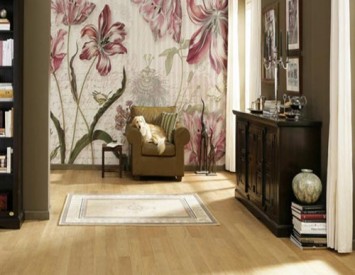
A single-layer or two-layer paper is used as the main material for the photo wallpaper with the subsequent application of photography. At the same time, paper photographs are subject to mechanical damage, various kinds of pollution, a change in the shade under the influence of sun rays. To improve operational characteristics, an additional layer of acrylic, varnish and other similar compounds is applied over the photo image.

Pros:
- open huge prospects for decorating the interior;
- low cost.
Minuses:
- even the slightest irregularities do not hide;
- sticking complexity.
The cost and wide design opportunities open the right way to change the boring interior by adding bright colors, emotions deposited on the photo wallpaper.
Linker
Linker is a combination of gorgeous refinement with wonderful decorative characteristics. Wallpaper is produced by applying various composition of elastic mastics on the paper basis, allowing you to get the ornament of any complexity. Linker - occurs with a smooth and embossed surface, which allows you to create unique masterpieces from one type of wallpaper.

Pros:
- the possibility of repeated repainting;
- duration of use;
- easy and easy care.
Minuses:
- the presence of a smooth surface;
- complexity of gluing;
- high price.
Linker, despite the high cost, has a long term use with minimal and unpretentious care, which significantly increases the demand for this finishing material.
Wallpaper from wood veneer
A fairly new material consisting of environmentally friendly components. Wallpapers made of wood veneer are made of veneer of valuable wood on a paper base, excluding the manifestation of allergies to this finishing material.

Advantages:
- good noise, thermal insulation qualities;
- a slight change in the original color with time;
- contribute to the creation of a good microclimate indoor;
- resistance to mechanical damage;
- the possibility of coating with an additional layer of varnish, wax to extend the operational period.
Disadvantages:
- the complexity of the work on the surface of the surface;
- high price.
Thus, wallpapers from wood veneer have better operational qualities than duplex paper, and they look much more effectively.
Metal wallpaper
Compared to other types of wallpaper, metal wallpapers are less known as the finishing material, although the originality of the design of the room with such wallpaper is amazing with refinement and uniqueness, since metal wallpaper with gold, bronze, silver coating are manufactured. Wallpapers are carried out by imposing on a paper fine foil subsequently by embossing or applying a decorative pattern.

Advantages:
- good thermal insulation qualities;
- do not fade;
- do not miss radio waves;
- belong to detergent wallpaper;
- ease of sticking.
Disadvantages:
- ease of damage to sharp objects;
- the presence of a smooth basis;
- expensive finishing material.
Metal wallpapers, being moisture-resistant material, are suitable for use in premises, even with high humidity, but it is necessary to take into account the high probability of their mechanical damage.
Thus, a huge range of all kinds of wallpaper species, including no less than their varieties, allows you to choose the necessary option based on the conditions of operation and financial capabilities. At the same time, you can buy paper wallpaper in any specialized store, without worrying for the inconsistency of the price and quality declared by the manufacturer.