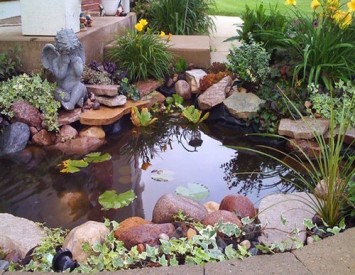
In sultry weather, water is an oasis of a lifeful coolness, so everyone wants to have a pool or at least a small pond on his household plot. If you contact a specialized company, producing work on landscape design, then pleasure it will be expensive.
Content
- Types of ponds
- Types of ponds, their advantages and disadvantages
- Determination of the location and size of the pond
- Required for the construction of a water branch materials
- Construction Technology of a Bloomed Concrete Pond
- How to make a pond from a concrete ring?
- Decorative decoration of the water branch
However, the abundance of building goods of the modern market allows you to choose all the necessary materials for self-improvement of the territory, based on any financial capabilities, and to build the same pool or pond with your own hands, preventing our most intimate desires.
Types of ponds
Based on the shape of the outlines, the ponds are divided into:
- Formal water, characterized by the correct geometric shape. Constructed in the front part of the garden, harmoniously complement the existing buildings.

- Landscape, as close as possible on the configuration to a natural pond. Located in the depths of the garden, contributing to a comfortable stay.

Both formal and landscape reservoirs are:
- Bloomred - made with concrete, film, clay materials, hard forms.

- Raised - constructed from concrete, bricks.

The positive and negative sides of the individual type of reservoir are largely dependent on the material being chosen for its construction.
Types of ponds, their advantages and disadvantages
Based on the preferred shape of the reservoir, location, the location of the site, the period of operation, the installation speed and cash resources depends on the choice of the main material for the construction of the pond in the country, therefore the following types of water bodies are distinguished:
1. Film - represented by butyl rubber rubber, polyvinyl chloride and polyethylene film.

Advantages:
- mobility;
- the possibility of forming an arbitrary shape of the reservoir;
- ease of installation;
- the probability of use for urgent repairs in order to eliminate leakage in cast or rigid waterproofing of the pond;
- ease of repair in case of damage.
Disadvantages:
- high probability of violation of the integrity of the material from physical impact, ultraviolet rays;
- the need to build coastal ledges;
- it is impossible to lay out without the formation of folds in ponds having straight angles;
- limited service life;
- danger of falling into the pond of young children;
- the need to mask the edge of the film;
- average cost.
2. Hard forms in the form of finished bowls are made of plastic and fiberglass.

Pros:
- have high strength;
- equipped with coastal ledges;
- the possibility of moving to another place;
- relative simplicity of installation;
- the ability to repair with minor damage;
- easy maintenance.
Minuses:
- limited size;
- strictly specified shape of the bowl;
- difficulties with transportation;
- the possibility of gradual destruction of the material under the influence of the Sun;
- in view of the slippery surface, the likelihood of children in it is high;
- high price.
3. From concrete.

Advantages:
- high strength of the structure;
- long service life;
- creating a pond of any size and configuration;
- easy service;
- concrete facilities are compatible with various engineering equipment;
- low cost.
Disadvantages:
- the need to facing a frost-resistant means;
- labor complexity;
- the need for waterproofing with liquid glass to extend the operational period and preserving the biological balance required for the normal existence of the water world;
- duration of installation work.
Thus, despite the few minuses, the concrete pond has indisputable advantages regarding other materials used to create a pond. In addition, from concrete you can recreate both a raised and raised pond.
Determination of the location and size of the pond
Before stopping the choice on a certain type of pond, it is worth considering a number of features:
- The presence of stable soil is necessary to avoid deformation of the constructed pond during the movement of the earth's crust.
- The absence of trees with a developed root system, because in hot weather, the roots will punch the road to a water source, breaking and over time destroying the waterproofing layer of the pond. In addition, the leaves flying out in the autumn will be clogged by water, contributing to the formation of algae and disguised bacteria for the water world.
- Moderate illumination of the pond, favorably affecting the plants growing in water and floating fish.
When determining the size of the future structure, it is worth considering that the pond should take no more than 5 parts from a free territory, since its main purpose is in the harmonious supplement of the garden. However, the reservoir of small size requires constant care. In addition, a full-fledged biological balance in it is much more difficult to establish than in the reservoir of impressive dimensions.
Required for the construction of a water branch materials
To carry out work, it will be necessary:
- cement;
- crushed stone;
- sand;
- formwork boards;
- level;
- armature;
- wire;
- waterproofing material (butyl chub, polyvinyl chloride film or regular rubberoid);
- primer;
- shovel;
- concrete mixer;
- brush;
- liquid glass.
Construction Technology of a Bloomed Concrete Pond
Preparation of Kotlovana
- By the size of the future reservoir, given the ledges for installing pots with plants, put the pegs in increasing about 70 cm and pull the rope between them.
- Drop pitched, increasing the depth of 25 cm for the thickening of the bottom.
- Required ledges to form as the land are notched.
- The walls of the pit to do with a bias of 20-30 ° C.
- Remove sticking roots of trees, plants.
- Fall asleep at 15 cm rubble, align.
- Cover the sand layer at 10 cm, a little moisturizing and carefully tumped.
- Without tensions, lay a waterproofing coating, ranging from the center to the surface of the Earth. At the edges, leave the stock of 10-15 cm and reliably press the stones to avoid slipping during subsequent work.

Filling concrete
- Mix the solution from sand and cement in respect of 3: 1 so that it is immediately enough for one layer of fillings of the entire area of \u200b\u200bthe future pond. Otherwise, in places of dusting of the solution, cracks will appear over time.
- Pour the cement mortar first the walls, and then the bottom of the layer of 6-7 cm.
- With the help of reinforcement and wire, the mesh with the diameter of the cells is about 7-10 cm.
- In an unequivocal concrete, press the reinforcement grid so that the edges perform a little over concrete coating.
- After drying the laid layer, the cement mortar again knead.
- Mix the walls, the bottom of the water.
- Pour 2 layer of concrete with a thickness of 5-6 cm, while the upper edge must overlap the lower concrete layer by 3-4 cm.
- To form an upper edge, thoroughly pressing the edge of the waterproofing coating.
- Align the bottom, the walls of the pit.
- For uniform drying, a sprinkled surface is better to cover with cellophane.

Application of liquid glass
- After a complete grazing of the concrete bowl, the area to wipe from cement dust or apply a primer.
- Pour the surface of the bowl with liquid glass with a thickness of 3-4 mm or apply a special paint.

After drying, you can proceed to direct decoration of the water branch.
How to make a pond from a concrete ring?
Preparation of the pit for subsequent works is carried out similarly to the constructed facility.

Then:
- Through the rammed layer of sand, pour the bottom of the cement mortar with a thickness of 10 cm.
- After drying, install the finished ring.
- Shake all the irregularities and places of dusting rings with a bottom cement mortar.
- Free space between the walls of the pit and the ring fall asleep the earth and thoroughly tamper.
- Clean the surface from dust.
- Apply primer, special paint or liquid glass, or lay a polyvinyl chloride film.
- Place the edges of the pool.

Thus, the pond of the concrete ring greatly simplifies the work and reduces the deadline for the installation.
Decorative decoration of the water branch
Bring to perfection The built pond will help various stones, laid out both around the edge, and inside the pond, creating intricate outlines.
At the bottom and the existing ledges of the reservoir, it is advisable to establish aquatic plants in pots.
It will not hurt to run into the pond and several fish.
In a word, it is possible to arrange a pond by any elements, as prompting the imagination.