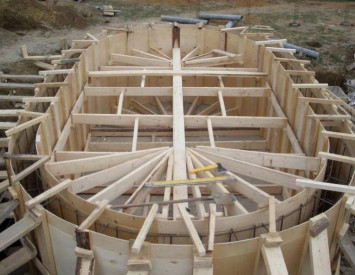
Anyone who began to build their dwelling from scratch, first of all encountered a question related to the construction of the foundation of the building. Properly performed works will allow the foundation for a long time, and will become a reliable basis of your home. To achieve the best results, it is important to pick up and mount the formwork. If you do everything, adhering to all the necessary rules and technologies, then the design will serve you not one dozen years, and the installation of concrete formwork with your own hands, will save on the workforce.
Content
General characteristics of concrete formwork
Before starting concrete work, pay attention to the method of installing the formwork. An important point when the foundation device is the strength of the structure required to give a form base. To determine this or another formwork, it is better to consider each method separately.

Methods of installation and materials for concrete formwork
The primary task of the formwork is the holding of a concrete solution necessary for further solidification and gives various forms of construction. Since the solution is sufficiently heavy, when installing the formwork of concrete structures, additional screeds, covers and struts are used. They give extra strength to the foundation in the hardening process. The dimensions of the components of the formwork vary depending on the mass of the building and the type of soil.

For formworking foundations and other concrete structures use the following installation methods:
Removable opal A very popular installation method associated with the simplicity of work and low costs. To give strength to the foundation, materials are used, which can be subsequently dismantled with further use. To do this, collecting the formwork, try to reduce the amount of damage to extend the life of a removable formwork. When assembling such a formwork usually use moisture-resistant faeer, boards, bars, OSP and other infrid materials. The mounting elements are nails and strips, as well as studs of different diameters, which are fixed with nuts.

The following types of materials are used as a material for arranging removable formwork:
- board (the most common and cheap option. To build structures, cut-up boards made of coniferous and hardwood wood thickness with a thickness of at least 25 mm. Thickness varies depending on the width of the foundation and its purpose. For example, for monolithic or multi-storey structures, 40-45 MM, and for a bath or a barn, the board is 25-30 mm. The main lack of a fence made from such a material is a long process of assembly, strengthening and installation. The main and the only advantage of such a material is the low price);
- plywood, OSP, chipboard (in the creation of the structure, use plywood sheets 1220x1500 or 1220x3000 mm, which bonded with each other with a stranded bar 40x40, 40x50 or 50x50 mm. It is better to use a laminated phaneer with a thickness of at least 18 mm. Due to the protective moisture-resistant layer, the sheets can be Apply repeatedly. In case you use formwork once, it is enough to use the usual faeer).

The removable formwork option is the most common, due to the simplicity of installation and the possibility of using cheap materials. By assembling, installing and disassembling correctly, you can extend the service life of the concrete formwork, and use it in the future, more than a dozen times.
Mounting unabotable formwork It happens in such a way that all the elements that determine the shape and size of the solution remain in their places. They give extra rigidity design. This is a more costly method in which the remaining formwork elements can serve as a foundation as a heater or waterproofing.

The following types of materials are used to install the beam formwork:
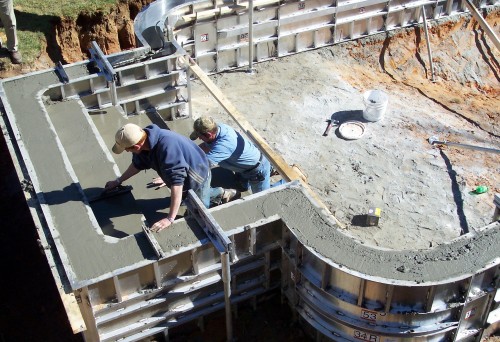
- metal (expensive material used for formwork in places, most prone deformation and displacements. In order to achieve strengthening strength, the strapping can be directly welded to the metal formwork. Such material is more often used in large-scale projects or on complex surfaces using a wooden timber as a root surface. for metal sheet. Correctly formed design, will not allow the solution to sell the walls of the future foundation or concrete wall);
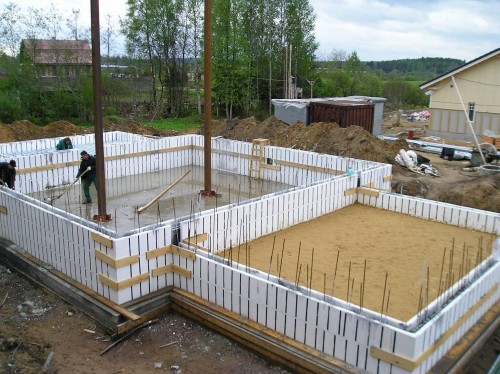
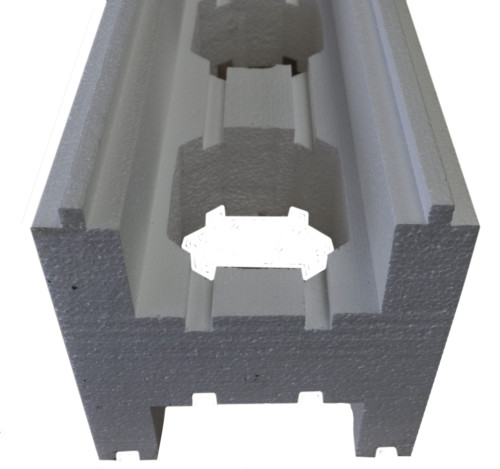
- polystyrene foam (used for waterproofing and insulation of the foundation. Such material also has excellent properties of protection against fungus and bacteria, and has excellent soundproofing indicators. The formwork made of such a material consists of two sheets of high density polystyrene, which are fixed with metal brackets and struts. . This formwork is made under the order at the factories. It resembles a huge children's designer, the details of which are connected using grooves located from the end. The blocks are quite light, and after harvesting the solution, form a single design);
- reinforced concrete blocks (used as guides for the foundation of large-sized buildings. For the construction of the foundation, the boiler is removed, in which the reinforced concrete blocks are fixed using the struts. Additionally, the construction is fixed with the valve, and then the finished solution is poured into the block of the block. When the formwork is hardening, it forms A single design with the foundation. The main drawback of such a material is a huge weight. In this regard, it will have to resort to additional assistance to the lifting technology).

To select the desired option, count the project budget. Think over whether the formwork will be needed in the future. Perhaps the right decision will be the rental of removable formwork, or the use of infringement materials as a non-coordinate option.
Assembly and installation of the formwork of a ribbon foundation
Starting concrete work, pay special attention to the arrangement of formwork. Concrete formwork for stairs, foundation or walls made by their own hands will become an excellent solution because it will not require additional costs on expensive construction brigades. The installation process is quite simple, if you adhere to all basic rules and technologies.

Planning foundation
Before collecting and installing a formwork, you need to place and prepare a plot. Strength, reliability and service life, directly depend on the correctness of the preparatory work. If you adhere to clear instructions, the process will pass quickly.

In order to prepare a plot under the foundation, it is necessary to make the following actions:
- Align the site by removing the top layer of the soil at 100-150 mm. You can do it using a shovel. If the site is problematic, then you can resort to the use of heavy equipment.
- Tension the thread around the perimeter of the future foundation. Use metal pieces of fittings to achieve the necessary forms and bends. The reinforcement ties the thread, and then drive into the ground.
- Parallel to the first thread, at the required distance, pull the second. It will determine the width of the future foundation and denotes the layout of the formwork.

In order to place the plot, you can draw a future foundation directly on Earth. Exactly manufactured marking is the key to high-quality formwork. Do not forget to also use the plan-scheme of the future foundation, observing all the sizes.
Calculation of material
When buying a material for formwork, it is important to correctly produce calculations in order to further avoid the shortage or recalculation of raw materials. Calculate the required amount of the board is simple enough.

To calculate the board cube needed to create a formwork, are applied as follows:
- Measure the length of the perimeter. The resulting value multiply by 2 (as the formwork is located on both sides of the foundation).
- Now, the overall length of the formwork multiplies the thickness of the board used and the height of the foundation (taking into account the allowance).
Consider the calculation of the formwork material using the following example:
- L \u003d 30 m (perimeter length);
- h \u003d 0.5 m (the foundation height);
- p \u003d 0.2 m (cabin height);
- n \u003d 0.025 m (boards thickness);
- where V is the necessary cub.
Thus, you can withdraw the following formula:
V \u003d l x 2 x n x (h + p) or
V \u003d 30 x 2 x 0.025 x (0.5 + 0.2) or
V \u003d 60 x 0.025 x 0.7 \u003d 1.05 m³
Taking into account trimming and future struts, it is better to add 30-40% to the result.

Calculation of the required amount of timber produced, pushing out from the height of the foundation and the thickness of the board. Please note that the foundation in each case is unique, besides, the bar can be replaced with reinforcement. On average, the timber is installed at a distance of 0.7 m from each other.
Installation and strengthening of formwork
First of all, when installing a formwork, pay attention to the installation of the basics. They should be installed in the corners and around the perimeter of the future foundation. Bar or fittings are mounted at the same distance from each other from the outside of the formwork. It is better to immediately get a template for cutting timber to the desired length. The number of necessary supports directly depends on the size of the future formwork and the quality of the soil. To secure the timber, it is enough to deepen it into the ground for a distance of 300-400 mm.

Now to the installed supports it is necessary to nail the shields that will fulfill the role of the wall of the future formwork. If you are using Fanur or OSP, then you can immediately begin to mount. In the case when the board is used, you must first collect shields. For this, the boards are laid parallel to each other so that their overall width is equal to the foundation height, taking into account the allowance. Do it on a flat surface, bonding the boards with each other with a bar. The amount of the required bar is determined by the length of each shield.

When the shields are assembled and installed on both sides of the foundation marked, it's time to fix them. Please note that the shields must be strictly parallel to each other to achieve the correspondence of the actual size of the foundation with the drawing indicators. As installation, check the distance between the shields. To avoid the shift of the walls, the formwork is additionally fixed with the planks that are attached from above, connecting both shields.

In long sites, you can protect the formwork from deformations using additional items. Enough from cutting timber and boards set spacers. For this, they are driven by an angle in the ground so that the second end rests on the shield at an angle of 45 °.

When the formwork is ready, you can proceed to the process of reinforcement and fill the future foundation. For this, the reinforcement is placed in the trench and tied. The number of required rods is determined by dimensional indicators and other elements of the foundation. When armopoyas is ready, you can pour a finished solution.
Visually demonstrate the process of assembling and mounting formwork, the following video will help:
Advice

In order for the process of assembling and mounting the formwork, it is as accurate as possible, take advantage of the following tips:
- to seal the connections between the boards, which occur when assembling the shield, use the construction film with a density of at least 60 μs. It will not allow the solution to penetrate through the slots in the fill process. And during dismantling formwork, it will not give a solution to stick to the wood;
- instead of planks that serve the connection of parallel shields, you can use studs. To do this, two holes must be drilled in each shield at the same height, after which insert the stud in them, securing on both sides using nuts and washers. Before removing the hairpins are removed and can be used repeatedly;
- to connect the formwork elements, use the screws on the tree of the desired size. In contrast to nails, they do not rust and twisted much easier, without harming the formwork, which perfectly affects the durability of the structure;
- make all preparatory work with maximum accuracy and compliance, then the foundation will serve you for many years.

As you can see, build a formwork for concrete structures with your own hands in the theory simple enough. To achieve maximum indicators of the strength of the foundation, the non-coordinate metal formwork is chosen. In order to save time on the processing and insulation of the base, the polystyrene foam formwork is used. The most common, acceptable, economical and convenient option will be the installation of a wooden formwork. We hope our instruction helped to fully figure out the formwork for your future home.