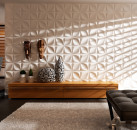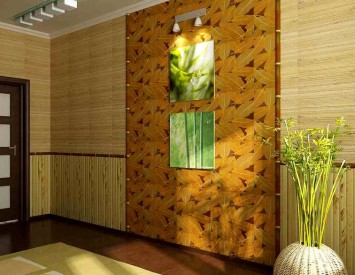
Wallpaper is the most common finish option. Relatively low cost, ease in carrying out work, which can be performed independently, the possibility of concealing wall defects - became the key to the fact that the finishing of wallpaper is present in almost 100% of residential premises. The growing fashion for environmental types of finishing materials and oriental motifs in interior design, provided bamboo wallpaper well-deserved popularity. This type of wallpaper has an attractive appearance and excellent performance.
About what bamboo wallpaper and the features of their use in the finishing are further.
Content
- What is bamboo wallpaper
- Advantages and disadvantages of bamboo wallpaper
- Glowing bamboo wallpaper in the interior of the room
- Bamboo Wallpaper in the interior of the hallway
- Cuisine interior with bamboo wallpaper
- Bamboo wallpaper in the interior: photo
- Bamboo wallpapers in the bedroom interior: video
What is bamboo wallpaper

Bamboo wallpaper, as it is not difficult to guess, is made from a famous tropical plant. The rapid growth of bamboo and its widespread distribution in the Asian region made it one of the most affordable natural building materials. Making wallpapers from bamboo shoots consists of several production steps. Initially, the escape of the plant is dissolved on a large amount of thin stripes whose width is not more than 20 mm (there are wallpaper with a bandwidth of about 4 mm). Then the obtained strips are placed on the basis. As the latter use rice paper or one of the varieties of fabric.
There are two main types of bamboo wallpaper:
- Produced from the outside of the plant trunk.
- Produced from the inside of the plant trunk.
The first type of this material has a more natural ornament, as well as a natural inhomogeneous surface, which is resistant to the effects of ultraviolet radiation. Wallpaper from the outer part of the trunk is characterized by a rich variety of coloring from light olive to chocolate. With uneven roasting surfaces of the lamellas, they acquire a turtle and wenge shades.
The lamellas from the inner surface of the trunk have a smooth surface, which does not tolerate the effects of sunlight too well. That is why they are often revealed with colorless varnish. Such wallpapers are only bright natural tones. To give them another color, they are painted or toned.
Due to the special technology of production, the structure of the wallpaper becomes dense and strong enough. Environmentally friendly material allows the walls to "breathe". At the same time, due to its dense structure, such wallpapers can hide quite significant disadvantages of the wall surface, which reduces the cost of its preparation.
When drying, bamboo strips acquire a different shade, which allows the masters, combining them, make fascinating patterns.
Advantages and disadvantages of bamboo wallpaper
In addition to ecological purity and its dense structure, bamboo canvases have another indispensable quality. Bamboo has excellent moisture-resistant properties, which will allow you to successfully apply them in places of high humidity, such as a bathroom or kitchen.
They perfectly carry the temperature differences, which makes it possible to use bamboo wallpaper in the interior of unheated premises, such as attic, balconies, etc.
With all its merits, bamboo wallpapers have not remnants, the main of which is the price.
Also, the sticking of such wallpapers requires the use of special glue, since their weight is more than the usual. It is worth noting that when working with bamboo wallpaper, experience is needed, because the adhesive of such webs is a rather difficult task.
Despite the disadvantages, the popularity of this finishing material is constantly growing.
Glowing bamboo wallpaper in the interior of the room

The first step of sticking bamboo wallpaper is the selection of glue. As mentioned above, water-soluble glue, which is used to work with paper or vinyl web, is not suitable in this case. For this type of finishing material, vinyl or polychloroprene-based glue is needed. Only they can securely fix the cloth on the wall surface. Some professionals advise liquid nails as a wallpaper glue, which are even suitable for working with a slight variety of ceramics. However, when using it, it is necessary to select its color to the wallpaper.
An exemplary consumption of glue for bamboo wallpaper during double-sided surface treatment is 400 g / m2. Having calculated the area of \u200b\u200bthe walls on which work will be carried out, you can determine the total consumption of glue for its purchases. Just need to keep in mind that it is better to buy 5-10% more.
When sticking bamboo wallpaper, it is necessary to take into account what they do not bend. That is why manufacturers offer rolls of different widths. In order to reduce the consumption of the material, it is necessary to correctly pick up the web. If this fails to do, they can be cut off. For this, without unwinding, the canvas are cut with a metal or electric bison.
After that, the wallpaper must be prepared for work. To do this, cut the necessary bands in the size of the walls and lay them on a flat surface for a day to align moisture in the room and on the surface of the wallpaper.
From the tools you will need:
- wide brush for applying glue,
- spatula for smoking wallpaper on the surface and removal of air,
- rag for removing surplus air.
The glue is applied both on the wrong surface of the wallpaper and on the wall, after which it is left for 5-10 minutes so that the composition acquires a certain density.
The wallpaper strip is applied to the wall and with a spatula is pressed. It is necessary to ram it up to full fit. Bamboo wallpapers are glued into the joint, removing the remnants of glue using a cloth. In the corners of the room, special decorative moldings are installed, which are selected under the tone of the wallpaper.
In some cases, the glued wallpaper is treated with varnish. This not only gives them an interesting shade, but also noticeably prolongs the service life.
Special care bamboo wallpaper do not require. They are perfectly clean, so they can easily be used both in the kitchen and in the children's room. Thanks to this property, the bottom of the wall in the hallways and corridors is often separated by bamboo wallpaper.
Bamboo Wallpaper in the interior of the hallway

Excellent performance allows you to apply bamboo wallpapers in the interior of rooms with high patency, such as an entrance hall. The baked lower part of the walls with this material will be securely protected from random stains of dirt and dust. This is especially important if there are pets in the house. Even the strongest contamination from their surface can be removed without a trace with a conventional damp cloth.
Due to its versatility, and natural materials are perfectly combined with almost all parts of the interiors, pick up bamboo wallpapers for any designer solution will not be much difficult. It will be great to look at the hallway in a classic style or with a minimalist design.
The ideal combination for bamboo wallpaper designs can be vinyl wallpapers. The latter, as a rule, stick to the upper half, separating from bamboo canvases with a special molding. Vinyl wallpapers are selected by light pastel colors, with a large clear pattern. Then, in combination with the natural structure and color background, they will look very interesting.
It is often used to combine the combination of various shades of bamboo wallpaper. At the same time, one type is used for the background, and different inserts are glued from others.
An excellent solution to use bamboo wallpaper in the interior will be in the event that it is planned to create a small corner of nature among glass and concrete. They are perfectly combined with rattan furniture or the same bamboo, green plants. If a home furniture will be installed in the hallway, the skin of either flax will be the most optimal type of upholstery. They are very beautifully combined with bamboo walls of the walls. In general, it is worth noting that bamboo wallpaper is perfectly harmonized with all natural finish materials such as natural stone, wood, brick, ceramics, etc.
Color rules for finishing the hallway bamboo wallpaper - no. It all depends on the preferences of the owner of the room.
Cuisine interior with bamboo wallpaper

Bamboo wallpaper due to its natural texture can bring home warm and special charm in the kitchen interior. They wear a change in humidity and temperature differences. A wonderful combination with ceramic tiles makes this kind of crafts with an excellent option for decoration of the kitchen. With this material, the kitchen can give Japanese, Scandinavian or even a Greek style.
A good combination with such a type of finish will be bamboo blinds that will create comfort in the kitchen in the morning and evening.
Wallpapers collected from large lamellas can easily serve as a kitchen apron at a working surface for a long time without loss of quality. To combine this beautiful material with ceramic tiles, it is better to choose the last with a large natural pattern.
For the perfect combination of bamboo wallpaper with other decor elements, you must choose a suitable color palette. They are perfectly combined with light and beige tones. Natural colors are perfectly suitable, such as pistachio, olive, light yellow.
A good option is a combination of bamboo wallpaper with wallpaper "under painting". There are options with a 3-D print in the form of plant topics. Painting them into suitable colors, you can achieve excellent results.
When using bamboo wallpapers in the interior, the most important thing is not to overdo it. Usually they do not separate the walls entirely to not feel the discomfort and closetness of space. With their help you can make accents on certain areas of the room.
Bamboo wallpaper in the interior: photo