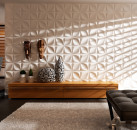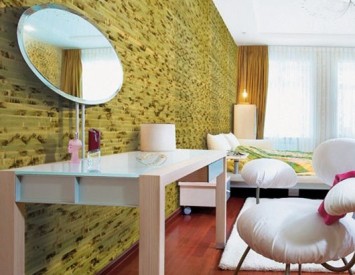
If you are going to do repair in the room, it is worth planning to plan the interior design, including deciding what wallpaper you want to glue on the walls. For the design of the room in various styles, you can use natural finishing material, which looks very spectacular - bamboo wallpaper. This finish will revive the interior and decorate it, and any kind of furniture will look at its background quite organically. Thanks to such properties, bamboo wallpapers have now gained quite wide popularity.
Content
What is bamboo wallpaper
The use of bamboo wallpapers in the interior is particularly relevant for fans of natural and environmentally friendly materials, because they are made of freshly cut bamboo stems by splitting and further drying on special technology without using any auxiliary substances for health.

Bamboo grows in many countries and, depending on the place of cultivation, and varieties are different. It can vary from snow-white and dairy-white, golden yellow color to greenish-pistachio and various shades of reddish brown. Such colors are provided with large opportunities for combining. You can buy bamboo wallpaper with rolled meters, as well as in the form of rolls. This finishing material is recommended to be purchased with a slight margin.
In the original state, the bamboo contains about 80% of moisture, after drying it remains approximately the tenth of the initial mass. In order to prevent the appearance of cracking, the initial drying is carried out in special rooms with a special mode of temperature and humidity (usually about 45%), and then leave the stalks in storage facilities until the final misses. After that, the sections of up to 17 mm long, taken from the top layer of the material thus prepared, are placed on the basis of the tissue or rice paper, as well as, if necessary, be selected with decorative kapron or ordinary thread. For the manufacture of wallpapers, special bamboo grades are used, characterized by the resistance of the color, while the stems of similar shades are selected for the manufacture of wallpapers, so as not to use staining. Manufacturers can handle such products to antistatic to give them dust repulsion properties.

Wallpapers from bamboo are universal and harmoniously fit into any atmosphere. This finish looks on the walls very exotic and effectively, giving the room a kind of natural flavor. Designers are happy to use bamboo wallpaper, making the interior design in ethnic oriental style, as well as in natural, minimalist style or safaris. Thanks to dust-repellent properties, environmentalities, as well as wear resilience, this finishing material can be used to finish the kitchen, hallway, as well as a children's room. At the same time, staining will not need, although if desired, you can cover bamboo wallpaper with a thin layer of varnish.
Advantages and disadvantages of this finishing material
Options, how to glue bamboo wallpaper, several. For example, it is possible to separate them completely walls - it is worth considering that such a monophonic finish may look a little boring. More expressively looks at the walls of a combination of several tones of bamboo wallpaper. In addition, this material can be used to finish certain sections of walls - for example, in the form of panels. It is also necessary to take into account that beautifully combined in the interior decoration bamboo and cork wallpaper. By saving bamboo wallpaper part of the wall, you can create a decorative panel on it with your own hands placed in a decorative frame. Using the wallpaper from the bamboo, it is easy to zonate the room, focusing on its individual elements - for this it will be necessary to select the available columns and arches in it, and also emphasize the niches.

Among the advantages of using bamboo wallpaper, you can mention the following:
- their fully natural composition;
- high heat and sound insulation properties;
- that this finishing material is characterized by antistatic properties, dust and dirt absorbs, as well as smells;
- resistance to entering small droplets of water;
- the strength and durability of such a finish.
Bamboo wallpaper do not need special care to clean from dust, it will be enough to wipe them with a wet cloth.
The disadvantages of this type of finishing material include some capriciousness during processing, as well as a fairly high price of bamboo wallpaper, which depends on the quality of the material, varieties and method of processing bamboo. In addition, it is worth considering that the bamboo wallpaper is quite capricious when sticking, they can not be wetted with water, as well as process with a rigid brush. Due to its composition of natural wood fibers, this material does not always have a perfectly smooth and smooth structure, sometimes small seals and irregularities are sometimes observed on its surface. In addition, the joints of the Bamboo wallpapers are well noticeable on the walls.
How to choose glue for bamboo wallpaper
It is very important to choose the appropriate glue for bamboo wallpaper. This finishing material is sufficiently dense and heavy, so the usual wallpaper adhesive on a water basis will not fit (like PPA). For sticking bamboo wallpaper, special glue should be used, which recommends applying the manufacturer of this finishing material, or it will be necessary to choose the appropriate adhesive composition of the contact action based on vinyl or acrylic. Determine the right amount of glue is easy - for applying wallpapers and wallpapers at the rate of 1m 2 the treated surface will require it about 400 in this way, to calculate the required amount of adhesive composition for a particular area will be easy.

For reliable fixation of bamboo wallpaper, especially on wooden and brick walls, and liquid nails can also be used (it is necessary to take into account that the color will need to be selected in the tone of the main finishing material) and decorative cloves for wallpaper. In addition, the canvas of such finishes are smoothly to the walls, it will be necessary to pay attention to high-quality preliminary preparation of walls.
How to glue bamboo wallpaper
For finishing with this material, a concrete or brick base, plastic, wood and other surfaces are suitable, on which minor irregularities are allowed, since the bamboo will easily cover them.

Preparation of the surface
In the presence of significant protrusions or recesses, bamboo wallpapers, which are sufficiently rigid material, are not secured properly on the walls, so it is necessary to pre-prepare them. To do this, their surface must be cleaned from the remains of the old finish in the form of paint or wallpaper, as well as from the peeling plaster - it is convenient to do this with a tight grater. To clean the treated surface from dust, fifth fat and soot, it must be washed. In addition, in the presence of irregularities, the walls will be checked, aligning their surface - while close attention should be paid to the corners. After drying, the putty will need to apply a primer fluid, and then, waiting for the walls of the walls, you must apply markup on them.

Stages of work
It is possible to accumulate by bamboo wallpaper only completely dry walls, otherwise there is a probability of climbing wet glue with heavy beverages for raw plaster or their removal from the walls.
To perform work on sticking wallpaper from bamboo, you will need a wallpaper glue, as well as a plastic spatula or a rigid rubber roller, as well as a soft brush with nylon bristle.
A few hours before the start of the walls of the walls, the wallpaper rolls should be deployed, decompose them on a flat horizontal surface and leave in that position for several hours.

To stick the wallpaper, you will need to perform the following sequence of actions:
- before sticking, you need to cut wallpaper. To cut the cloths along the roll, you will need to use the sharp knife, trying to act as accurately as possible. Cut the bamboo wallpaper across it will be somewhat harder - for this you can use the electrolovka or the metal knife. It is important to note that the walls of the wallpaper should not be folded, otherwise the folds formed and the reference are subsequently smalleled;
- when using a special vinyl adhesive, it must be applied with the help of a brush on the surface of the walls, as well as from the back side of the wallpaper (and on the edges of the canvas should be missed more intensively) and leave for absorption - it may be necessary to be needed for 5-10 minutes. The adhesive composition should fully absorb, the remaining excess should be carefully laughed with dry clean rags (while not rubbed);
- next, the wallpaper canvas must be applied to the wall and carefully press, gradually moving it with the help of a plastic spatula, if necessary, eliminating the formed air bubbles. You should not move the glued cloth along the wall, try to post it from the first time optimally, otherwise you can damage the bamboo;
- cutting glue with the front side should be accurately removed from wallpaper with a soft cloth;
- if necessary, the edge of the wallpaper should be carefully fired with a sharp knife.
It is worth noting that the gluing of bamboo wallpaper should be maximally carefully so as not to remember their web, since after such an impact this material will not return to its original state, and the bamboo plate can break. Wallpapers should be carried out strictly in the joint, including the corners. It is important to note that it does not follow to buy corners with bamboo wallpaper, in such places the canvas, if necessary, it should be neatly trimmed, and then disguised the places of compounds of angular joints using special connecting plates or decorative moldings of suitable coloring - they are fixed on the same glue and further fixed with wallpaper carnations.
It is worth considering that it is not recommended to glue such wallpapers in places of direct sunlight, as the bamboo burnout occurs - similar to many natural materials, it can lose the brightness of the color and change its shade. Do not allow moisture from the bamboo wallpaper, as it can provoke the discrepancy between the joints and detaculate the wallpaper from the wall. Bamboo wallpapers do not require complex care, it is enough to periodically wipe them with a wet tissue napkin or a sponge from dust, in addition, they can be vacuumed.
Bamboo Wallpaper - Photo