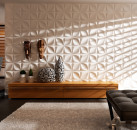
Those times have long passed when all the buildings were built according to the template, today every new home can be turned into a work of art, and all thanks to the architectural decor. It is performed from different materials: plaster, polyurethane, foam, it all depends on the preferences of the architect and the host of the house.
Content
Gypsum Decor.
In the pre-revolutionary time, when the pace of construction accelerated every day, they began to pour the architectural decor from the gypsum. It was mainly used inside the building, and the outside was in the form of sculptures. In order to obtain good material resistance to weather conditions, the gypsum elements were impregnated with turpentine, olifa and rosin, and enhanced protection with the help of a mood. If the weather conditions were severe, then instead of gypsum used concrete, and for saving to the solution layers and sand. This decor was very durable and preserved in almost unchanged form to the present day.
And in the Soviet years, the strength of plaster stucco decreased slightly and, nevertheless, the manufacturing technology was considered the best in the world. Gypsum casting is used and now, and is very popular.
Pluses of plaster decor:
- high material density;
- long service life;
- the possibility of restoration;
- high resistance to tectonic shifts;
- you can make very complex forms;
- possibility of transformation;
- changing additives can be achieved by the desired properties.

Cons of plaster decor:
- complex installation;
- requires special storage before installation;
- long production;
- when drying, it happens shrinkage, and joints appear;
- sensitivity to moisture;
- large weight.
Despite the significant number of shortcomings, the gypsum remains the leading technology in the production of complex elements of the architectural decor.

Polyurethane decor
Polyurethane has all the properties to become a good material for facade elements.
Of the advantages of the architectural decoration of polyurethane can be allocated:
- strength;
- low weight;
- resistance to moisture;
- high-quality surface.
There are not many shortcomings in polyurethane products, but they are:
- high price;
- you can only buy ready-made details.
In order to make a unique decor, you will need to first make the mold, and it is expensive. Thus, this technology is suitable for non-counseling construction. But if you invite a talented designer and purchase products not one company, but several, then you can create an interesting image of the house.
The leading firm forms from polyurethane is the Europlanist, the architectural decor of which has been used for decorating the interior for many years.

Decor from Polyeopleolster.
Polyenopolster or, as it is also called, the foam is a more versatile material than polyurethane, since due to the thermal of profiles from it you can create various forms. This technologies have been developed in the mid-90s Europeans for rapid construction. The potential of this material is only revealed, one can say exactly: it is light and using a computer you can quickly cut out of the raw material. From above rolling the layer of a special solution with a reinforcing grid to give the surface of rigidity and protect against moisture. In the finished form, the architectural decor facade is easy to transport on the construction site, the installation does not require material and physical costs. It can be carried out at zero temperature, without fear of dampness. And if you use a winter mounting solution, it is possible to work with stucco in frost.
The architectural decor of foam has a number of advantages:
- weight of the material is much easier to stone or plaster, so the foam does not give a greater load on the foundation and floor of the building;
- long service life - due to the protective coating, the architectural stucco decor can serve as decades;
- low cost is the cheapest material from which the decor do. Also much less with its use and maintenance costs.
Disadvantages of architectural decoration of foam:
- not suitable for decopter with stucco elements, does not give space for creativity. You can only buy ready-made forms;
- the fragile structure of the foam and natural drying can affect the loss of the form; If the protective coating is low-quality, then the product will last no more than two seasons.

Installation of architectural decoration
Store products for architectural decor are needed in a warm and dry room. Weather for mounting should also be warm and not wet. It is impossible to install the installation of the architectural decor on the crude surface. It is also necessary to avoid large temperature differences between storage conditions and installation. Before starting the installation, it is desirable to leave all the elements of the decor and glue at the installation site for a day.
Required tools tools:
- saw with small teeth;
- stuslo;
- glue pistol;
- roulette;
- sandpaper (thin);
- pencil;
- sponge;
- finishing nails;
- anodized selflessness;
- glue;
- hammer;
- forms for architectural decor.

Installing installation can be done, without causing masters:
- In the place where decoration elements will be installed, it is necessary to remove the residues of the building mortar, pollution, mold. This procedure is performed by a mechanical method, but you can also purchase a special solution.
- The base must be smooth. If there is a deviation at least for a centimeter, then the base is aligned. The plaster must be attaching to determine whether there are voids, after which they are aligned with solution. If the facade was painted, then the paint that is peeling is removed.
- Decorative panels are attached to the base with special glue. If the forms are heavy, they are fixed on the anchors and mortgage parts. But glue use in any case, as it provides the kneading material to the base without gaps.
- On the entire back side of the decor element, glue is applied and tightly pressed the shape to the base, hold a few minutes in this position so that the glue tact with the wall. If you need to additionally enhance fasteners with a dowel, then you only need to drill holes after the glue dry completely.
- Close the holes under the dowel and the connection site with the help of the facade sealant.
- After drying, the sealant decor is painted with facade paints on an acrylic basis.
After mounting, the decor from the foam visually does not differ from the same from the plaster and stone.